NVIDIA Dynamo EPD Disaggregation for Multimodal Serving: Conditional Gains and Placement Tradeoffs
The NVIDIA Dynamo post documents encode-prefill-decode (EPD) disaggregation as a serving mode for multimodal models, separating vision encoder workers from prefill-decode (PD) workers and allowing colocated or disaggregated encoder placement. Benchmarks on Qwen3.5 122B A10B NVFP4 over GB200 and RTX 6000D hardware report 58%/50% TTFT reductions and a 70% goodput gain for a 10-image/OSL1024 case, but end-to-end gains narrow with output sequence length and colocated EPD regresses at long OSL. The contribution is a conditional decision framework; the headlined 5x/7x multipliers are not tied to the reported experimental grid.
The NVIDIA Dynamo post documents encode-prefill-decode (EPD) disaggregation as a serving mode for multimodal models, separating vision encoding from LLM prefill and decode so encoder and PD workers can batch, schedule, and scale independently. Its decision rule is conditional: EPD is most effective for image-heavy prompts, short-to-medium outputs, and small, quantized, or mixture-of-experts LLMs, while aggregated serving remains appropriate for light media processing or long decode-dominated latency.1
Context
The operative change is placement flexibility. Dynamo separates encoder and PD roles without fixing their hardware placement; encoder workers produce vision embeddings and PD workers consume them, with embeddings transferred through NVIDIA Inference Transfer Library (NIXL). The post evaluates colocated encoder workers on the same GPUs as PD workers against a disaggregated encoder tier on lower-cost GPUs; in its test environment two RTX 6000D GPUs ran encoder workers while four GB200 GPUs ran PD workers.1
Assessment
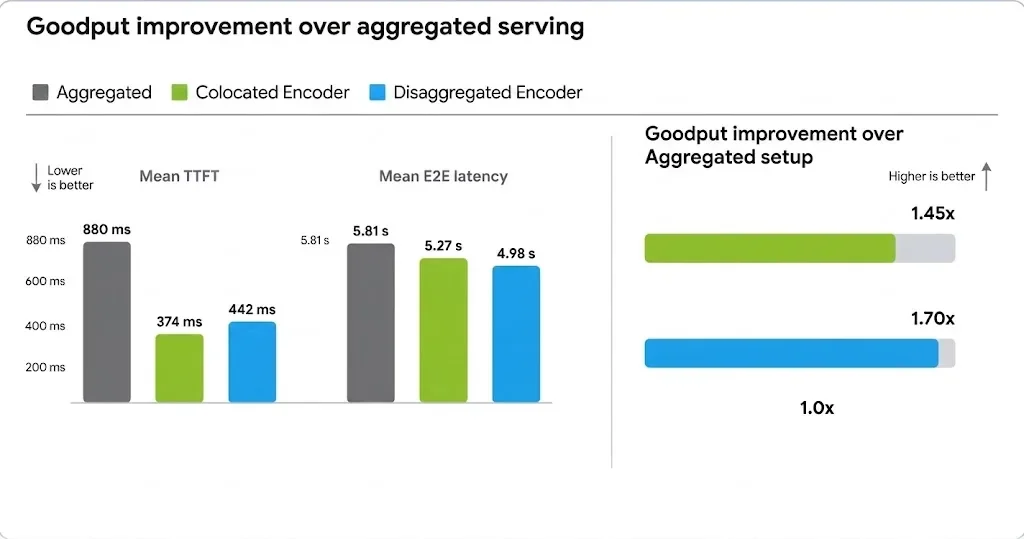
The detailed results narrow the headline. For a 10-image-per-request, OSL 1024 workload, TTFT falls 58% with colocated encoder and 50% with heterogeneous encoder, end-to-end improvements are modest, and the larger benefit is 70% more goodput for the heterogeneous tier at an inter-token latency under 100 ms SLO. Across an OSL sweep from 128 to 2,048, heterogeneous E2E gain over aggregated narrows from 20.3% to 5.2%, and colocated shifts from an 11.8% gain to a 2.5% regression as GPU contention grows. The technique is therefore a workload- and SLO-conditional optimization, not a general improvement.1
Caveats
What would change this assessment: independent replication on non-NVIDIA hardware or in vLLM/SGLang, a direct MoE-versus-dense ablation, SLO sensitivity analysis, and disclosure of the configuration behind the 5x TTFT and 7x E2E headline. The post itself notes vLLM and SGLang have EPD roadmaps, so cross-stack replication is plausible. Single-vendor benchmarks without variance estimates, with limited workload disclosure and one main model, keep confidence moderate.1
Encode-prefill-decode (EPD) disaggregation is an inference optimization technique for multimodal models that separates the vision encoder stage from the prefill and decode stages. It is most effective for image-heavy prompts, short-to-medium outputs, and quantized mixture-of-experts (MoE) models.
This post shows when and how to use EPD disaggregation with NVIDIA Dynamo to achieve up to 5x faster time to first token (TTFT) and 7x faster end-to-end response time. The post also addresses the scenarios where EPD disaggregation is not recommended.
Dynamo is an open source inference framework for serving AI models in distributed environments. It supports EPD disaggregation, separating these phases into independently scalable stages rather than running them together with tightly coupled scheduling and scaling patterns. Dedicated encoder workers can improve batching, memory efficiency, and overall throughput.
A multimodal request adds work before LLM prefill can begin. The serving stack must preprocess the media and run the vision transformer (ViT) to produce embeddings. In aggregated serving, vision encoding, LLM prefill, and decode all share one worker and one scheduling domain. This simple design works well when media processing accounts for only a small portion of the workload.
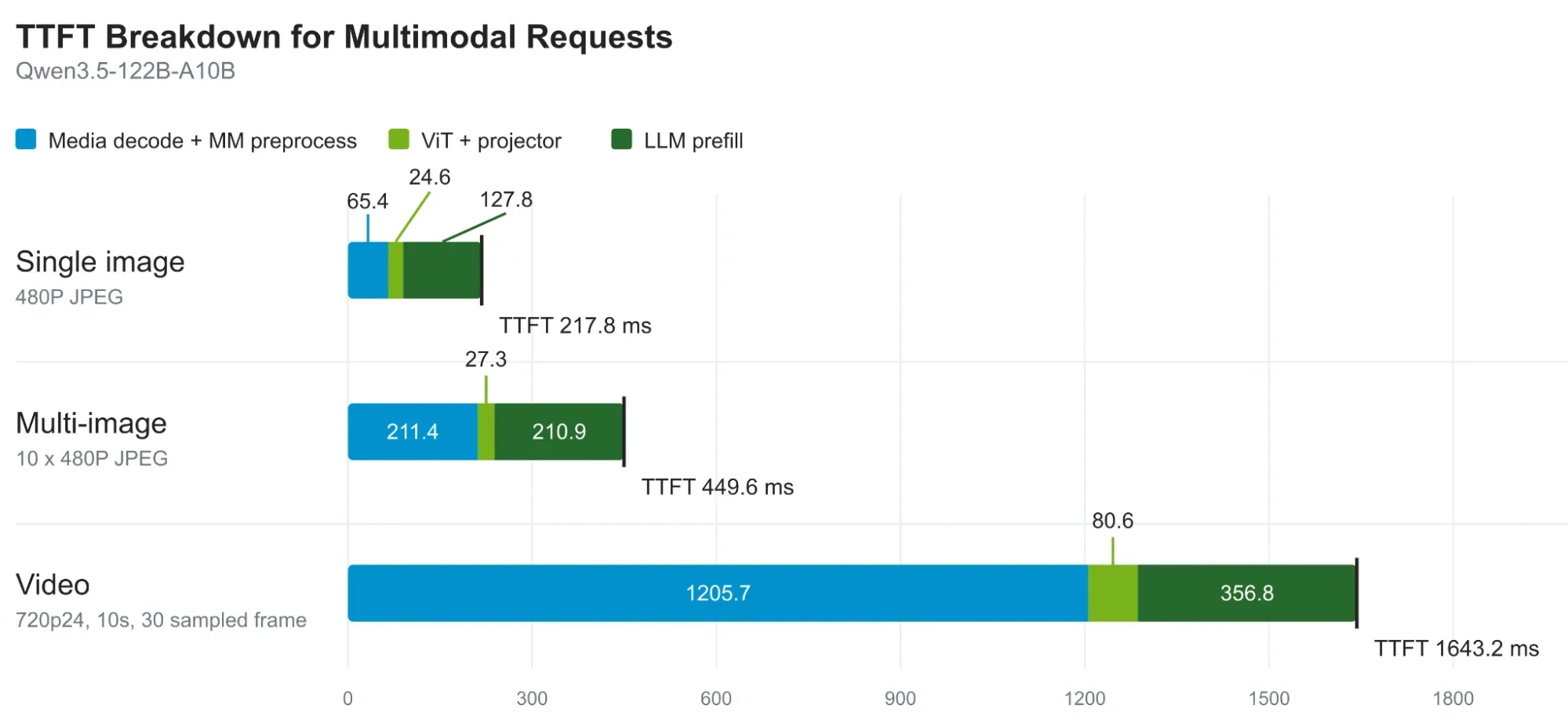
Figure 1. TTFT breakdown across single-image, multi-image, and video requests, separated into media preprocessing, ViT forward and projection, and LLM prefill
The balance changes as requests contain more images or video. Vision encoding can take hundreds of milliseconds or longer. Because encoder and LLM work share the same GPU, a media-heavy request can delay its own prefill and contend with concurrent prefill and decode work. In contrast, under mixed traffic, text-only requests may also wait behind multimodal requests even though they do not require vision encoding.
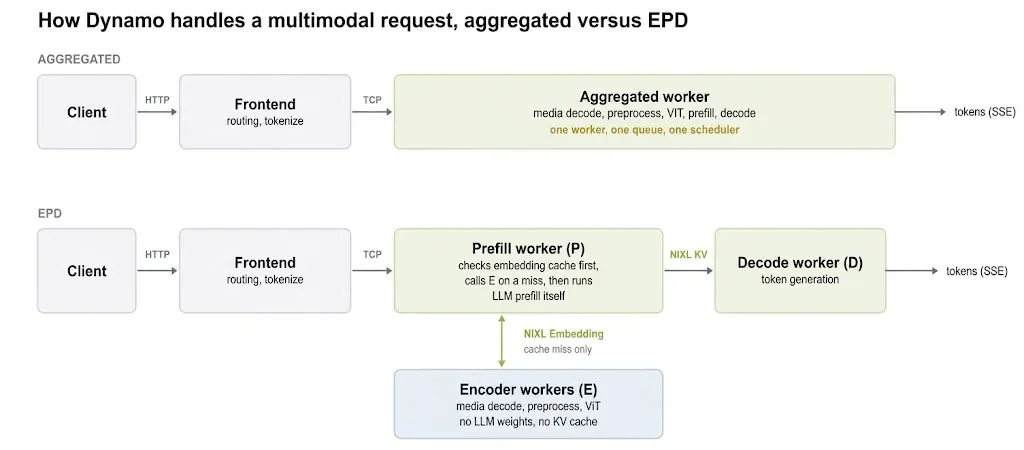
Dynamo implements EPD serving by separating the encoder and PD worker roles without fixing their hardware placement. Encoder workers produce vision embeddings, while PD workers consume those embeddings and run the LLM. This separation allows the stages to batch, schedule, and scale independently. Figure 2 compares aggregated and EPD serving, with encode workers passing embeddings to PD workers through NVIDIA Inference Transfer Library (NIXL).
Figure 2. Aggregated and EPD request flows in Dynamo. EPD separates encode execution from the PD workers and transfers embeddings through NIXL
Encode disaggregation can reduce TTFT and increase same-SLO goodput only in certain scenarios. The encode work being isolated must be large enough to offset worker coordination and embedding transfer overhead. Encode workers may share the PD GPUs or run on a separate GPU tier, leading to different placement options. Here, we explore the different placement options for the encode worker and the benefits they yield under various scenarios.
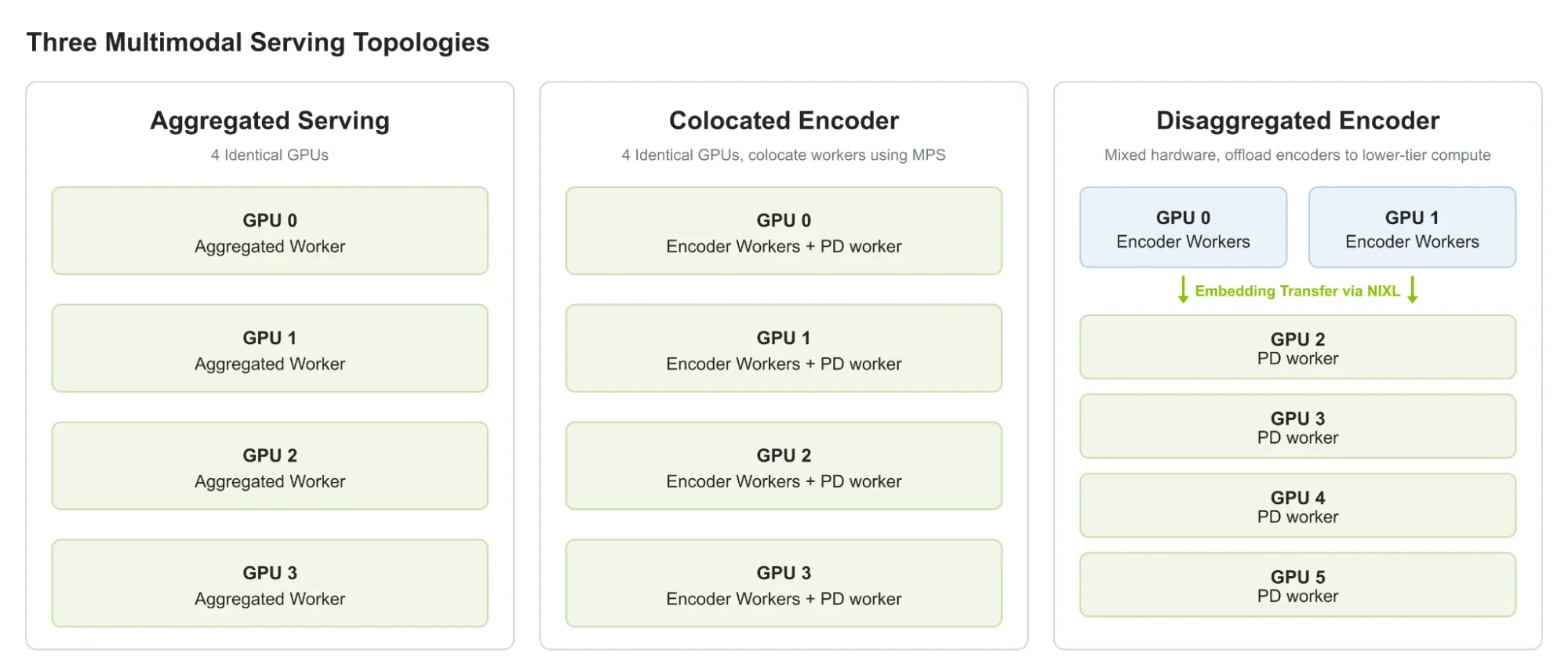
Figure 3 compares aggregated serving with the two encoder disaggregated topologies, colocated and disaggregated:
Aggregated: Each GPU runs a single aggregated worker whose scheduler manages vision encoding, LLM prefill, and decode as part of the same request lifecycle.
Colocated encoder: Each GPU runs one or more encoder workers alongside one PD worker. This allows the workers to share GPU compute while maintaining separate request queues and batching. On a homogeneous cluster, Colocated Encoder is generally the better fit. The vision encoder is lightweight relative to the LLM, so reserving an entire same-class GPU for encoder work can leave much of that GPU underutilized. Colocation separates the workers without dedicating a GPU exclusively to the encoder.
Disaggregated encoder: Disaggregated Encoder becomes attractive when the cluster includes a lower cost GPU tier better matched to encoder work while the primary GPU tier hosts the PD workers. Dynamo transfers the resulting vision embeddings to the PD tier through NIXL. In our test environment, two NVIDIA RTX 6000D GPUs ran the encoder workers, while four NVIDIA GB200 GPUs ran the PD workers. This placement keeps the lighter encoder workload on the RTX GPUs and reserves the GB200 GPUs for the more compute- and memory-intensive LLM workload. Note that this analysis does not consider the disaggregated setup with homogenous GPUs as it always underperforms the colocated encoder setup.
Hardware availability determines where the encoder can run and workload characteristics determine whether separating it pays off.
Figure 3. Three encode-placement options: aggregated serving, co-located encoder and PD workers, and disaggregated encoder with a separate lower cost GPU tier for the encoder workers
The benefits of EPD depend on how work is divided among vision encoding, LLM prefill, and decode. EPD is most useful when vision encoding accounts for a significant share of request processing time or limits throughput. Media-heavy requests often create this condition, but media load alone does not determine the result. Output length, model size and precision, and traffic mix also change this balance.
Factor
Why it matters for EPD
When does EPD yield gains
Input media load
Heavier media load brings more visual tokens, which means more encoder work. EPD allows scaling up encoders, preventing encoding bottleneck.
Multiple images, high-resolution images, or video input that yields more visual tokens.
Output sequence length (OSL)
Longer OSL shifts total latency toward decode. TTFT gains from EPD hold, but end-to-end (E2E) gains shrink.
Short OSL: E2E gains hold Long OSL: E2E gains erode
Model size / precision
ViT compute is largely fixed, while LLM compute decreases with fewer active parameters and lower precision. Small, MoE, and quantized LLMs therefore have higher ViT-to-LLM compute ratios.
Smaller, MoE, and lower-precision models benefit more from EPD, while large dense models see less gain.
Mixed traffic (text + multimodal)
Mixed prefill batches can make text requests wait for ViT. EPD isolates encoder work, allowing text requests to skip waiting for encoder.
Heavy multimodal traffic mixed with latency sensitive text requests.
All benchmarks were run with Qwen3.5 122B A10B NVFP4 except in the precision ablation experiments. We used four GB200 GPUs (and extra RTX 6000D GPUs in disaggregated setup):
Aggregated: One TP1 aggregated worker per GB200
Co-located EPD: Two encoder workers plus one PD worker per GB200
Disaggregated EPD: RTX nodes as the encoder tier, GB200 as PD
We used NIXL over UCX RC/TCP Ethernet for vision embedding transfer, measured peak 20 Gbps. We used the Dynamo front end with front end parallel media decoding enabled. The goodput SLO is inter-token latency (ITL) under 100 ms.
We compared the aggregated versus encoder disaggregated serving with the following request: Ten images per request (capped 256 token per image) at OSL 1024 to simulate moderately heavy visual workload with a long output sequence. Figure 4 shows the results.
Figure 4. Mean TTFT and end-to-end latency across topologies for an image-heavy workload (10 images/request) (left). Goodput improvement over the aggregated setup given an SLO of ITL under 100 ms (right)
TTFT drops 58% with colocated encoder and 50% with heterogeneous. End-to-end improvements are modest because OSL 1024 means the model generates 1024 tokens and decode time is not reduced by Encoder disaggregation. The larger signal is goodput: the heterogeneous tier serves 70% more traffic at the same latency SLO, because encoder capacity was added without touching the GB200 budget.
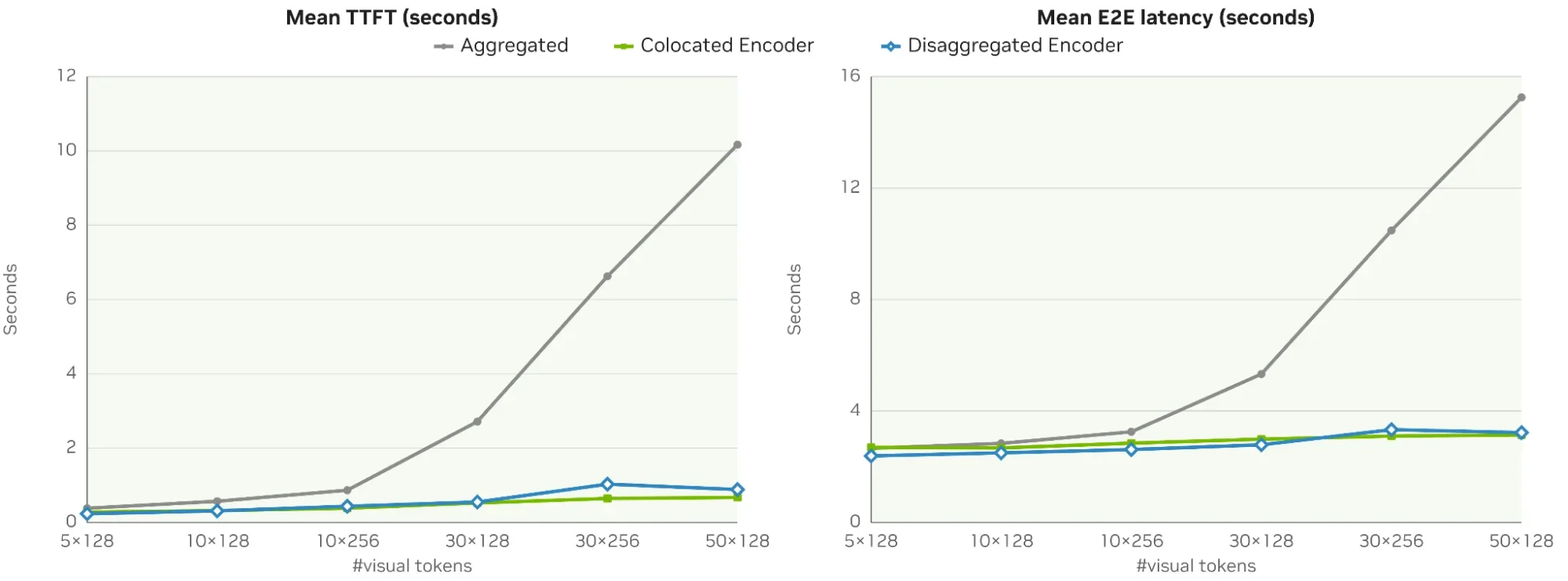
We analyzed the impact on TTFT and end-to-end latency in a range of experiments with 5-50 images, with each image using 128/256 token budget, keeping the OSL constant. The performance, both TTFT and end-to-end latency, degrades in the aggregated encoder scenario, while the performance is relatively constant for both disaggregated topologies.
Figure 5. Mean TTFT versus visual-token load (5 to 50 images, OSL 512). Aggregated latency rises steeply with visual tokens (image count times token per image) image count; both EPD topologies stay nearly flat
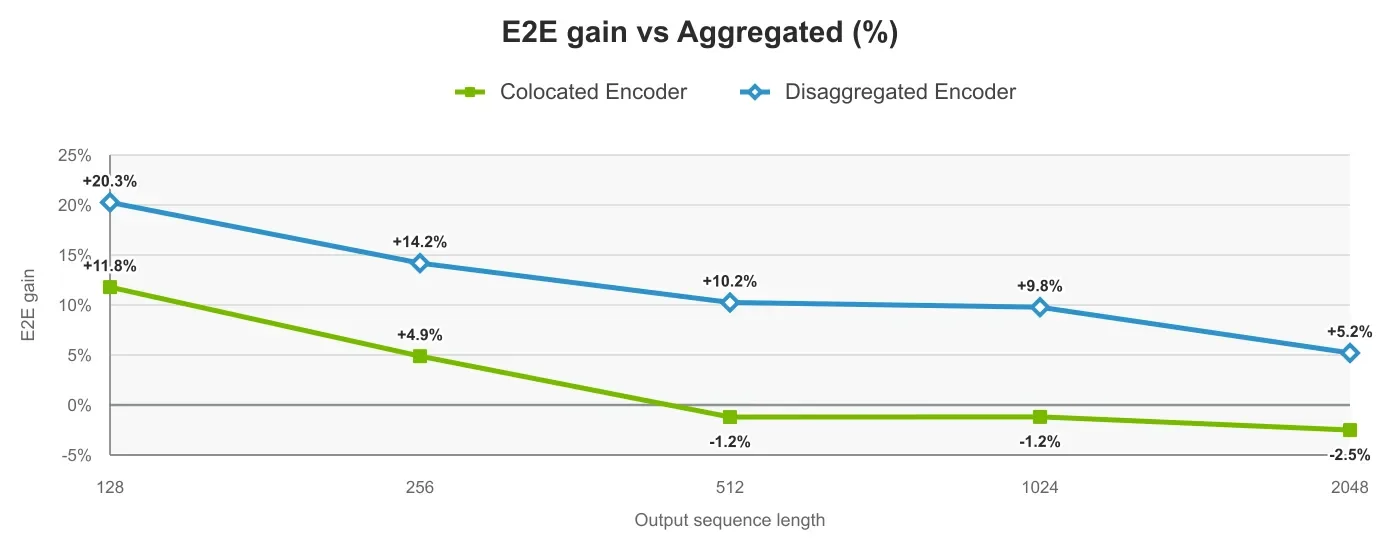
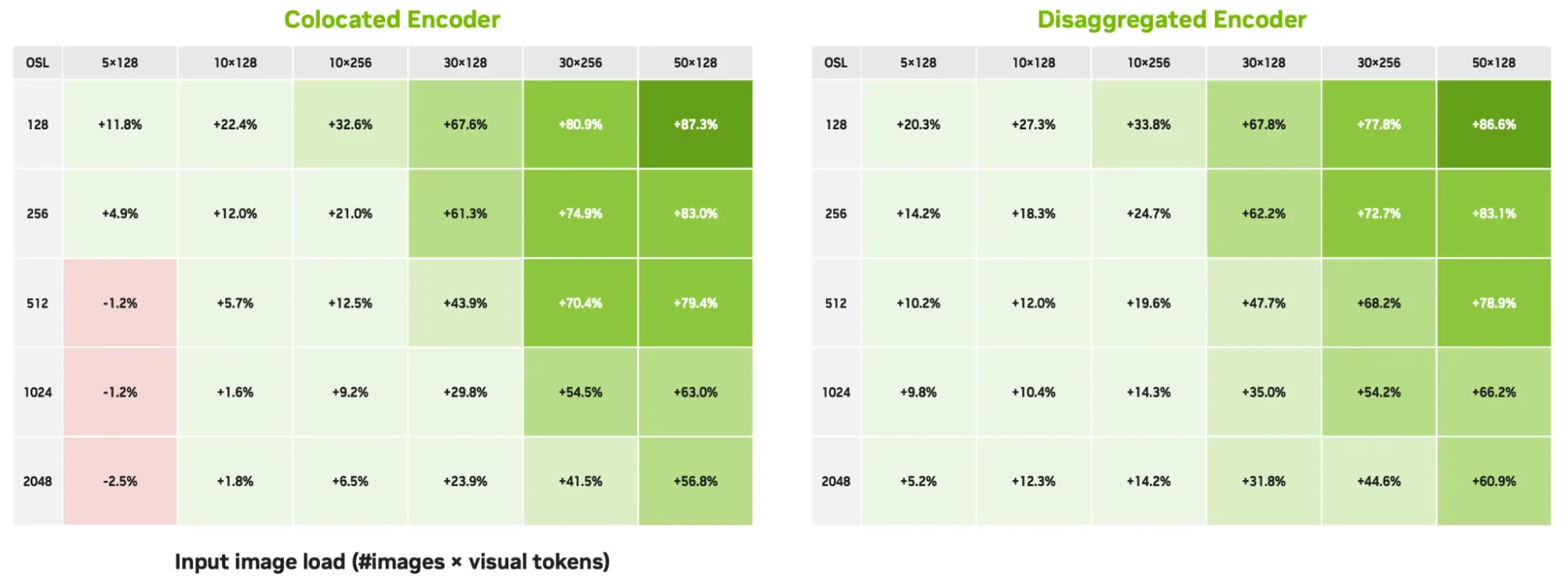
Next, we varied OSL from 128 to 2,048 while holding the image load fixed at five images. TTFT remains largely unchanged as OSL increases, but decode time increasingly dominates end-to-end latency. Consequently, heterogeneous EPD end-to-end gain over aggregated serving narrows from 20.3% to 5.2%. Co-located encoder shifts from an 11.8% gain to a 2.5% regression because its additional encoder workers share the same GPUs as the PD workers. As OSL increases and decode pressure grows, GPU contention increasingly offsets, and eventually outweighs, the benefit of encoder disaggregation.
Figure 6. Mean end-to-end latency versus OSL. The end-to-end gap between EPD and aggregated narrows as OSL grows because decode time increasingly dominates
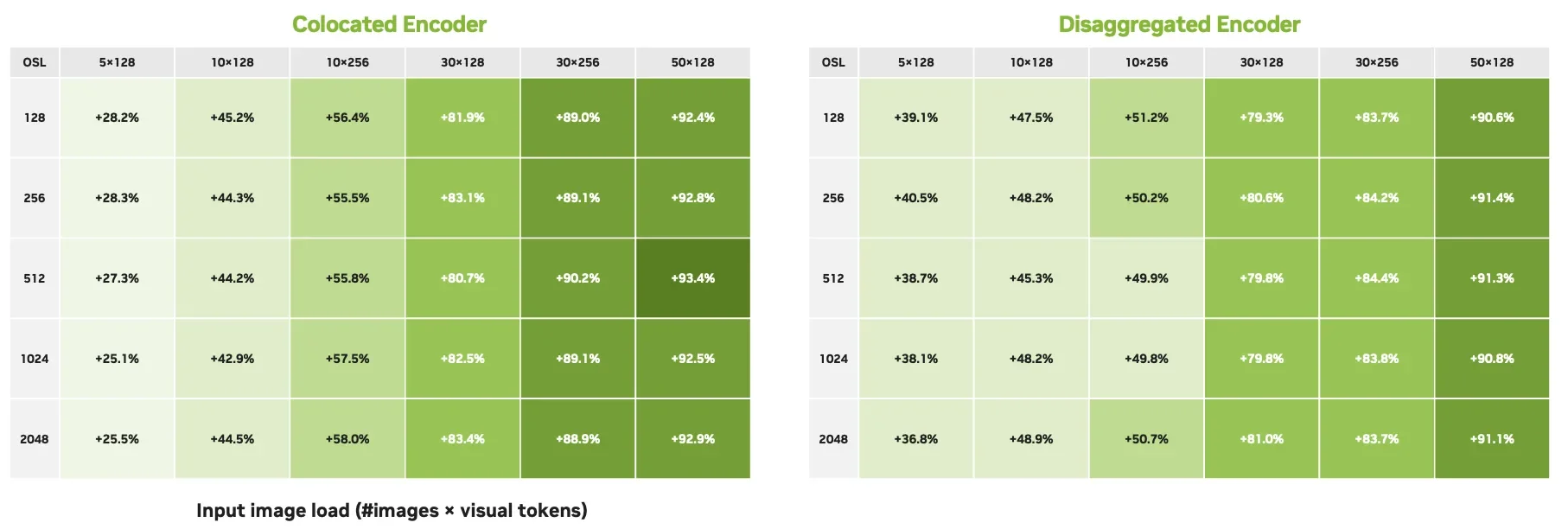
Figures 7 and 8 show percentage improvements in TTFT and end-to-end latency over the aggregated (baseline) across a range of OSL and image load. Encoder disaggregation delivers the most value with high input media load in almost all scenarios. In scenarios with high OSL and low image load, disaggregating the encoder compromises performance.
Figure 7. Input image load (number of images times visual tokens). TTFT improvement over aggregated (Qwen 3.5 122B NVFP4). Colocated EPD (top) and heterogeneous EPD (bottom). Both topologies deliver 25-93% TTFT improvement across the full grid. The heaviest cell (50 x 128 images, any OSL) reaches 92-93%. Gains are consistent across the OSL dimension because TTFT is not affected by output length
Figure 8. End-to-end request latency improvement over aggregated (same model and hardware). Gains are strong at high image load and short OSL, shrinking toward the upper-left corner (light media, long outputs). Colocated EPD shows slight end-to-end regression at 5 x 128 images / OSL 2048 (-2.5%), where embedding transfer overhead is not recovered by encoder capacity savings
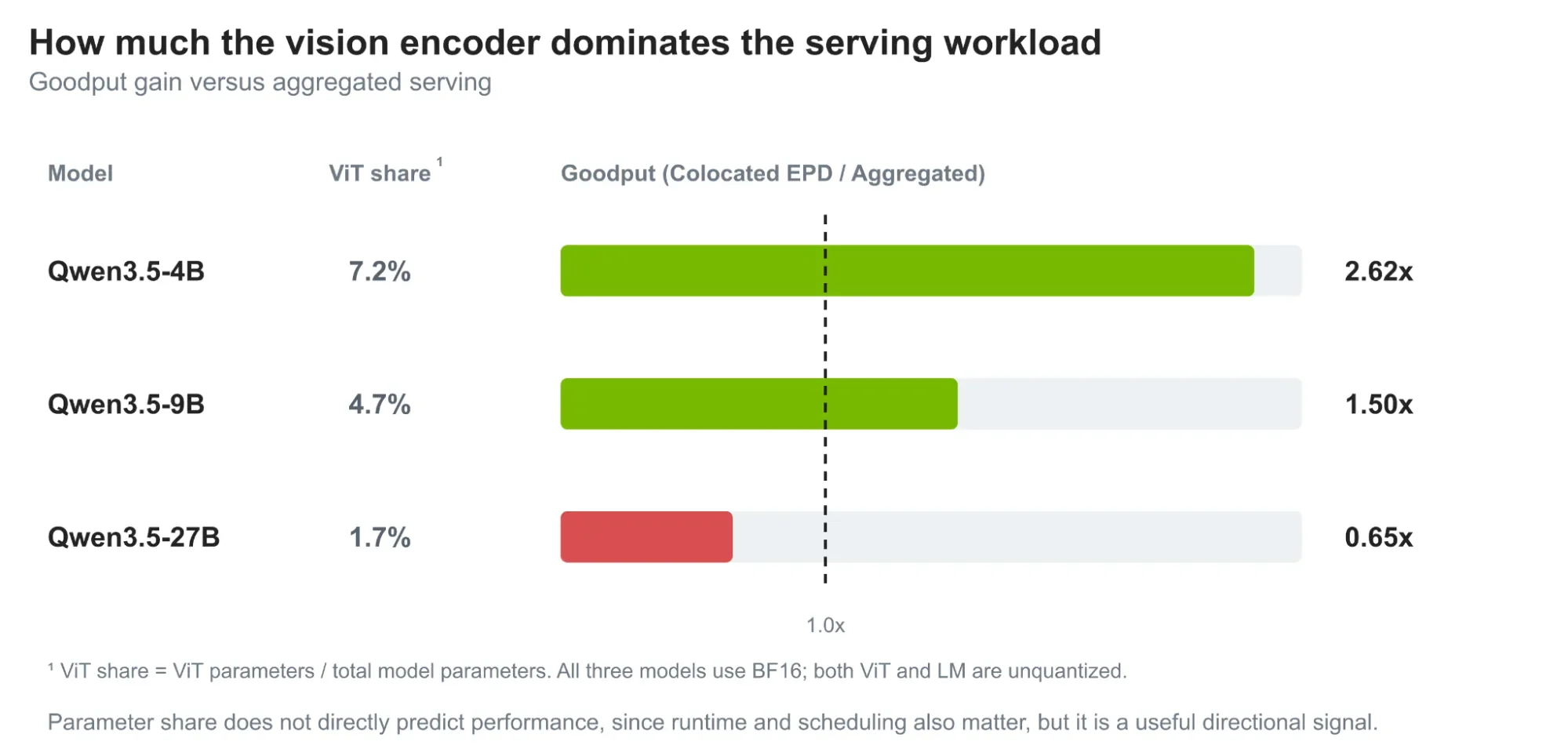
As model size grows, the LLM accounts for more of the serving workload, while the vision encoder remains roughly the same size. To quantify how this affects EPD, we ran a model-size ablation across Qwen3.5 4B, Qwen3.5 9B, and Qwen3.5 27B. The ViT parameter share decreases from 7.2% at 4B to 4.7% at 9B and 1.7% at 27B. Colocated EPD follows the same trend, delivering 2.62x, 1.50x, and 0.65x the goodput of aggregated serving, respectively.
Figure 9. Same-SLO goodput gain versus aggregated serving across model configurations. EPD gain decreases with model size and falls below break-even at 27B. Lower-precision and MoE models with less activated parameters show larger gains
Parameter share is only a proxy for the more direct factor: runtime balance among ViT forward, LLM prefill, and decode. EPD provides more benefit when ViT forward accounts for a meaningful portion of request processing time. As prefill and decode become dominant, there is less encoder work to optimize. In our 27B configuration, the LM costs outweighed the benefit of separating the encoder under a colocated setup.
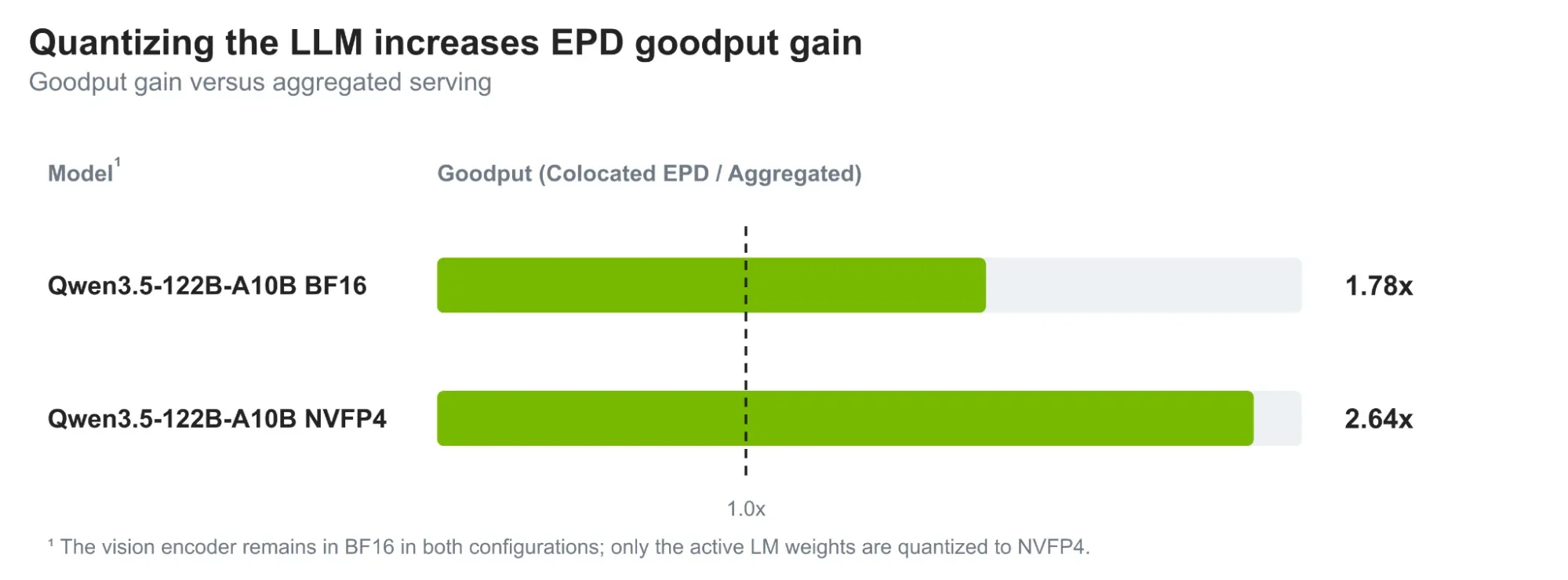
We measured how LLM precision affects EPD gain. When both the vision encoder and the LLM used BF16, colocated EPD delivered 1.78x the goodput of aggregated serving. Quantizing only the active LM weights to NVFP4 increased this gain to 2.64x.
Figure 10. Effect of LLM quantization on EPD goodput. Bars show colocated EPD goodput relative to aggregated serving. Quantizing the active LM weights from BF16 to NVFP4 increased the ratio from 1.78x to 2.64x. The vision encoder remained in BF16 in both configurations
NVFP4 accelerates LLM prefill and decode while ViT forward remains in BF16, shifting a larger share of request time to encoder work. This provides EPD with more room to schedule encoder workload independently from PD workers.
Production workloads often mix text-only and multimodal requests, and the two request types may be scheduled together for prefill. With aggregated serving, one worker handles both vision encoding and LLM prefill. If a batch includes a multimodal request, the worker completes media preprocessing and ViT forward before starting prefill. Text-only requests do not need this work, but can still wait for it, increasing their TTFT.
EPD removes this dependency by running vision encoding on separate encoder workers. The front end routes both request types to a prefill worker, but only multimodal requests with missing embeddings invoke the encoder pool. Text-only requests can proceed to prefill while the encoder processes multimodal requests independently, reducing head-of-line blocking between the two request types.
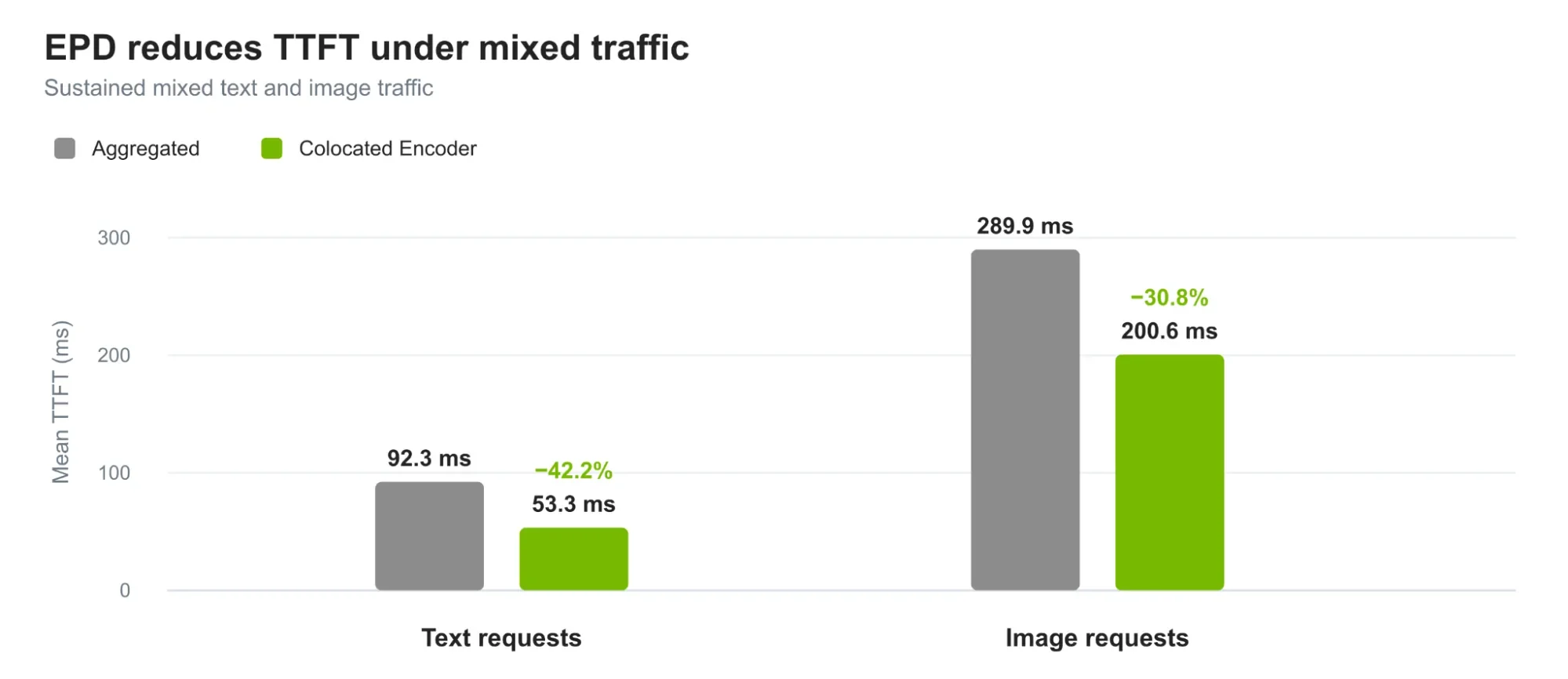
To measure this, we compared aggregated serving with co-located encoder under sustained mixed text and image traffic.
Figure 11. Mean TTFT for text and image requests under sustained 50:50 mixed traffic at OSL 128, comparing aggregated serving with co-located encoder
Encoder disaggregation reduced mean TTFT for text requests from 92.3 to 53.3 ms, a 42.2% reduction. Image-request TTFT fell from 289.9 to 200.6 ms, a 30.8% reduction. Image requests still incur encoder latency, whereas text requests can begin LLM prefill without waiting for vision encoding to complete. This accounts for the larger relative improvement in text-request TTFT.
The best encoder placement depends on where request time is spent. EPD provides the most value when vision encoding represents a significant part of request processing, such as with media-heavy inputs, short to medium outputs, smaller or quantized models, and mixed traffics. Aggregate serving remains a good fit when media processing is light or long decode sequences dominate the latency.
Hardware also affects the placement decision. On homogeneous clusters, co-located encoder separates encoder scheduling and batching without reserving an entire GPU for the relatively lightweight vision model. A separate encoder tier is more useful with heterogeneous hardware, where lower-tier GPUs can run the encoder while higher-end GPUs remain dedicated to PD.
Note that vLLM and SGLang have roadmaps for further development of their EPD stacks.
To reproduce the experiments featured in this post, follow the ai-dynamo/dynamo GitHub guide.
As shown in Figure 1, 43% of TTFT was spent before ViT even started. EPD does not help optimize those stages of the pipeline. Try the other levers listed below in Dynamo to address different stages of your stack with it.
Parallel media decoding moves download and decode out of the worker and into the Dynamo front end, which ships decoded pixels to the backend. In an encoder-only benchmark at 30×256 on one GB200 with two encode workers, it cut mean encoder request latency 26%, from 281.3 ms to 207.0 ms, and P99 23%, from 752.1 ms to 581.7 ms, at matched throughput. Enable it with --frontend-decoding .
Embedding cache stores and offloads computed embeddings in CPU DRAM so repeated media is not re-encoded. When the same multimodal content, such as an image or video, appears in multiple requests, the cached embedding is reused instead of running the vision encoder again.
Multimodal KV routing hashes media content alongside text in the Dynamo KV-aware router, so requests sharing media land on workers already holding the relevant KV blocks. Without it, every image looks like the same placeholder token to the router.
We’d like to thank Roger Wang, co-founder of Inferact, for his feedback on this post, and the NVIDIA team, Alexandre Milesi, Ayush Agarwal, Guan Luo, Indrajit Bhosale, J Wyman, Kris Hung, Krishnan Prashanth, Qi Wang, and Zhongdao Ren for their core work on multimodality support in Dynamo.
The source text above remains the property of its publisher and is reproduced for commentary.