TimesFM-3: Native Multivariate Forecasting in a Single Pass
Google introduces TimesFM-3, a 330-million-parameter zero-shot time-series foundation model that natively supports multivariate forecasting and decodes an entire forecast horizon in a single forward pass. The model reports top rank among pre-trained foundation models on three public benchmarks and is released on GitHub, Hugging Face, and planned for BigQuery.
TimesFM-3 is a structural break from its predecessors: it is natively pre-trained for multivariate forecasting, whereas earlier TimesFM releases were strictly univariate. The architectural change that makes this possible is a 2D attention grid that alternates temporal and cross-series attention, allowing the model to use multiple target series and covariates simultaneously.1
The more consequential constraint shift is in decoding. Prior TimesFM versions generated forecasts one patch at a time; TimesFM-3 instead masks all future horizon patches and fills them in a single forward pass via Contiguous Patch Masking. This removes the autoregressive loop entirely, lowering latency and avoiding compounding error, while keeping known future covariates visible to the model.1
The release therefore changes what 'zero-shot' can mean for multivariate forecasting: no task-specific fine-tuning is required to exploit cross-series dependencies, and the model outputs a probabilistic forecast by predicting nine quantiles at every horizon step. The demonstration with promotion covariates (a ~20% forecasted sales lift) is illustrative rather than an evaluation result.1
Context
The model has 330M parameters and is pre-trained on a corpus of more than 1 trillion time points. It uses patch size 32 and per-series normalization, and it is evaluated on Gift-Eval, FEV-Bench, and Time, where it reports the top average rank among pre-trained foundation models in both point and probabilistic metrics. It is released on GitHub and Hugging Face, with BigQuery support planned soon.1
Assessment
The claims are plausible but self-reported. The blog provides benchmark rank plots rather than full error numbers, and there is no ablation separating the gain from multivariate conditioning, the single-pass decoder, or the larger pre-training corpus.1
Caveats
What would change my mind: a third-party replication that reproduces the benchmark rankings; a comparison against fine-tuned multivariate baselines; and evidence that the single-pass mechanism does not degrade long-horizon calibration relative to iterative decoding. Without those, 'state-of-the-art' should be read as vendor-reported among zero-shot foundation models.1
Ayush Jain and Rajat Sen, Research Scientists, Google Research
We introduce TimesFM-3, a state-of-the-art time series foundation model that enables highly accurate multivariate time series forecasting in a single forward pass, significantly outperforming other forecasting models across major benchmarks.
Since the debut of TimesFM in 2024, we’ve seen the adoption of time-series foundation models for real-world time-series forecasting tasks across multiple domains, such as retail, finance, observability, manufacturing, healthcare and natural sciences.
Up until TimesFM-2.5 (released in September 2025), our models were strictly limited to univariate forecasting: forecasting using only the history of a single time series. Yet, most real-world forecasting problems are inherently multivariate: where multiple time series and auxiliary external features jointly impact the future forecast of a time series. Consider forecasting ice cream sales for a retail chain. Past sales alone rarely tell the full story. A good forecast should also draw on sales of related products (e.g., ice cream cones, syrups), historical foot traffic, and known future events like weather forecasts, promotions, and holidays.
Today we introduce TimesFM-3, the next generation of our time-series foundation model that is natively pre-trained for multivariate forecasting. TimesFM-3 has 330 million parameters and is pre-trained on a real-world and synthetic time-series corpus comprising more than 1 trillion time points. Building on the efficiency and zero-shot generalization of its predecessors, TimesFM-3 adds robust support for complex multivariate scenarios in a zero-shot manner. It can jointly predict multiple coevolving time series, capturing dependencies that improve overall accuracy without requiring task-specific fine-tuning. The model natively supports:
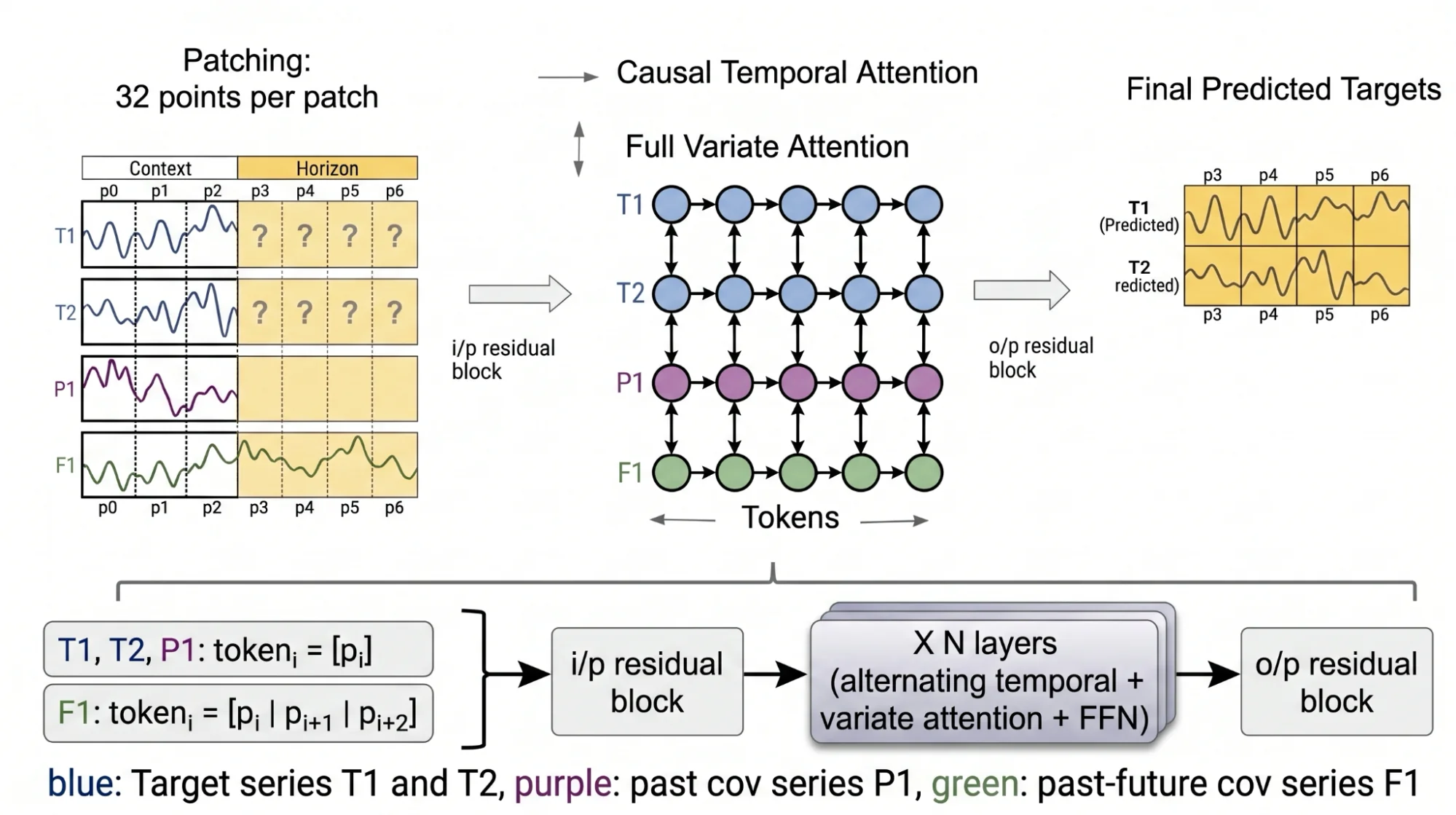
TimesFM-3 builds on the proven decoder-only transformer architecture of its predecessors. As in previous versions, we process time series efficiently by grouping contiguous data points into patches of 32 time steps. We then apply normalization per time-series similar to that of TimesFM-2.5 in order to account for time series with vastly different scales.
For target and past-covariate series, a token is constructed directly from a single patch. However, for past-future covariates, TimesFM-3 employs a clever "lookahead" strategy: each token concatenates the current patch with future patches, allowing the model to peek at upcoming known signals.
Once the patches are tokenized, they pass through an input residual block and enter the main transformer stack, which operates as a 2D grid:
These two attention mechanisms alternate for several layers, seamlessly blending temporal patterns with cross-series relationships.
TimesFM-3 architecture.
Previous versions of TimesFM generated forecasts one patch at a time, introducing latency, compounding error accumulation, and computational cost. TimesFM-3 uses the strategy of Contiguous Patch Masking to generate the entire forecasting horizon in a single forward pass. The model appends masked placeholder tokens for the future horizon alongside the observed context. Target and past-covariate series are masked in the horizon (since their future values are unknown), while past–future covariates remain visible, providing the model with known future signals like holidays or scheduled events. Through the alternating attention layers, the model fills in all masked horizon patches simultaneously, with no iterative loop required. The model predicts 9 quantiles (from the 10th to the 90th percentile) for each target time series at every horizon step, providing a full probabilistic view of the forecast uncertainty.
Let’s revisit the ice cream sales example. Imagine you are working on next month’s promotion schedule and want to forecast the sales to anticipate. A standard univariate model (the red line, below) looks at the historical sales and projects a weekly pattern forward — but it has no idea about planned promotions on specific days. TimesFM-3's multivariate mode (the blue line, below) takes a different approach: by passing in the planned promotion schedule as a past-future covariate, the model learns the relationship between promotions and sales lift from the historical context, then applies that knowledge to future days with planned promotions. The result is a forecast that anticipates a ~20% sales bump on each promotion day. In the chart below, the amber blocks in the promotion covariates highlight which days have promotions — and the blue forecast visibly responds to each one, while the red forecast does not. Over the full month, this adds up to a more accurate forecast for projected revenue.
Planning promotions: TimesFM-3's multivariate forecast uses a promotion covariate to anticipate sales lift on planned promotion days in the future.
We evaluated TimesFM-3 on three comprehensive public forecasting benchmarks: Gift-Eval, FEV-Bench, and Time. On all three benchmarks, TimesFM-3 is the top-ranked model in terms of both point and probabilistic forecasting metrics among all pre-trained foundation models. The plots below show average rank across tasks for both point forecast accuracy and probabilistic forecast quality (lower is better) for the three benchmarks. We compare against recent foundation models including multivariate-capable models, such as Chronos-2 and the Toto 2.0 family, as well as our previous model TimesFM-2.5.
Each plot includes two entries for TimesFM-3. The "univariate mode" point shows performance when the model is evaluated without any covariate or cross-series information, treating each target series independently, just like a traditional univariate model. Even in this univariate mode, TimesFM-3 already matches or outperforms other competing models. When we switch to the full multivariate mode, TimesFM-3 takes another leap, achieving the best average rank in both point and probabilistic forecasting across the board.
Performance on Gift-Eval (top), Fev-Bench (middle), and Time (bottom): TimesFM-3 in univariate mode already outperforms other replicable time-series foundation models in both point and probabilistic forecasting metrics. Multivariate mode further improves performance by leveraging cross-series information and covariates when available.
We introduce TimesFM-3, the latest generation of our TimesFM family of zero-shot time series foundation models, that obtains state-of-the-art multivariate and univariate forecasting performance on multiple public benchmarks. TimesFM-3 is now available on GitHub and Hugging Face, with its BigQuery integration landing in the coming weeks. In the meantime, you can try TimesFM-2.5 immediately on your univariate tasks to familiarize yourself with the AI.FORECAST command in BigQuery - no ML expertise required.
This project is joint work with Yichen Zhou, Petros Mol, Abhimanyu Das and Samet Oymak.
The source text above remains the property of its publisher and is reproduced for commentary.