AI Scraping as Labor Conflict: Unpermissioned Research and the Copyright Reframe
Doctorow argues that opposing AI-training data scraping on copyright grounds misidentifies the harm: creative labor is being displaced, not property taken. The text reframes scraping as 'unpermissioned research', a rights-protecting form of accountability research, and cites Ethan Zuckerman's move to McGill and the Hollywood writers' contract win as evidence that harm-based rights, not property rights, should govern. The key constraint shift is from permission-and-licensing rules under copyright to labor co-determination and human-rights balancing.
The article's genuinely novel move is to shift the AI-scraping contest from the copyright battlefield to the labor battlefield. It argues that framing AI training as 'theft' turns the remedy into a license, and a license is a property contract that media companies can acquire, resell, and force workers to surrender. Workers can win, on this account, only by asserting pre-existing employee rights to co-determination over new workplace tools, as the Writers Guild did. This is primarily a claim about strategic framing, not an empirical discovery.1
Context
The piece is embedded in a broader critique of 'property talk'. It first argues that privacy and human rights are non-market goods and therefore should not be priced; it then extends this logic to scraping, asserting that copying a corpus is not a rival taking because making copies does not remove anything from the original owner. The immediate occasion is the relocation of Ethan Zuckerman's research lab from UMass to McGill with Canadian federal funding, presented as evidence that the Trump administration is pressuring US researchers who study platform power.1
Assessment
The central inference—that a property framing necessarily hands employers the rights to creative workers' output—is asserted through a fifty-year history of copyright expansion but is not documented with specific contract or case evidence. The WGA example is the text's strongest counterweight: it shows that sectoral bargaining can constrain AI use, but it does not prove that copyright framing always fails. The 'blast radius' argument about search engines is the sharpest analytic point: if all unlicensed copying were theft, indexing every site would require a global licensing apparatus that only Google could finance.1
Caveats
What would change my mind: if copyright doctrine or settled precedent established that transient copies used in statistical analysis count as infringement, the source's 'not settled law' premise would be falsified. Similarly, if media-company standard contracts already assign AI training rights to employers, the property frame would already have been lost; that would undermine the essay's claim about the future, though not its case for labor co-determination as the alternative. The practical defense of unpermissioned research would also need to be weakened if documented cases showed it producing the human-rights harms the author concedes are possible.1
Unpermissioned research: Fighting Trump means preserving the internet, which means scraping.
Hey look at this: Delights to delectate.
Object permanence: Leaked advanced PalmOS device specs; Stalwart workers; "I, Rowboat"; SMS uprising; Facebook v switching costs; Capitalism of fools.
Upcoming appearances: Dąbrowa Górnicza, Warsaw, Brighton, London, Budapest, South Bend, Hudson, Victoria, Vancouver.
Recent appearances: Where I've been.
Latest books: You keep readin' em, I'll keep writin' 'em.
Upcoming books: Like I said, I'll keep writin' 'em.
Colophon: All the rest.
Unpermissioned research (permalink)
After half a century of neoliberalism, we are all drenched in capitalism's established religion, the worship of property rights. We are so marinated in property worship that even capitalism's critics frame their critiques in "property talk," to the exclusion of other, more important rights, like human rights, labor rights and privacy rights.
To do this is to surrender before the battle even starts. Critics lose when they allow oligarchs and their apologists to choose a battlefield where they have a nearly unbeatable advantage.
Take privacy: privacy is a human right, not a property right. Human rights aren't for sale. You can't sell yourself into slavery, you can't sell your kidneys to make the rent. If privacy is a property right – one that can be traded away – then Facebook's industrial-scale privacy invasions are actually fine, since you "traded" your privacy to Mark Zuckerberg in exchange for the privilege of talking to your friends.
Some self-styled critics of tech monopolists say that the answer to Facebook's privacy invasions is to force the company to pay for your privacy with cash, rather than services:
This is ideological capture in its purest form: the "data dividend" that Facebook would owe you under this system amounts to a few dollars per year. For wealthy people, the sums would be trivial, while working people, who've been on the downward leg of every K-shaped recovery for a quarter century, who've maxed out their credit cards and re-mortgaged their homes and drive Uber on the weekends to make rent, would have to subject themselves to ongoing surveillance.
That surveillance is already used to determine the highest price those working people will pay – companies like Plexure inform fast food places when you've just gotten paid so they can tack an extra dollar onto your breakfast burrito in the app:
Being forced to sell your privacy doesn't just raise the prices you pay, it also lowers the wages you earn. The same people who can't afford this "pay or privacy" system have their private data used to calculate the lowest wage they'll accept for each ride on those weekend Uber shifts:
In other words: not being able to afford privacy will result in you having even less disposable income, which will mean that you'll have to sell even more of your privacy. Lather, rinse, repeat.
But even the wealthy people who can afford to forego the pittances Facebook and others offer in exchange for their private information will find privacy elusive. That's because private information isn't a "rival good" – a thing only one person can own at a time. The fact that your mother is your mother "belongs" to both you and her, as well as your grandparents, your father, your siblings and your kids. The fact that you don't sell your family tree to a tech company won't stop all those other people from selling it on – as anyone whose foolish relations handed their genome over to 23andme can attest:
In the property religion, the way you can tell if something is valuable is if it has a high price. Property cultists insist that the problem with privacy is that our privacy is being sold too cheaply. They're wrong: private information isn't "mispriced" – it shouldn't be priced.
Human beings are the most valuable things in our world and they are literally priceless. Murder isn't "theft of life." Rape isn't "theft of sex." While insurers and civil courts have ways of calculating the "price" of an injury or violation, great care has been taken over the centuries to ensure that this does not turn human beings into commodities. You can't buy a "murder offset" that lets you kill people provided you pay into a fund that saves a human somewhere else:
Human beings are too valuable to be priced. We have an entire, sui generis way of balancing the conflicting interests of human rights. My daughter and wife have rights over me, I have rights over them, and when those rights come into conflict – say, if my daughter believes I can no longer care for myself and wants to put me in a care home – the process for resolving that conflict isn't an auction:
Your kids aren't your property. In fact, all the most important relationships in your life are non-market. Doctors have patients, not customers. Any time a doctor calls you a "customer" they are demoting you. A doctor doesn't sell you health. You have rights as a patient that far exceed the rights accruing to a mere customer. Same goes for other professions: Teachers have pupils, librarians have patrons, lawyers have clients. "Customer" is a demotion from all of these.
As every "user agreement" you've ever clicked through demonstrates, Big Tech loves to have everything defined in property terms – and so does all big business.
Take the fight over scraping for AI. You might think that this is a fight over the economic rights of creative workers – certainly, my fellow creative workers treat it as such. But because this debate is being framed in terms of property rights, rather than labor rights, this is a fight that workers are set up to lose.
The tell here is how the media companies – who have been eroding the wages of creative workers for decades as they consolidated into a curdled, inbred oligopoly – describe the AI companies' scraping: as an unlicensed taking. Mitch Glazier, the $1.4m/year CEO of the Recording Industry Association of America issues press releases decrying AI training for image generators without negotiating a license fee first:
Who's Mitch Glazier? Oh, just a former Congressional staffer who was drummed out of the Capitol Building after he snuck a clause into must-pass legislation that would have transferred hundreds of millions of dollars from musicians to record labels, who was then immediately hired as the CEO of the record industry's largest lobbying group:
Mitch Glazier – and the businesses he represents – aren't opposed to AI replacing artists. They're opposed to AI replacing media companies. Remember the Hollywood writers' strike? The proposal to replace screenwriters with chatbots didn't come from OpenAI, it came from Disney, Warner, Universal and other companies who claim that AI training is "theft."
If AI training is "theft," then it can be cured by making a purchase, something that the AI companies can easily afford, thanks to the hundreds of billions of dollars they have been given by the world's richest investors, who are the high priests and cardinals of the property religion.
The Hollywood writers are the only workers in the world who have successfully beaten back the use of AI in their workplace, and they didn't do it by making recourse to property rights. The Writers Guild is a union and it enjoys a weak form of "sectoral bargaining" (where all the workers in a field bargain with all the businesses at once) called "multi-employer bargaining":
The Hollywood writers' strike was an unqualified victory for the writers, who defended their labor rights to co-determination when it came to the use of new tools on their jobsite. Under the terms of their hard-fought contract, screenwriters don't have to use AI, but they can if they want. For example, writers on a long-running sitcom might train an AI with every script in the series' history, so they can ask a chatbot continuity questions as they beat out a new season of the show. But they don't have to do this if they don't want to, and even if they do, neither their wages nor their headcount can be reduced.
The media companies insist that scraping is a copyright violation, that it's "theft." As a matter of law, this is far from obvious or settled: the process of making transient copies of many works, performing mathematical analysis on them, and then publishing that analysis as software is not obviously a copyright violation, and anyone who claims otherwise doesn't understand copyright:
Worse: by demoting a labor rights issue to a mere property rights issue, AI critics are setting workers up to fail. Say the issue with AI training really is mere copyright. If that's so, the media companies who want nothing better than to pauperize creative workers can amend their standard contracts so that any worker who does business with them must irrevocably transfer their "AI training rights" to the company.
Then, that company will absolutely, 100% license those rights to an AI company to create a model designed to replace that worker. The company will get paid for the training, and the resulting model will come with "guardrails" to stop other media companies from using proprietary data to compete with it.
This is the story of the past 50 years of copyright expansion: every new copyright we've created "to help artists" was scooped up by their bosses, who grew more powerful and were able to demand more concessions from those artists, who were therefore poorer and thus needed more copyrights to help them (lather, rinse, repeat):
If creative workers' AI fight is merely a copyright fight, then that fight can only determine whether media companies or tech companies will get the biggest portion when those workers are devoured by corporations. Only a labor rights fight can take creative workers off the menu altogether.
Treating AI training as "theft" creates harms whose blast radius extends well beyond creative workers' livelihoods. Scraping is a hugely beneficial activity. If scraping – taking a vast corpus of copyrighted works without permission – is theft, then every search engine is a crime, unless it can afford to license "search indexing rights" from every site on the internet.
There's exactly one company that could pull that off: Google, a rapacious tech monopolist that is – not coincidentally – one of the leaders of the movement to beggar every creative worker. We will not improve the world, the internet, or creative workers' lives by ensuring that the last search engine anyone ever creates is Google.
Remember our earlier discussion of how privacy violations are weaponized to make poor people even poorer, by depressing their wages and raising prices based on inferences about their economic desperation? Our best weapon for fighting this practice is scraping, because that's how we catch corporations changing prices and wages based on surveillance data:
Scraping is how we produce evidence of the changes that powerful people are making to the world around us. Do you want to know whether Mark Zuckerberg or Elon Musk are downranking content critical of Trump and Big Tech and pumping racist and conspiratorial posts into the resulting void? You'd better hope you can scrape the feeds they cram into billions of people's eyeballs. Same goes for keeping track of genocide apologists, data-center astroturfers and ICE cheerleaders who've flooded Tiktok ever since Trump stole it and handed it over to his creepy billionaire pal Larry Ellison.
Making copies of that stuff isn't theft. It's not a copyright violation. Not even if you do it to billions of works. Not even if it's bad for the companies whose feeds you're capturing. Not even if it's bad for the dark money groups who funded the content.
Sure, if you do this carelessly or recklessly, you can end up violating someone's labor rights, or privacy rights, or human rights. And because those frameworks aren't based on the sanctity of property rights, they can be used to protect these important rights without giving corporate America the right to have you fined or arrested for documenting their takeover of the America.
The people who keep track of this stuff are worried about being fined or arrested. Ethan Zuckerman, one of America's foundational internet scholars, has just accepted Canadian government funding to move his lab from UMass to McGill in Montreal:
Zuckerman studies platform power: "using data to answer hard questions about social media, search engines and AI tools." He leads a team that is documenting exactly, precisely how tech companies collude with authoritarians to spy on us, manipulate us, and control us. And his methodology is something called "unpermissioned research," which is what academics call scraping:
"Unpermissioned research" seeks to circumvent limits that platforms establish specifically to stop outsiders from learning how they operate. When you're doing unpermissioned research, you try to get around rate limits, query throttles, and other measures that platforms use to block others from mapping their extent and documenting their conduct.
"Unpermissioned research" isn't a free-for-all. Universities have ethical rules designed to protect the privacy rights and other human rights of research subjects, and because these aren't property rights, they can be balanced against the socially beneficial outcomes of research. Universities can get this wrong, of course, but when they do, it's not theft. It's a human rights violation, a privacy violation, a labor violation.
If you want to know how AI companies are trying to destroy creators' livelihoods, you have to scrape the AI companies. You can't ask companies for permission to gather information that might be used to destroy them – they'll just say no. If taking information off the internet without permission is "theft," then gathering information by scraping AI companies is also theft.
Sometimes a tech company will set up a "research portal" that supposedly obviates the need to scrape by putting all the relevant information in one convenient place. That's what Facebook did in the wake of the 2016 election, when it was widely condemned for publishing paid political disinformation. But Facebook's official research portal omitted vast amounts of paid political disinformation, something we only know because NYU set up a scraping project called Ad Observer that documented the discrepancy:
Facebook used legal threats to kill Ad Observer, and then…they killed their official research portal, too:
Zuckerman is one of dozens of leading US academics who are relocating their labs and teams to Canadian universities, citing fear of political interference from the Trump regime:
The Canadian government has committed $504m to the project. Some of that research will help Canada develop new green energy, and some of it will help Canada make important medical breakthroughs. But Zuckerman's research has a special place in the portfolio of Canadian research projects, because – thanks to scraping – it is a leading source of information about how Trump's tech companies are waging war on the American people and the world.
Scraping isn't theft of data, just like murder isn't theft of life. Scraping can be harmful, and we can create laws and social regimes and ways of talking about those harms that don't give authoritarian governments and vast multinational corporations the right to decide who can document and analyze their conduct.
Take Wikipedia: the project exists solely to organize and disseminate information, for free, to everyone in the world. Wikipedia is among the most important parts of the internet, and one of the most positive developments of the 21st century. The entire project is licensed under a generous Creative Commons license that encourages unlimited commercial re-use of its contents. Even if you think scraping copyrighted works is theft, scraping Creative Commons Attribution 4.0 works is unquestionably not theft.
But Wikipedia is being hammered by AI scrapers, which are operating so aggressively that they threaten the project's ability to keep its servers online. Wikipedia has an AI problem, but that AI problem isn't "theft" – it's denial of service, the aggressive act of intentionally or recklessly flooding a server with so much traffic that it crashes.
If you've been lured into a cultlike worship of property rights, this seems like a contradiction. But once you relegate the relatively unimportant matter of property rights to its correct station, you can see – and reason about – the universe of rights that are far more important than mere property.
All it takes is realizing that there are far worse things you can do with information than "stealing" it.
(Image: Bearas, CC BY-SA 4.0, modified)
Hey look at this (permalink)
Meta's $17 Billion Settlement is a Bad Deal for Teens and All Social Media Users https://www.eff.org/deeplinks/2026/09/metas-17-billion-settlement-bad-deal-teens-and-all-social-media-users
New Twitter launches, says Musk’s X gave up the name https://arstechnica.com/tech-policy/2026/08/new-twitter-launches-says-musks-x-gave-up-the-name/
For The Economist, Mentioning Workers’ Interests Is Heresy https://jacobin.com/2026/08/acemoglu-economics-ai-automation-working-class
How Youth and Educators Can Fight Enshittified Tech https://clalliance.org/blog/how-youth-and-educators-can-fight-enshittified-tech/
Stalking the Wily Hacker: 40 years later – Cliff Stoll https://www.youtube.com/watch?v=656058JxTM0
Object permanence (permalink)
#25yrsago NYT says ebooks don't exist, fails to mention thriving ebook pirate scene https://www.nytimes.com/2001/08/28/business/forecasts-of-an-e-book-era-were-it-seems-premature.html
#25yrsago Parking tickets waived in exchange for written apologies https://web.archive.org/web/20010826013513/http://www.thesmokinggun.com/doc_o_day/lewiston1.shtml
#20yrsago Filipino students use SMS to organize mass demonstrations https://web.archive.org/web/20060902160514/http://blog.wired.com/sterling/index.blog%3Fentry_id%3D1545927
#20yrsago Spam pump-and-dumps work http://news.bbc.co.uk/2/hi/technology/5284618.stm
#25yrsago Leaked: Handspring's next PalmOS device https://web.archive.org/web/20020824213501/http://www.palmstation.com/view_article.asp?article=4614
#15yrsago “Stalwart Workers”: neglected backbone of the firm https://web.archive.org/web/20110920155246/http://blogs.hbr.org/hbsfaculty/2011/08/stop-ignoring-the-stalwart-wor.html
#5yrsago Facebook's war on switching costs https://pluralistic.net/2021/08/28/talking-hard-work-blues/#hostage-takers
#5yrsago The "work ethic" is a dirty trick we play on ourselves https://pluralistic.net/2021/08/28/talking-hard-work-blues/#work-will-set-you-free
#1yrago The capitalism of fools https://pluralistic.net/2025/08/28/strew-deal/#neither-fish-nor-fowla
Upcoming appearances (permalink)
Dąbrowa Górnicza, Kongres Regeneracja! to interdyscyplinarna, Sep 5 https://regeneracja.plse.org.pl/
Warsaw: Romana i Jana Podoskich, Sep 6 https://wydarzenia.phub.pl/events/0ee0e198-f843-423a-890f-c84ff50a46c0
Brighton: The Reverse Centaur's Guide to Life After AI with Carole Cadwalladr (Brighton Dome), Sep 8 https://brightondome.org/whats-on/LSC-cory-doctorow-the-reverse-centaurs-guide-to-life-after-ai/
London: The Reverse Centaur's Guide to Life After AI with Riley Quinn (Foyle's Picadilly), Sep 9 https://www.foyles.co.uk/events/enshittification-cory-doctorow-riley-quinn
Budapest: Brain Bar, Sep 17 https://brainbar.com/munkatars/cory-doctorow
South Bend: An Evening With Cory Doctorow (Notre Dame), Oct 6 https://franco.nd.edu/events/2026/10/06/an-evening-with-cory-doctorow/
Hudson, OH: Hudson Library, Oct 7 https://engagedpatrons.org/EventsExtended.cfm?SiteID=3850&EventID=596952&PK=
Victoria: Munro's Books, Oct 20 https://www.munrobooks.com/events/6113620261020
Vancouver: BC Policy Solutions Gala, Nov 12 https://bcpolicy.ca/gala/
Recent appearances (permalink)
How Tech Platforms Took Over the Economy (Dystopia Now) https://sites.libsyn.com/566555/enshittification-and-reverse-centaurs-cory-doctorow-on-how-tech-platforms-took-over-the-economy
Hope, AI, Fixing the Internet and the Reverse Centaur of it all (Wilosophy) https://podcastaddict.com/everyone-relax/episode/231414816
Deflating the AI Bubble (Do Not Pass Go) https://www.donotpassgo.ca/p/deflating-the-ai-bubble-with-cory
Who The Machine Serves (EFF) https://archive.org/details/effecting-change-who-the-machine-serves
Latest books (permalink)
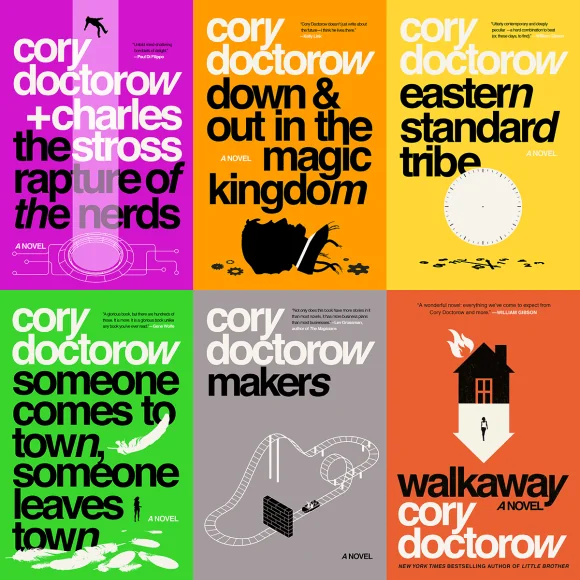
"The Reverse-Centaur's Guide to AI," a short book about being a better AI critic, Farrar, Straus and Giroux, June 2026 https://us.macmillan.com/books/9780374621568/thereversecentaursguidetolifeafterai/
"Canny Valley": A limited edition collection of the collages I create for Pluralistic, self-published, September 2025 https://pluralistic.net/2025/09/04/illustrious/#chairman-bruce
"Enshittification: Why Everything Suddenly Got Worse and What to Do About It," Farrar, Straus, Giroux, October 7 2025 https://us.macmillan.com/books/9780374619329/enshittification/
"Picks and Shovels": a sequel to "Red Team Blues," about the heroic era of the PC, Tor Books (US), Head of Zeus (UK), February 2025 (https://us.macmillan.com/books/9781250865908/picksandshovels).
"The Bezzle": a sequel to "Red Team Blues," about prison-tech and other grifts, Tor Books (US), Head of Zeus (UK), February 2024 (thebezzle.org).
"The Lost Cause:" a solarpunk novel of hope in the climate emergency, Tor Books (US), Head of Zeus (UK), November 2023 (http://lost-cause.org).
"The Internet Con": A nonfiction book about interoperability and Big Tech (Verso) September 2023 (http://seizethemeansofcomputation.org). Signed copies at Book Soup (https://www.booksoup.com/book/9781804291245).
"Red Team Blues": "A grabby, compulsive thriller that will leave you knowing more about how the world works than you did before." Tor Books http://redteamblues.com.
"Chokepoint Capitalism: How to Beat Big Tech, Tame Big Content, and Get Artists Paid, with Rebecca Giblin", on how to unrig the markets for creative labor, Beacon Press/Scribe 2022 https://chokepointcapitalism.com
Upcoming books (permalink)
"The Post-American Internet," a geopolitical sequel of sorts to Enshittification, Farrar, Straus and Giroux, 2027
"Unauthorized Bread": a middle-grades graphic novel adapted from my novella about refugees, toasters and DRM, FirstSecond, April 20, 2027
"Enshittification, Why Everything Suddenly Got Worse and What to Do About It" (the graphic novel), Firstsecond, 2027
"The Memex Method," Farrar, Straus, Giroux, 2027
Colophon (permalink)
Today's top sources:
Currently writing:
“Once Is Enemy Action,” a science fiction novel about the origins of modern technofascism. Today's words: 527 (10843 total).
"The Post-American Internet," a sequel to "Enshittification," about the better world the rest of us get to have now that Trump has torched America. Fourth draft completed. Submitted to editor.
A Little Brother short story about DIY insulin PLANNING
This work – excluding any serialized fiction – is licensed under a Creative Commons Attribution 4.0 license. That means you can use it any way you like, including commercially, provided that you attribute it to me, Cory Doctorow, and include a link to pluralistic.net.
Quotations and images are not included in this license; they are included either under a limitation or exception to copyright, or on the basis of a separate license. Please exercise caution.
How to get Pluralistic:
Blog (no ads, tracking, or data-collection):
Newsletter (no ads, tracking, or data-collection):
Mastodon (no ads, tracking, or data-collection):
Bluesky (no ads, possible tracking and data-collection):
Medium (no ads, paywalled):
Tumblr (mass-scale, unrestricted, third-party surveillance and advertising):
"When life gives you SARS, you make sarsaparilla" -Joey "Accordion Guy" DeVilla
READ CAREFULLY: By reading this, you agree, on behalf of your employer, to release me from all obligations and waivers arising from any and all NON-NEGOTIATED agreements, licenses, terms-of-service, shrinkwrap, clickwrap, browsewrap, confidentiality, non-disclosure, non-compete and acceptable use policies ("BOGUS AGREEMENTS") that I have entered into with your employer, its partners, licensors, agents and assigns, in perpetuity, without prejudice to my ongoing rights and privileges. You further represent that you have the authority to release me from any BOGUS AGREEMENTS on behalf of your employer.
ISSN: 3066-764X
The source text above remains the property of its publisher and is reproduced for commentary.