Customer lock-in as the reported engine of falling business dynamism
A Stigler Center paper, reported through Cory Doctorow's commentary, uses 9,500 acquisition filings with over $1 trillion in customer-relationship intangibles plus earnings-call admissions to show that firms deliberately build lock-in. Sectors with stronger lock-in are reported to have higher margins, fewer entrants, less innovation, and weaker job and wage growth. The work challenges Chicago-school assumptions, but the underlying study is not yet independently assessed.
What is new is a measurement strategy: instead of inferring monopoly power from market shares, the reported Stigler paper codes deliberate lock-in from regulatory filings that companies must file for acquisitions. Across 9,500 deals, firms disclosed more than $1 trillion in customer-relationship intangibles, and earnings calls were mined for executives describing contractual restrictions, bundling, and switching costs. This evidence is then tied to outcomes such as entry rates, patenting, wages, and job creation.1
Context
The constraint moved by this event is the Chicago-school assumption that a monopolist cannot profit from bad treatment because entrants would steal its dissatisfied customers. The reported work reverses the causal story: firms profit by making customers harder to leave, and that very stickiness makes entry unattractive. Rising documented customer durability from 7.5 to 11.5 years between 2002 and 2024 is presented as evidence that the older competitive check has weakened.1
Assessment
As a piece of public evidence, the source is unusually concrete: it quotes executives linking profits to the end of Click to Cancel, to patients being unable to export their own data, and to supply-chain integration that locks in business customers. But the correlations between lock-in and lower dynamism are reported second-hand, and the blog supplies no formal econometric detail. The account is plausible enough to justify close study but is not itself a completed evidentiary case.1
Caveats
What would change my mind is access to the underlying paper's identification strategy: how lock-in is separated from other reasons customers stay, how the accounting line 'customer-relationship intangibles' is validated, and whether results survive controls for sector consolidation, technology shocks, and changing consumer demographics. Independent replication and direct evidence that lock-in deters actual entrants would be decisive. Without those, the reported causal chain remains a strong hypothesis rather than a settled finding.1
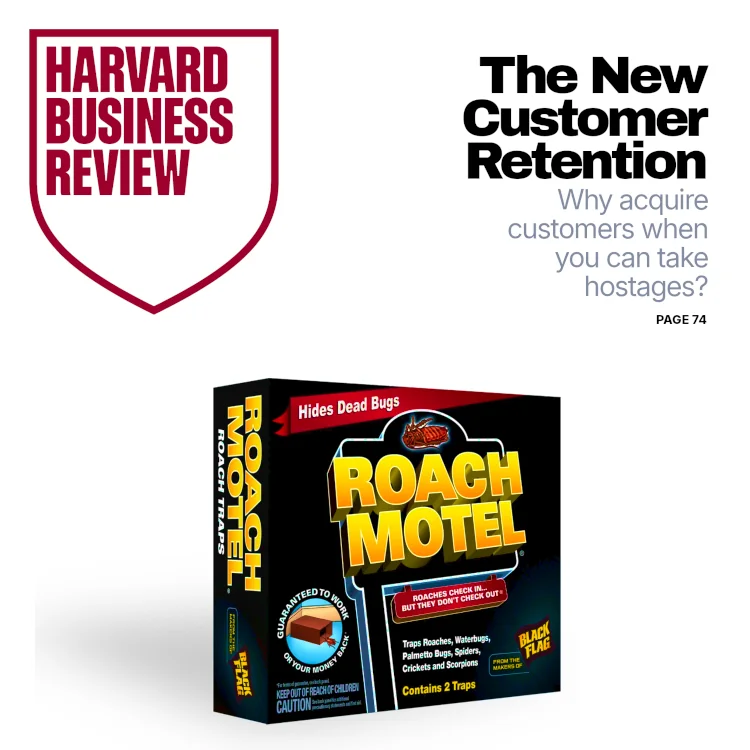
How corporate America built a better Roach Motel: Hostages beat customers every day.
Hey look at this: Delights to delectate.
Object permanence: 3-hole punches; Warner Bros v Warner Bros; Privacy wars get worse; "Weapons of Math Destruction"; HK elections go to pro-democracy reformers; Stock buybacks are swindles; NZ v Open source; MSFT patches DRM faster than other bugs; Wikipedia's worst arguments; Pirates x Iceland.
Upcoming appearances: Brighton, London, Budapest, Edmonton, South Bend, Hudson, Calgary, Winnipeg, Vancouver, Victoria, Ottawa.
Recent appearances: Where I've been.
Latest books: You keep readin' em, I'll keep writin' 'em.
Upcoming books: Like I said, I'll keep writin' 'em.
Colophon: All the rest.
How corporate America built a better Roach Motel (permalink)
"If economists wished to study the horse, they wouldn’t go and look at horses. They'd sit in their studies and say to themselves, 'What would I do if I were a horse?'" -Ely Devons
Half a century ago, a group of lavishly financed economists from the University of Chicago (the "neoliberals") convinced governments all over the world to completely upend the way they treated monopolies. Up until then, the purpose of competition enforcement was to reduce corporate power, with the understanding that once a corporation became more powerful than the government, it would be impossible to force it to follow any rules:
But for the "Chicago Boys," monopolies were evidence of efficiency. When you encounter a company in the wild that has acquired a commanding market share, your first assumption should be that it has taken over its sector by being better than anyone else – you should not assume that the company cheated its way to glory. After all, if a company with a large market share was cheating – say, if it was increasing its profit margins by reducing quality or jacking up prices – then smaller companies would rush into the market to poach its dissatisfied customers.
Thus, all competition enforcement was reduced to an empty syllogism: monopolies are the result of excellence and any less-than-excellent monopolist will have its advantage "competed away." Therefore, any monopolist you encounter in the wild is definitionally not a bad monopolist, otherwise it would already have disappeared.
To quote another economist joke:
Two economists are walking down the street when one notices a $20 bill on the sidewalk. "It's not a real $20 bill," the other declares. "If it were a real $20 bill, someone would have picked it up off the sidewalk already."
Half a century later, our entire economy is dominated by monopolies, duopolies and cartels, who boast of gigantic margins, whose products are palpably worsening at an accelerating clip, and yet there is no sign of the "new market entrants" who should be flooding into the market to "compete away" those amazing margins. It turns out that asking "What would I do if I were a horse?" does not yield a series of accurate predictions about horses.
Things have changed. Today, the University of Chicago's Stigler Center harbors a cluster of influential economists who largely or entirely repudiate the orthodoxy of the Chicago Boys. The Center hosts an annual, rather radical conference on antitrust; runs an excellent heterodox podcast (Capitalisn't); its house organ, Promarket.org, regularly hosts work that torches the received wisdom of High Chicago Neoclassicism; and the school's researchers publish papers that dare to actually "go and look at horses."
A recent horse-looking excursion has yielded some distressing, alarming, and thoroughly documented equine facts. In a new Stigler paper, "Rising Customer Durability, Falling Business Dynamism," UC's Li Azinovic-Yang, Ava E Speros and Christopher R Stewart and Stanford's John D Kepler report on some clever research into how a monopolist could raise prices, lower quality, anger its customers, and still dominate its market:
The researchers' hypothesis was that dominant businesses don't maintain their lead by making their customers happy, but by making it harder for those customers to leave. There's good reasons to suspect this. Between 2002 and 2024, the average "customer relationship" (how long a customer continues to purchase from a merchant) has risen from 7.5 years to 11.5 years, a 50% surge in "customer loyalty," far outstripping any measure of customer satisfaction over the same period. This is true across all the largest sectors of the economy: "manufacturing, information, professional services, financial services, and wholesale trade."
How to explain the falling divorce rate between customers and businesses? That's where the researchers got very clever. They realized that when a company seeks permission to acquire another business, it must publish truthful and comprehensive information about how the merger is expected to increase the profits of the new combination. These disclosures are validated by external auditors, boards of directors, and/or audit committees. There are legal repercussions for falsifying them or making material omissions to them, and they are matters of public record.
Crucially, these disclosures must include the business's plans to retain its customers, and its plans to increase the profits from those customers. That's where the researchers struck gold. They amassed a novel data-set of 9,500 acquisitions that disclosed over $1t worth of "customer relationship-related intangibles," more than 20% of all the assets that changed hands.
They supplemented this data by mining earnings calls (also subject to strict penalties for omissions and falsehoods), finding CEOs boasting about "practices that may impede switching or increase customers’ dependence on the firm." Executives bragged about their "contractual restrictions, bundling and ecosystem lock-in, and switching costs."
You can get a sense of these in a short accompanying article by the study's co-author Christopher Stewart:
The article recounts how Sirius XM's execs celebrated the news that an appeals court had struck down the FTC's "Click to Cancel" rule, which required companies to make it as easy to resign from a subscription service as it was to sign up for it. Click to Cancel is a response to increasingly sleazy, increasingly pervasive tactics that make it all but impossible to stop being someone's customer. Trump's FTC walked away from defending the rule, which let the court kill it:
After Click to Cancel died, Sirius XM's C-suite got on a call with their shareholders to project "better outcome(s) as a result of not having that in place." Sirius believed that a rule that made it easy for customers to resign from their monthly subscriptions would hurt its business. Put another way: Sirius believes that its profits come in part from the fact that dissatisfied customers can't figure out how to cancel their service.
Then there's the online insurance company eHealth, whose execs crowed about a new "innovation" that forced senior patients to painstakingly enter a long list of their medications and doctors, but did not give them any way to export that data. The lengthy investment of time in getting set up on eHealth would stop customers from leaving, because they wouldn't want "to repeat all of that information over the phone."
This is also a feature of business-to-business relationships. In 2019, US Silica's execs described how they had launched a program to become embedded in their customers' supply chains, because that "really locks in the business," making it "much more difficult for customers to switch and go to someone else."
That's the first half of the story: an empirical account of how the business world switched from "acquiring customers" to taking hostages.
But the second half of the paper is even more interesting: an empirical investigation into the effects of this customer lock-in. For starters, increased customer retention is "associated with higher gross profit margins": that is, the companies whose customers can't leave squeeze those customers for more profit. What's more, once a company has its customers locked in, it starts to capture a larger share of all the profits in its entire sector: these hostage-takers become so profitable that their profits dwarf the profits of their competitors.
The paper also solves the mystery of the missing market entrants that the neoclassical horse-ponderers insisted would be conjured up to compete away an abusive monopolist's margins. The more locked in the customers of a monopolist are, the fewer companies try to enter that market. This makes sense: who would invest in a new business in a market where none of its potential customers can switch to its new business?
This is the opposite of what the horse-ponderers have insisted upon for 50 years. The more lock-in a company attains, the more profitable it becomes, and the less it has to worry about new competitors coming after those incredible margins. This is obvious to everyone, except the monopolist-funded "social scientists" and the governments they captured.
This is bad news, and not just for those locked-in customers. New businesses are the source of new jobs, and, yup, it turns out that sectors dominated by firms with high lock-in create fewer jobs. Of course, as workers chase fewer jobs, bosses are able to suppress their wages by forcing workers to bid against one another. Once again, the study finds that the sectors with the most lock-in also see declining wages in addition to declining jobs.
These are not the horse-ponderers' "efficient" monopolists. Once a company has its customers locked in, it innovates less – as measured by the number of patents a company is awarded, and by how often those patents are cited in other patents (this second measure helps distinguish companies that file mountains of bullshit patents from companies that actually invent useful things). Naturally, R&D spending also declines in companies with more lock-in.
All of this is entirely compatible with the theory of enshittification. Once a company knows its customers can't leave, it can switch from treating them well to abusing them in order to extract money from them. The same goes for companies whose workers can't leave – because they're bound by noncompete clauses, or because their employer has bought out all their rivals:
It's like the old Lily Tomlin sketches on SNL and Laugh-In, where she played Ernestine the telephone operator narrating satirical ads for AT&T. Those sketches would end with her obviously true catch-phrase: "We don't care. We don't have to. We're the phone company":
Decades later, Tomlin's phone company joke is a perfect distillation of modern management philosophy. As a famous NBER working paper showed, when a family business is handed over to a professional manager with an MBA, the company doesn't become more profitable overall; it just finds ways to pay its workers less:
That's why Tim Wu named this "the age of extraction." "Growth" no longer means "making something new that people want" – now it means "finding ways to take a larger share of the pie, even if that makes the pie smaller overall":
This is something we can all feel. We experience it in our daily lives, through "shrinkflation" and "junk fees" and a million other gross and petty scams. But it's rare that we actually catch executives explicitly admitting that their job is to find ways to take you hostage and squeeze you.
Historically, those revelations have come from extraordinary circumstances, like when Frontier (the worst ISP in America) went bankrupt and we learned that the company had 1.6 million customers who had no access to competing broadband connections. Frontier carried these hostages on their balance sheet as a special, highly valued asset, since they could be charged more for slower, less reliable service:
In assembling this novel, high-quality data-set, the researchers on this paper have performed an important service, capturing a vast number of sworn confessions of highly paid enshittifiers, and then showing how their hostage-taking wrecked competition, prices, wages, jobs and innovation.
Hey look at this (permalink)
Gloria Steinem Helped Transform the World for Everyone https://www.meditationsinanemergency.com/gloria-steinem-helped-transform-the-world-for-everyone/
Keep the Internet free https://keepitfree.ai/
Money Does Not Decide What It Becomes https://sekimonyo.com/money-does-not-decide-what-it-becomes
Object permanence (permalink)
#20yrsago Three-hole punch debut, April 1940 https://web.archive.org/web/20061119140057/https://blog.modernmechanix.com/2006/09/06/three-hole-paper-punch-debut/
#20yrsago New Zealand redefines open source as “code you can’t modify” https://memex.craphound.com/2006/09/07/nobel-prize-sperm-bank-human-tragicomedy-about-eugenics/
#20yrsago MSFT quicker to patch DRM than security vulnerabilities https://www.schneier.com/blog/archives/2006/09/microsoft_and_f.html
#10yrsago Why the Pirate Party could end up running Iceland https://web.archive.org/web/20211024071400/https://www.newstatesman.com/culture/2016/09/how-internet-pirates-became-political-force-iceland
#10yrsago Sampling bias: how a machine-learning beauty contest awarded nearly all prizes to whites https://web.archive.org/web/20160906154712/https://motherboard.vice.com/read/why-an-ai-judged-beauty-contest-picked-nearly-all-white-winners
#10yrago Warner Bros flags its own website as a piracy portal in copyright takedowns https://torrentfreak.com/warner-bros-flags-website-piracy-portal-160904/
#10yrsago The privacy wars have been a disaster and they’re about to get a LOT worse https://locusmag.com/feature/cory-doctorowthe-privacy-wars-are-about-to-get-a-whole-lot-worse/
#10yrsago Weapons of Math Destruction: invisible, ubiquitous algorithms are ruining millions of lives https://memex.craphound.com/2016/09/06/weapons-of-math-destruction-invisible-ubiquitous-algorithms-are-ruining-millions-of-lives/
#10yrsago Pro-democracy reformers win big in Hong Kong’s elections https://globalvoices.org/2016/09/06/hong-kong-voters-elect-pro-democracy-legislators-to-defend-the-citys-autonomy-from-china/
#1yrago Stock buybacks are stock swindles https://pluralistic.net/2025/09/06/computer-says-huh/#invisible-handcuffs
Upcoming appearances (permalink)
Brighton: The Reverse Centaur's Guide to Life After AI with Carole Cadwalladr (Brighton Dome), Sep 8 https://brightondome.org/whats-on/LSC-cory-doctorow-the-reverse-centaurs-guide-to-life-after-ai/
London: The Reverse Centaur's Guide to Life After AI with Riley Quinn (Foyle's Picadilly), Sep 9 https://www.foyles.co.uk/events/enshittification-cory-doctorow-riley-quinn
Budapest: Brain Bar, Sep 17 https://brainbar.com/munkatars/cory-doctorow
Edmonton: Elbows Up (Edmonton Public Library), Sep 28 https://www.epl.ca/blogs/post/elbows-up-with-cory-doctorow/
South Bend: An Evening With Cory Doctorow (Notre Dame), Oct 6 https://franco.nd.edu/events/2026/10/06/an-evening-with-cory-doctorow/
Hudson, OH: Hudson Library, Oct 7 https://engagedpatrons.org/EventsExtended.cfm?SiteID=3850&EventID=596952&PK=
Calgary: Wordfest, Oct 8 https://wordfest.com/2026/show/wordfest-presents-cory-doctorow-2026/
Winnipeg: McNally Robinson, Oct 9 https://www.mcnallyrobinson.com/event-18991/An-Evening-with-Cory-Doctorow
Victoria: Munro's Books, Oct 20 https://www.munrobooks.com/events/6113620261020
Vancouver: Life After AI (Vancouver Writers Festival), Oct 22 https://writersfest.bc.ca/festival-event-2026/46
Ottawa: Life After AI (Ottawa Writers Festival), Oct 24 https://writersfestival.org/event/life-after-ai
Vancouver: BC Policy Solutions Gala, Nov 12 https://bcpolicy.ca/gala/
Recent appearances (permalink)
Downstream with Michael Walker (Novara) https://www.youtube.com/watch?v=nTqCVJFr7XM
The future of the tech crisis (How the Light Gets In) https://iai.tv/video/the-future-of-the-tech-crisis?_auid=2020
How Tech Platforms Took Over the Economy (Dystopia Now) https://sites.libsyn.com/566555/enshittification-and-reverse-centaurs-cory-doctorow-on-how-tech-platforms-took-over-the-economy
Hope, AI, Fixing the Internet and the Reverse Centaur of it all (Wilosophy) https://podcastaddict.com/everyone-relax/episode/231414816
Deflating the AI Bubble (Do Not Pass Go) https://www.donotpassgo.ca/p/deflating-the-ai-bubble-with-cory
Latest books (permalink)
"The Reverse-Centaur's Guide to AI," a short book about being a better AI critic, Farrar, Straus and Giroux, June 2026 https://us.macmillan.com/books/9780374621568/thereversecentaursguidetolifeafterai/
"Canny Valley": A limited edition collection of the collages I create for Pluralistic, self-published, September 2025 https://pluralistic.net/2025/09/04/illustrious/#chairman-bruce
"Enshittification: Why Everything Suddenly Got Worse and What to Do About It," Farrar, Straus, Giroux, October 7 2025 https://us.macmillan.com/books/9780374619329/enshittification/
"Picks and Shovels": a sequel to "Red Team Blues," about the heroic era of the PC, Tor Books (US), Head of Zeus (UK), February 2025 (https://us.macmillan.com/books/9781250865908/picksandshovels).
"The Bezzle": a sequel to "Red Team Blues," about prison-tech and other grifts, Tor Books (US), Head of Zeus (UK), February 2024 (thebezzle.org).
"The Lost Cause:" a solarpunk novel of hope in the climate emergency, Tor Books (US), Head of Zeus (UK), November 2023 (http://lost-cause.org).
"The Internet Con": A nonfiction book about interoperability and Big Tech (Verso) September 2023 (http://seizethemeansofcomputation.org). Signed copies at Book Soup (https://www.booksoup.com/book/9781804291245).
"Red Team Blues": "A grabby, compulsive thriller that will leave you knowing more about how the world works than you did before." Tor Books http://redteamblues.com.
"Chokepoint Capitalism: How to Beat Big Tech, Tame Big Content, and Get Artists Paid, with Rebecca Giblin", on how to unrig the markets for creative labor, Beacon Press/Scribe 2022 https://chokepointcapitalism.com
Upcoming books (permalink)
"The Post-American Internet," a geopolitical sequel of sorts to Enshittification, Farrar, Straus and Giroux, 2027
"Unauthorized Bread": a middle-grades graphic novel adapted from my novella about refugees, toasters and DRM, FirstSecond, April 20, 2027
"Enshittification, Why Everything Suddenly Got Worse and What to Do About It" (the graphic novel), Firstsecond, 2027
"The Memex Method," Farrar, Straus, Giroux, 2027
Colophon (permalink)
Today's top sources:
Currently writing:
“Once Is Enemy Action,” a science fiction novel about the origins of modern technofascism. Today's words: 574 (7730 total).
"The Post-American Internet," a sequel to "Enshittification," about the better world the rest of us get to have now that Trump has torched America. Fourth draft completed. Submitted to editor.
A Little Brother short story about DIY insulin PLANNING
This work – excluding any serialized fiction – is licensed under a Creative Commons Attribution 4.0 license. That means you can use it any way you like, including commercially, provided that you attribute it to me, Cory Doctorow, and include a link to pluralistic.net.
Quotations and images are not included in this license; they are included either under a limitation or exception to copyright, or on the basis of a separate license. Please exercise caution.
How to get Pluralistic:
Blog (no ads, tracking, or data-collection):
Newsletter (no ads, tracking, or data-collection):
Mastodon (no ads, tracking, or data-collection):
Bluesky (no ads, possible tracking and data-collection):
Medium (no ads, paywalled):
Tumblr (mass-scale, unrestricted, third-party surveillance and advertising):
"When life gives you SARS, you make sarsaparilla" -Joey "Accordion Guy" DeVilla
READ CAREFULLY: By reading this, you agree, on behalf of your employer, to release me from all obligations and waivers arising from any and all NON-NEGOTIATED agreements, licenses, terms-of-service, shrinkwrap, clickwrap, browsewrap, confidentiality, non-disclosure, non-compete and acceptable use policies ("BOGUS AGREEMENTS") that I have entered into with your employer, its partners, licensors, agents and assigns, in perpetuity, without prejudice to my ongoing rights and privileges. You further represent that you have the authority to release me from any BOGUS AGREEMENTS on behalf of your employer.
ISSN: 3066-764X
The source text above remains the property of its publisher and is reproduced for commentary.