NVIDIA AVO Hits 100.00 RHAE on ARC-AGI-3 Public Set; Same Harness Transfers from GPU-Kernel Optimization
NVIDIA reports that its AVO agent architecture achieved 100.00 RHAE on the ARC-AGI-3 public set, solving all 183 levels across 25 environments using Claude Opus 5 and 6,624 environment actions, about 12% fewer than VISTA's reported 7,542. The same AVO system was previously applied to GPU-kernel optimization, and both sources frame the result as evidence that the agent harness—persistent memory, supervision, and an inspect-plan-implement-evaluate loop—rather than model capability alone drives long-horizon performance.
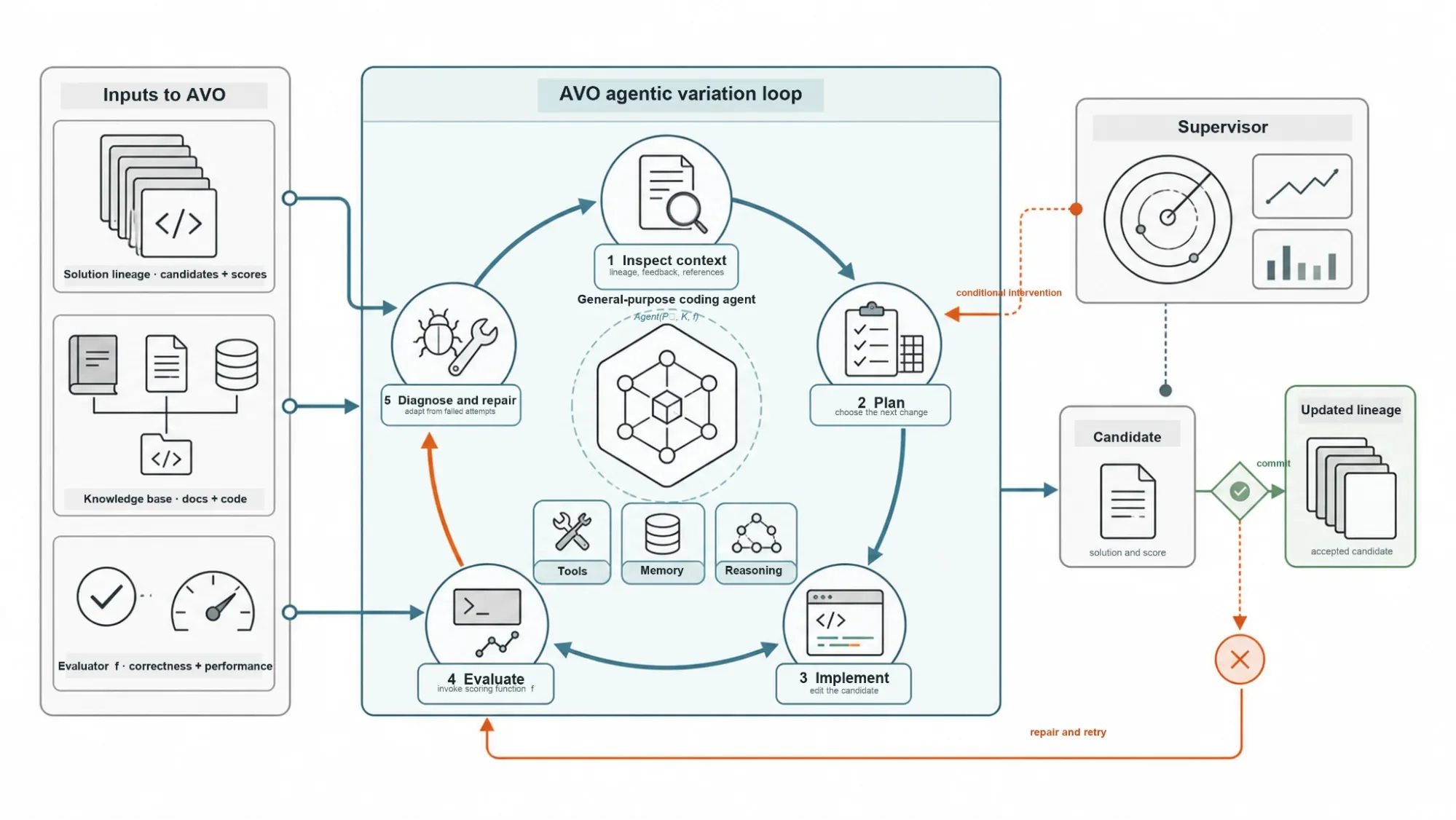
NVIDIA's AVO agent system achieved a 100.00 RHAE score on the ARC-AGI-3 public set, solving all 183 levels in 25 environments with 6,624 environment actions. The result is new not because a stronger model appeared, but because the same agent harness previously applied to GPU-kernel optimization was transferred to an interactive-reasoning benchmark. AVO cycles through inspection, planning, implementation, evaluation, diagnosis, and repair, with persistent memory and a supervisor monitoring for stagnation. Both the NVIDIA announcement and the secondary newsletter story attribute the jump from a roughly 30% model-only score to the harness, not to the model itself.12
Context
ARC-AGI-3 drops agents into unfamiliar environments without instructions, stated rules, or stated goals, and scores them using Relative Human Action Efficiency (RHAE), which combines task completion with per-level action efficiency relative to human baselines. AVO's run used Claude Opus 5 with text-only observations supplied as exact 64x64 text grids, while VISTA, the comparison system, used rendered 512x512 PNGs and a different backend. AVO used approximately 12% fewer environment actions than VISTA's reported 7,542.12
Assessment
The headline shows a constraint shift: long-horizon performance is presented as a property of the full agent system, with model capability necessary but not sufficient. The evidence for that shift is the same model family reaching both ~30% and 100% depending on the surrounding harness, plus one architectural transfer across two very different task families. The claim is suggestive but not yet a controlled demonstration: the ~30% figure comes from an external run at a different reasoning setting, and the 12% action-efficiency comparison with VISTA is explicitly non-ablative—the systems differ in backend, observation, memory, and context management.12
Caveats
The public-set result does not cover ARC-AGI-3's semi-private or fully private sets, and no code or third-party replication is provided. A controlled ablation isolating persistent memory from other harness components, or replication on held-out levels, would materially change our confidence in AVO's claimed generality. Until then, 'general-purpose architecture' remains a hypothesis supported by one domain pair and one benchmark run.1
Cross-source check
2 sources
Agreed
AVO scored 100.00 RHAE on the ARC-AGI-3 public set, solving all 183 levels across 25 environments.NVIDIA Technical BlogDAIR.AI — AI Papers of the Week
The run used Claude Opus 5 as the underlying model and AVO as the harness.NVIDIA Technical BlogDAIR.AI — AI Papers of the Week
AVO is built around an agentic variation loop with persistent memory and a supervisor; the same architecture was originally developed for CUDA GPU-kernel optimization and transferred to ARC-AGI-3.NVIDIA Technical BlogDAIR.AI — AI Papers of the Week
AVO used 6,624 environment actions compared with VISTA's reported 7,542, approximately 12% fewer.NVIDIA Technical BlogDAIR.AI — AI Papers of the Week
Disputed
Interpretation of the Claude Opus 5 model-only score
NVIDIA Technical Blog
The ~30% figure is an external ARC Prize result at High reasoning effort under a different reasoning setting and should not be interpreted as a direct measurement of AVO's contribution.
DAIR.AI — AI Papers of the Week
Claude Opus 5 alone scores roughly 30% on the same benchmark; wrapping it in AVO takes it to 100%, presented as direct evidence that system design, not model capability, unlocks performance.
Reported by one source only
AVO's observation interface for ARC-AGI-3 was text-only: each observation was an exact 64x64 text grid, with no images or image tokens sent to the model.NVIDIA Technical Blog
In limited experiments, AVO paired with GPT-5.6 Sol reached matched levels faster in wall-clock time in several cases, while Opus used fewer environment actions in matched-level comparisons.NVIDIA Technical Blog
The 100.00 RHAE result covers only the 25-environment public set and not the semi-private or fully private competition sets.NVIDIA Technical Blog
A frontier language model is only one component of an AI agent. The surrounding agent system—often called a harness—determines how the model receives context, uses tools, maintains state, responds to feedback, recovers from failure, and sustains progress over long-running tasks. The challenge is how to build the agent architecture that makes frontier language models work reliably on extended, multistep tasks.
The NVIDIA research project Agentic Variation Operators (AVO) addresses this challenge of building a general-purpose agent architecture. AVO was first demonstrated on difficult software engineering and GPU-kernel optimization tasks, where success requires far more than generating code in a single response. An agent must inspect existing implementations, form hypotheses, make changes, execute hardware-grounded tests, interpret feedback, and repeatedly revise its approach.
This post introduces the AVO architecture and the system-level mechanisms that enable it to sustain long-running autonomous work. We first summarize its application to GPU-kernel optimization, then describe how the same architecture was adapted to the ARC-AGI-3 benchmark and present the resulting public-set performance, efficiency, and key lessons.
AVO is a general-purpose coding agent system developed by NVIDIA. Like modern coding agents, AVO can inspect and edit code, run commands, consult documentation, and validate its work through execution. Its distinguishing focus is sustained autonomous operation across long horizons.
In our GPU-kernel optimization work, AVO replaces the predefined variation step of conventional evolutionary-search systems with an autonomous agent that decides how to generate the next candidate—what to inspect, what to change, what to test, and what to commit. For ARC-AGI-3, we connected the same general-purpose agent to a different task interface. The underlying agent remains the same; only the environment-specific tools and evaluation change.
Figure 1. AVO architecture for long-horizon autonomous agent work. The main agent iteratively inspects context, plans, implements changes, and evaluates results using persistent memory and tools, while a supervisor monitors the broader search trajectory and can intervene when progress stalls
GPU-kernel optimization provided an early demanding test of this architecture.
The search space is large, the performance landscape is difficult to reason about directly, and small implementation changes can affect correctness, memory behavior, scheduling, and throughput in ways that are hard to predict without execution.
In our attention-kernel study, AVO operated continuously for seven days, explored more than 500 optimization directions, and produced 40 committed kernel versions.
On NVIDIA DGX B200 systems, the resulting multihead attention kernels outperformed cuDNN by up to 3.5% and FlashAttention-4 by up to 10.5% across the evaluated configurations. The agent subsequently adapted the evolved kernel to grouped-query attention in approximately 30 minutes of additional autonomous work.
Beyond the final kernel performance, this experiment demonstrates that AVO can sustain a productive engineering loop over many iterations without requiring each step to be manually prescribed. More broadly, AVO reinforces a system-level view of agent design: building a trusted agent stack requires performance, reliability, and security to be designed across the full system—not treated as properties of the model alone. This same principle also shapes how we think about securing the AI agent stack.
AVO is designed to preserve progress beyond a single model context. Two mechanisms are particularly important: persistent memory and supervision.
Persistent memory carries forward prior implementations, evaluation results, compiler and profiler outputs, and accumulated reasoning, allowing the agent to resume from the current state rather than repeatedly reconstructing the search.
The supervisor monitors the broader trajectory for stagnation or repeated unproductive cycles and can redirect the main agent toward alternative strategies when needed. During the seven-day attention-kernel run, the main agent remained responsible for deciding what to inspect, change, test, and evaluate, while the supervisor helped maintain forward progress when the search plateaued.
The NVIDIA team recently applied the same underlying AVO architecture to a very different challenge: the interactive reasoning benchmark ARC-AGI-3, in which agents enter unfamiliar environments without instructions, stated rules, or stated goals.
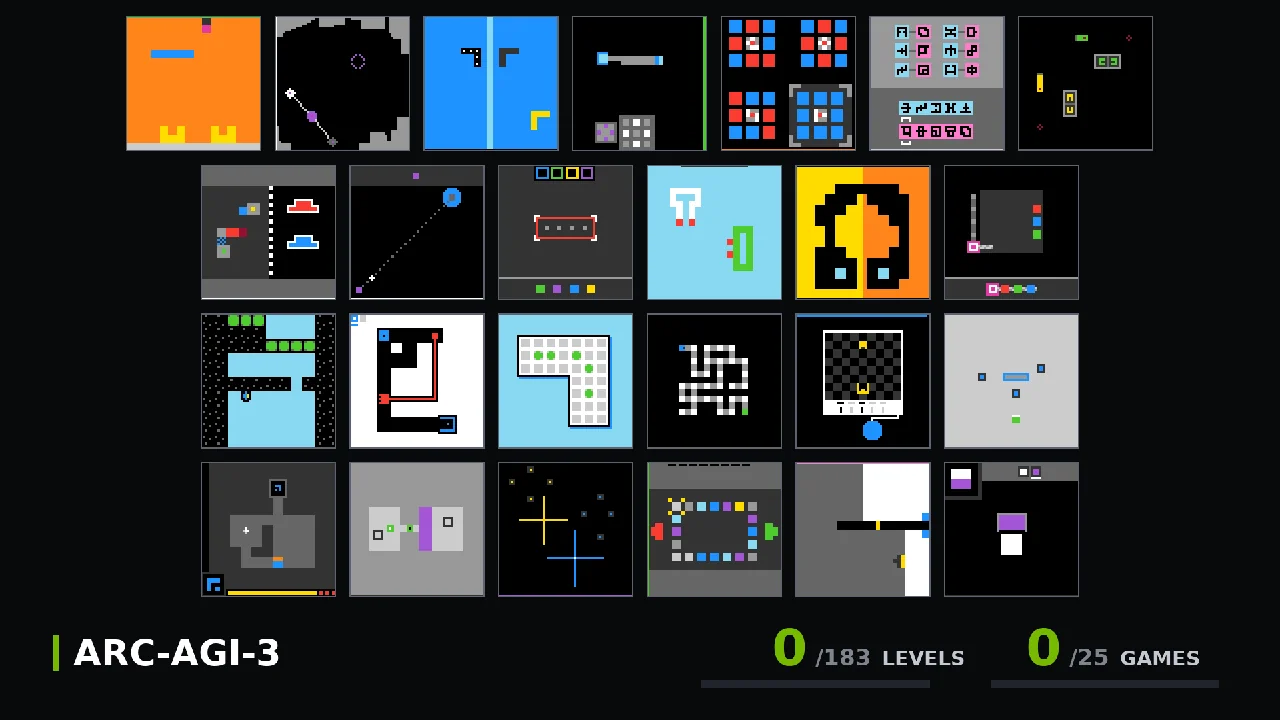
AVO achieved a 100.00 RHAE score across all 25 environments in the ARC-AGI-3 public set, completing all 183 levels. The result illustrates a broader point: evaluating a model is not the same as evaluating an agent. Model capability matters enormously, but the surrounding system determines how effectively that capability can be converted into sustained autonomous progress.
GPU-kernel optimization and the ARC-AGI-3 benchmark appear very different on the surface.
One involves source code, compilers, profilers, and throughput. The other involves unfamiliar interactive environments in which an agent must infer the effects of available actions, discover objectives, and act efficiently enough to make progress.
But the underlying computational pattern is similar. In both settings, the agent must:
Build hypotheses from incomplete evidence
Take actions through an external interface
Observe the consequences
Preserve useful state
Revise its model of the problem
Recover from incorrect assumptions
Continue making progress over a long horizon
The domain changes. The feedback channel changes. The core agent loop does not.
What transfers is not domain knowledge, but the machinery for sustained autonomous progress.
For this reason, ARC-AGI-3 provided a useful test of whether the AVO architecture was fundamentally tied to software engineering or captured something more general.
Figure 2. AVO achieved a 100.00 RHAE score across all 25 game environments in the ARC-AGI-3 public set, completing all 183 levels
ARC-AGI-3 is an interactive reasoning benchmark. An agent enters unfamiliar game-like environments without instructions, explicit rules, or a stated goal. It must explore through interaction, infer the environment’s dynamics and objectives, and plan actions efficiently across progressively harder levels.
The benchmark uses Relative Human Action Efficiency (RHAE), a metric that combines task completion with per-level action efficiency relative to first-time human baselines. Performance is aggregated across levels and environments.
This metric makes ARC-AGI-3 a demanding long-horizon agent task. Success requires more than solving an isolated state. The agent must preserve useful knowledge, learn from previous interactions, recover from mistakes, and spend environment actions efficiently.
Rather than centering our ARC-AGI-3 system on explicit programmatic world-model construction, as explored by Tycho, we adopted the direct-interaction design principles described by VISTA and reimplemented the task interface independently. This was better aligned with our goal of evaluating AVO as a general-purpose agent rather than introducing an ARC-specific world-model layer.
Several elements of the task interface were informed by VISTA, but the agent backend was fundamentally different. VISTA instantiates the harness with Claude Opus 5 through Claude Code or GPT-5.6 Sol through Codex, whereas our system uses AVO, the NVIDIA long-horizon agent architecture with persistent memory, supervision, and its own execution loop.
The observation interface also differs. VISTA’s primary configuration uses a rendered 512 x 512 PNG, while also exploring textual-grid representations. In the AVO configuration, the LLM operated in a text-only modality: each observation was supplied as an exact 64 x 64 text grid, with no images or image tokens sent to the model. Consistent with the direct-interaction setup, the agent received the available actions without descriptions of the game’s rules or goals and had to infer their effects through interaction.
Recent ARC-AGI-3 systems have explored substantially different agent architectures, from explicit executable world models such as Tycho to direct-interaction harnesses such as VISTA. Together, these results highlight that benchmark performance reflects the complete agent system, not only the underlying model.
Using Claude Opus 5, AVO completed the full 25-environment public set with a 100.00 RHAE score, solving all 183 levels in 6,624 environment actions. For reference, VISTA reports 7,542 environment actions with Claude Opus 5 while completing the same 183 public-set levels. AVO therefore used approximately 12% fewer actions in this cross-system comparison.
This should not be interpreted as a controlled ablation: the two systems differ in agent backend, observation representation, memory, context management, and other implementation details. One architectural difference that may matter over long horizons is the AVO memory system, which is designed to carry useful understanding forward and reduce repeated exploration, although this experiment does not isolate its individual contribution.
ARC Prize separately reports approximately 30% for Claude Opus 5 at High reasoning effort on the public set. Our run used the same model family under a different reasoning setting and a substantially different agent system and evaluation setup. These numbers therefore should not be interpreted as a direct measurement of the performance contribution of AVO; rather, they illustrate that model-level evaluation alone does not characterize the performance of a complete agent.
AVO is also designed to operate across frontier models. While our full public-set result used Claude Opus 5, we additionally paired AVO with GPT-5.6 Sol on a challenging subset of games. In these limited experiments, Sol reached matched levels faster in wall-clock time in several cases, while Opus used fewer environment actions in matched-level comparisons. These preliminary results suggest complementary operating profiles across models, and we leave a broader systematic comparison to future work.
These results cover the 25-environment ARC-AGI-3 public set using the official scorecard and RHAE metric. They are not results on the semi-private or fully private competition sets.
The most important result was not simply the 100.00 score, but that the same agent architecture transferred from highly specialized GPU-kernel optimization to a very different interactive reasoning task.
In GPU optimization, feedback comes from compilers, tests, profilers, and performance benchmarks. In ARC-AGI-3, feedback comes from environment transitions and action outcomes. The interfaces differ, but the loop is the same: form a hypothesis, act, observe evidence, update state, and continue.
This suggests that generality can come not only from domain knowledge, but from the machinery that allows reasoning and feedback to compound over time.
More broadly, long-horizon capability is a property of the full system. Memory determines what survives, tools determine what actions are possible, feedback grounds progress, and recovery allows work to continue beyond a single model invocation.
NVIDIA AVO research began with autonomous software engineering and high-performance GPU-kernel optimization. ARC-AGI-3 shows that the same underlying architecture can transfer to a very different reasoning environment.
The larger opportunity is to build general-purpose agent systems around persistent state, tool use, grounded feedback, recovery, and long-horizon context management—systems that can accumulate evidence and sustain progress across increasingly diverse tasks.
The model matters, but the model is not the entire agent.
To learn more, check out these resources:
Read the paper, AVO: Agentic Variation Operators for Autonomous Evolutionary Search
Explore the ARC-AGI-3 benchmark
Review the ARC-AGI-3 scoring methodology
Browse related work
The source text above remains the property of its publisher and is reproduced for commentary.
Weekly newsletter summary of NVIDIA's announcement, highlighting the perfect ARC-AGI-3 score and framing it as evidence for system-level agent design over raw model capability.