Memora: Decoupling Memory Storage from Retrieval in Long-Horizon Agents
Memora is a memory framework from Microsoft Research that separates rich memory content from a lightweight retrieval index, claiming to break the abstraction-specificity tradeoff that limits agent memory systems. It reports state-of-the-art accuracy on LoCoMo and LongMemEval with up to 98% fewer context tokens than full-context inference. The evidence comes from a single self-reported blog post; independent replication and averaged efficiency figures are not yet available.
Microsoft's Memora is an agentic memory framework that decouples what is stored from how it is retrieved. The central novelty is that each memory entry keeps rich content but indexes it only by a 6–8 word primary abstraction and cue anchors, so new information merges into an existing entry instead of fragmenting. The reported results are state-of-the-art on LoCoMo and LongMemEval with up to 98% fewer context tokens than full-context inference.1
Context
Current memory systems fall into content-fragmentation approaches such as RAG and Mem0, coarse-abstraction summaries, and graph-based systems with rigid ontologies. Each fails at one end of the abstraction-specificity tension. Memora's decoupling is presented as the first design to avoid this tradeoff rather than optimize within it, using a policy-guided retriever that iteratively refines queries and expands through cue anchors to reach non-local memories.1
Assessment
The published comparison includes Mem0, RAG, Nemori, Zep, LangMem, and full-context inference, with the largest gains on multi-hop reasoning. This is consistent with the retrieval policy expanding through cue anchors. However, the evidence is entirely self-reported: the benchmark scores are LLM-judge accuracies, not exact-match metrics, and the post provides no significance tests, ablation of the decoupling mechanism, or per-benchmark error analysis.1
Caveats
The headline efficiency figure is an upper bound: 'up to 98% fewer tokens' does not reveal the average saving or the conditions under which it holds. The claim to outperform full-context inference depends on LLM judges, which can reward fluent style over factual correctness. Independent replication with ground-truth metrics and reported average token savings would materially change confidence in the central claims.1
Today’s AI agents don’t remember past interactions. They must repeatedly be fed relevant information or retrieve it from external sources, which becomes less efficient as they handle longer and more complex tasks. To scale agent capabilities, we need a more efficient way to retain and access information over time.
Memora is a scalable memory system that dramatically increases agent productivity on long-horizon tasks by decoupling what is stored (rich memory content) from how it’s retrieved (lightweight abstractions and cue anchors), balancing abstraction and specificity.
Memora sets new state-of-the-art on LoCoMo and LongMemEval, outperforming Mem0, RAG, and full-context inference while using up to 98% fewer context tokens.
Memora paper (opens in new tab) is published at ICML 2026. Memora code is available at https://github.com/microsoft/Memora (opens in new tab).
Imagine a workplace AI assistant helping you run a multi-month project. Over weeks of conversations, you share constraints, agree on milestones, revise deadlines, and surface dozens of stakeholder preferences. When you later ask it to draft an update for a colleague, it should recall not just the latest decision but the journey that got you there: what was tried, what was ruled out, who weighed in. Today’s AI agents struggle with this. Modern large language models (LLMs) are powerful reasoners, but they are effectively stateless: every session starts from zero, every long conversation forces the model to re-read its entire history, and every new piece of information is either stored as raw text (fragmented and noisy) or compressed into a vague summary (precise details lost). As AI assistants and autonomous agents move into long-horizon deployments, such as copilots that track a project for many months or even research agents that build up domain expertise with long horizon usage, the absence of principled memory system has become the critical bottleneck.
A growing line of work has begun to fill this gap. Systems like Mem0 extract atomic facts from conversations; retrieval-augmented (RAG) approaches index raw text fragments for later recall; and graph-based memory systems such as Zep and GraphRAG impose structure through entity relations. Each represents real progress, yet each runs into the same wall: existing designs force an unavoidable tradeoff between specificity (preserving fine-grained detail) and abstraction (organizing memory efficiently as it grows). Memora is built to give agents both.
What is Memora
Memora is an agentic memory framework designed for long-horizon AI agents. Memora’s central insight is to decouple what is stored from how it is retrieved. Memory content can remain rich and expressive, such as a project timeline, a multi-turn discussion about constraints, while a separate, lightweight structural layer handles indexing and retrieval. The result is a memory system that scales: it consolidates related information into stable units, surfaces fine-grained details when they matter, and lets the agent navigate its own history without re-reading everything. On standard long-conversation benchmarks, Memora sets new state-of-the-art performance while using up to 98% fewer tokens than would be consumed by dumping the full history into context.
Why this is hard: the abstraction–specificity tension
Existing memory systems fall into two extremes. Content-fragmentation systems, such as RAG and Mem0, embed extracted facts or text fragments directly. This preserves detail but produces brittle, isolated entries that lose narrative coherence. Coarse-abstraction systems compress experience into compact summaries. They are efficient, but summarization strips away the constraints, edge cases, and numeric details that make memory useful in the first place. Graph-based systems add structure on top of content, yet still rely on the content itself for retrieval and typically require rigid ontologies that don’t generalize across domains. None of these resolves the underlying tension between abstraction (which keeps memory efficient) and specificity (which gives memory utility).
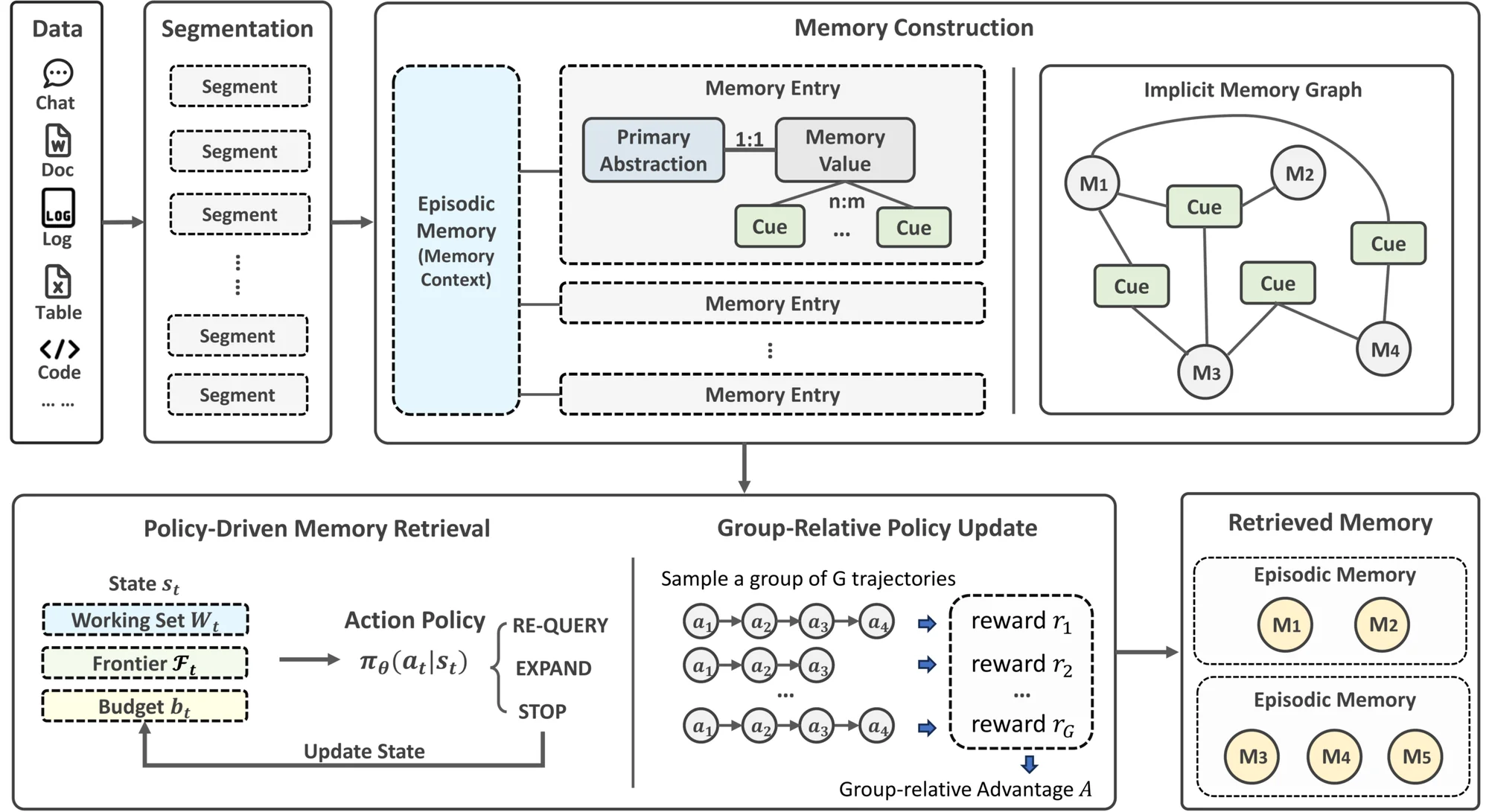
Figure 1: Architecture overview of Memora.
How Memora works
Memora resolves this tension through a harmonic organization. Each memory entry has two components: a primary abstraction, which a short phrase (6–8 words) that captures what the memory is fundamentally about, and a memory value holding the rich content itself. Crucially, only the primary abstraction is embedded for similarity search; the value is never directly retrieved through its own content. This separation means new information about an evolving topic merges into the existing memory entry under the same primary abstraction, rather than fragmenting into a chain of partial duplicates. Complementing primary abstractions, cue anchors are short, context-aware tags extracted from each memory’s value, providing alternative access paths to the same memory. They function as flexible, organically-generated metadata.
To make this concrete: suppose a user says, “Dave and Sarah agreed to push the prototype to April 1, the pilot to May 2, and the MVP to May 30.” A knowledge-graph system would need predefined entity types and relation schemas: Person → agreed_on → Milestone → has_date → Date, and any new relation type would require schema extension. In Memora, the primary abstraction Updated Project Orion timeline agreed by Dave and Sarah serves as the canonical access point, while cue anchors like Dave Project Orion update, Project Orion prototype schedule, and Project Orion pilot timeline provide alternative retrieval paths — all without committing to an ontology. A later query about Dave’s recent contributions, or the prototype schedule, or pilot timing can all route to the same underlying memory through different cues, with the full detail preserved in the memory value.
On top of this representation, Memora introduces a policy-guided retriever that treats memory access as an active reasoning process. Rather than returning the top-k semantically similar items in a single shot, the policy retriever iteratively refines its query, expands through cue anchors to surface related-but-not-similar memories, and decides when to stop. This lets the agent navigate to relevant non-local context that pure semantic search would miss, chasing multi-hop dependencies the way a human would when recalling connected events. The retrieval policy can be either hand-prompted with a strong LLM or distilled into a much smaller model via reinforcement learning.
Results
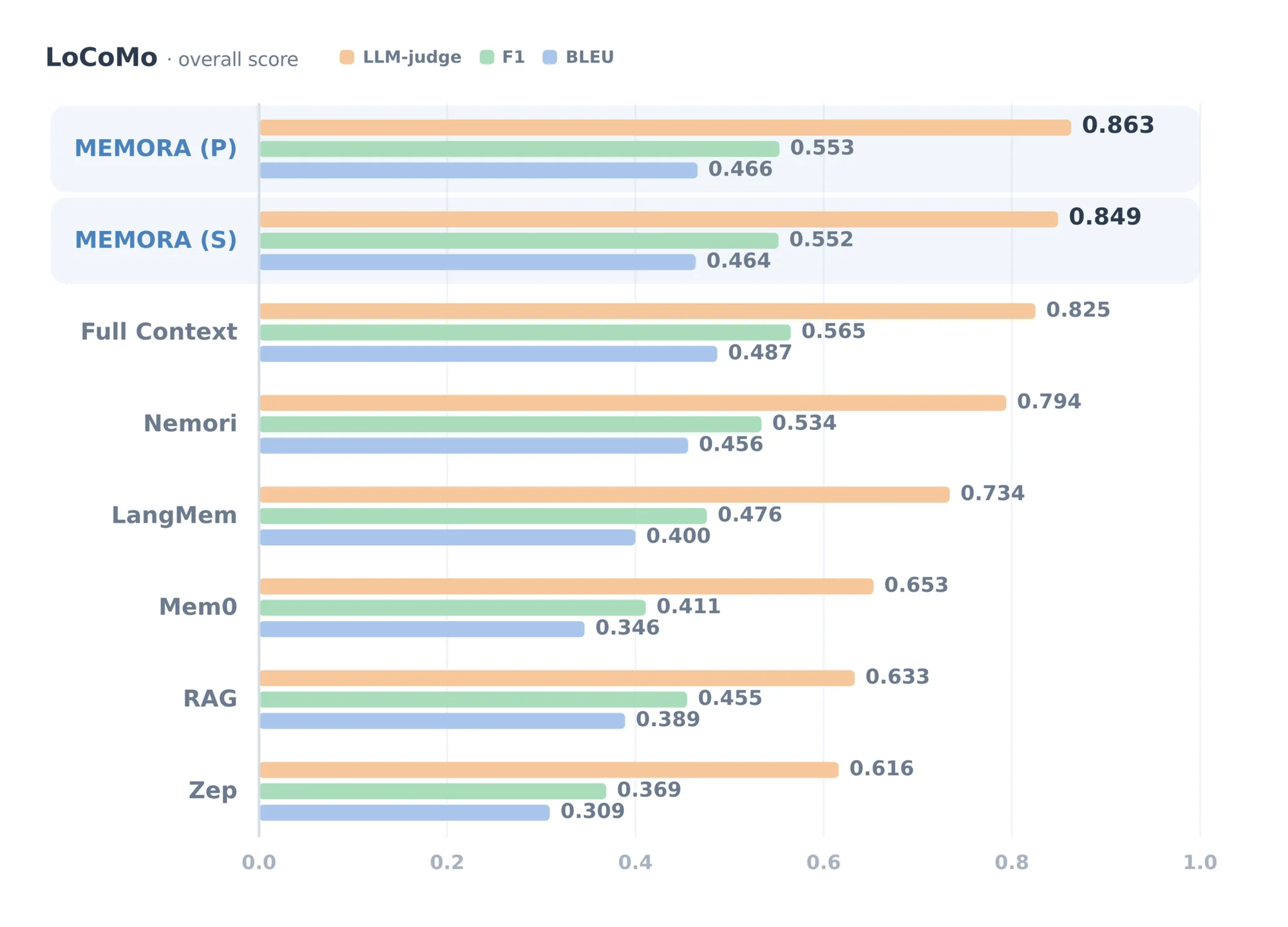
Figure 2: Memora performance on LoCoMo dataset.
We evaluate Memora on two long-context benchmarks: LoCoMo, where dialogues average 600 turns, and LongMemEval, with 115,000-token contexts. Memora achieves new state-of-the-art performance on both: 86.3% LLM-judge accuracy on LoCoMo and 87.4% on LongMemEval, outperforming RAG, Mem0, Nemori, Zep, LangMem, and even full-context inference. The gap is largest on multi-hop reasoning, where Memora’s ability to traverse cue anchors pays the biggest dividends. The efficiency story is just as striking: Memora stores roughly half the memory entries per conversation that Mem0 does (344 vs. 651) and reduces token consumption by up to 98% relative to full-context inference. Less to read, less to store, better answers.
Looking forward
Memora’s design has implications beyond benchmark performance. We see this work as a step toward AI agents that can sustain long-term collaboration with users and accumulate organizational knowledge over months and years, not just within a single session. Building on this foundation, we are pursuing several complementary directions. MemLoop explores how memory systems can learn from retrieval and task failures, attribute errors to specific stages of the memory pipeline, and improve themselves over time. Deferred Memory investigates when memory construction should be postponed until sufficient context, evidence, or future utility becomes available, rather than committing prematurely to what should be stored. Group Memory examines how knowledge can be shared across teams and agents while preserving provenance, access boundaries, ownership, and sensitive context. We release our code alongside the paper and invite the community to build on this representation and explore what becomes possible when AI agents are no longer stateless.
Acknowledgements
We would like to thank Shantanu Dixit (Research Fellow) Paramaguru Harimurugan (Research Fellow), Rujia Wang, Victor Rühle, and Robert Sim for contributing to this project.
The source text above remains the property of its publisher and is reproduced for commentary.