Muse Glimmer: Meta's Return to Open-Weight Local Agentic Multimodal Models
Meta released Muse Glimmer, a 30B dense multimodal open-weight model under Apache 2.0 optimized for local agentic workloads, with 4-bit quantized versions around 18 GB, day-0 support in major serving stacks, and the promise of open Muse Spark 1.2.
On 10 August 2026, Meta released Muse Glimmer, a 30B dense multimodal model under the Apache 2.0 license, explicitly optimized for local agentic workflows. The release combines several previously separate constraints into one package: a permissive license that removes Llama-era usage restrictions, a 4-bit quantized footprint around 18 GB that fits in consumer 32 GB systems, speculative decoding for low-latency generation, and day-0 support across transformers, llama.cpp, vLLM, and NVIDIA NIM.1234
The constraint that moved is the viability of running an always-on, multimodal agent entirely on local hardware without licensing friction. Earlier open Llama licenses restricted commercial use at scale and imposed usage conditions; Apache 2.0 removes those, and Meta itself ships calibrated quantizations plus a DFlash drafter. NVIDIA's claim of over 20K tokens/sec on Blackwell Ultra further suggests the dense 30B architecture can sustain interactive agent loops, though this figure is specific to high-end hardware.123
What would change my mind is evidence that the reported agentic gains are scaffold-dependent rather than model-inherent. The HF blog's benchmark table shows Muse Glimmer leading on MCP Atlas and DeepSearch QA, but trailing Qwen3.6-27B on OSWorld-Verified and SkillsBench. If third-party harness comparisons fail to reproduce a similar overall advantage—or if the logit-distillation from Muse Spark means the model inherits a ceiling from its teacher—then the 'agent-optimized' label would be less distinctive than claimed.12
Context
Muse Glimmer arrives amid an active open-weights cycle from Chinese labs (Qwen, DeepSeek) and after Meta's years of restricted Llama licensing. Zuckerberg's accompanying personal-superintelligence essay frames the release as part of a broader strategy to put capable agents in individuals' hands, and the promise of an open Muse Spark 1.2 suggests Glimmer is the first step in a staged open release. Technically, the model marries a 2B perception encoder with a 28B text decoder using hybrid SWA/full attention, gated grouped-query attention, and QK-normalization.12
Assessment
Evidence strength is moderate but not yet rigorous. The Hugging Face and NVIDIA blogs provide checkable integration code and hardware guidance, yet benchmark numbers are self-reported, without variance or reproducibility details. Simon Willison's hands-on tests corroborate that the 4-bit model runs in LM Studio and can perform vision description and a coding-agent task, but they do not substantiate the benchmark claims. Third-party analysis reported in Latent Space places Glimmer at 35 on the Artificial Analysis Intelligence Index, below Qwen3.6-27B, and flags weak hallucination calibration.1234
Caveats
Key caveats: (1) The benchmark tables and performance figures come from Meta and NVIDIA, not independent evaluators; (2) the 18 GB footprint is a 4-bit quantization, and full BF16 weights are roughly 60 GB, so the local-fit claim depends on quantization; (3) the announced open Muse Spark 1.2 release, if stronger, could quickly supersede Glimmer; and (4) '20K tokens/sec' applies to Blackwell Ultra at BF16/NVF4, not typical consumer hardware. If these caveats are borne out, the strategic significance of this exact release would diminish.1234
Cross-source check
4 sources
Agreed
Muse Glimmer is a 30B dense, multimodal, open-weight model released by Meta.Hugging FaceNVIDIA Technical BlogSimon WillisonLatent Space
Muse Glimmer is released under the Apache 2.0 license.Simon WillisonLatent Space
The model is designed for agentic workloads and local deployment, including long-horizon tool use and always-on operation.Hugging FaceNVIDIA Technical BlogSimon WillisonLatent Space
Quantized versions of Muse Glimmer are around 18 GB in 4-bit, enabling local execution on systems with roughly 24-32 GB memory.Simon WillisonLatent Space
Muse Glimmer launched with immediate support in major serving and tooling libraries, including transformers, llama.cpp, vLLM, and NVIDIA NIM.Hugging FaceNVIDIA Technical BlogLatent Space
Disputed
Benchmark positioning and capability assessment
Hugging Face
Self-reported table shows Muse Glimmer leading on many agentic benchmarks (MCP Atlas 75.5, DeepSearch QA 74.6) but trailing on OSWorld-Verified (65.9 vs 75.6) and SkillsBench (44.3 vs 46.6).
Latent Space
Third-party Artificial Analysis places Muse Glimmer at 35 on the Intelligence Index, below Qwen3.6-27B (38), and notes weak hallucination/knowledge calibration despite strong tool-use follow-up.
Reported by one source only
Meta distributed calibrated quantized GGUF checkpoints; the DFlash drafter was trained with a block size of 16 (one anchor plus 15 proposed tokens).Hugging Face
Muse Glimmer delivers over 20K tokens/sec/GPU on NVIDIA Blackwell Ultra at BF16/NVF4 precision and fits on a single RTX 5090, DGX Spark, DGX Station, or Jetson; NVIDIA provides a NIM container and NeMo AutoModel post-training.NVIDIA Technical Blog
Simon Willison's informal tests show the quantized model runs in LM Studio and can generate a detailed visual description and complete an llm-coding-agent exploration of Datasette.Simon Willison
Muse Glimmer was logit-distilled from Muse Spark and trained from the outset on agentic traces, not as a base-then-post-train release.Latent Space
An open-weight Muse Spark 1.2 release is coming soon.Latent Space
Introducing Muse Glimmer (via) Meta are back in the open weights game! Muse Glimmer is a brand new 30B model under a clean Apache 2.0 license (a step up from the janky Llama licenses of old).
They claim to have optimized it for exactly the kind of things I'm looking for in a local model:
End-to-end Agentic Task Completion. Muse Glimmer achieves strong success rates on full-task benchmarks including DeepSearch QA, MCP-Atlas, 𝛕-Bench and SWE-Bench, which measure its ability to work within scaffolds, write and debug code, and resolve multi-turn requests from start to finish. Reliable Tool Use. The model handles a wide range of function calls, invoking tools with precise schemas throughout extended workflows. Multi-Step Reasoning. Muse Glimmer chains reasoning over long horizons, sustaining coherent plans across complex, extended workflows. [...]
Here's a pelican which I generated using LM Studio's 18.16 GB version of the model:
I also tried it out with my llm-coding-agent plugin, running against a fresh checkout of Datasette with the prompt:
how does auth work?
Here's the response, at the end of a long transcript showing all of the tool calls it made to explore the codebase. I ran this using llm-lmstudio with this patch applied to upgrade it for compatibility with LLM 0.32.
I really like this size of model, because if a machine has 32 GB of RAM or more (mine has 128GB) it leaves plenty of space for running other applications at the same time.
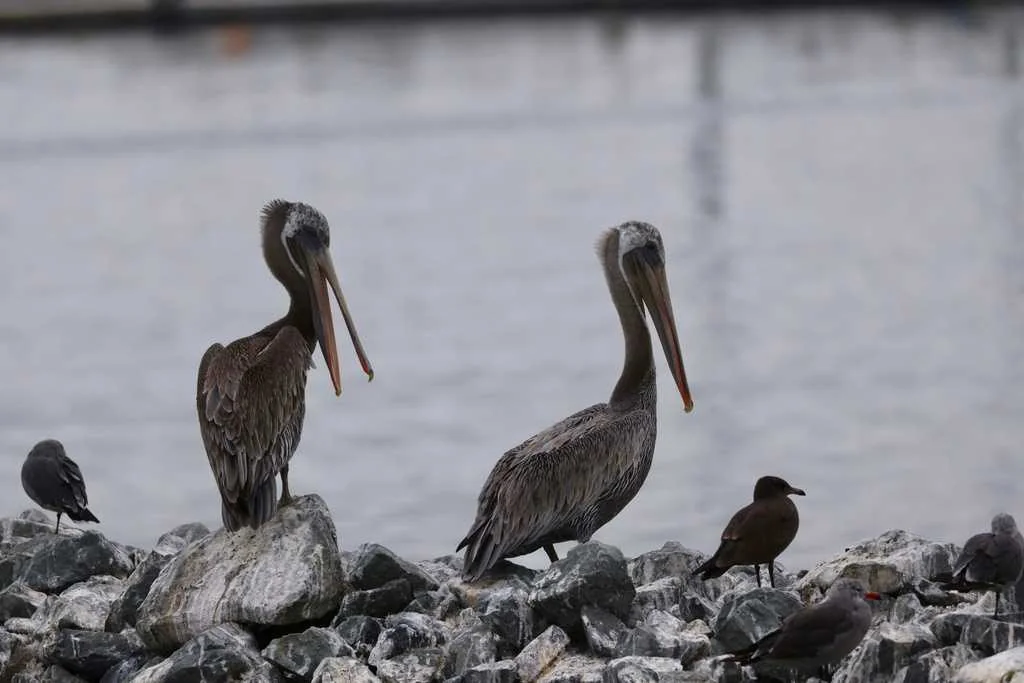
Glimmer is a vision model, so I asked it to describe this image:
llm -m lmstudio/meta/muse-glimmer -a https://static.inaturalist.org/photos/714731804/large.jpg 'describe image'
Here's what I got back:
The photograph shows a rocky, breakwater-style shoreline on an overcast day with a smooth, gray body of water and a faint dock/pier line in the soft-focused background. In the foreground two large brown pelicans, Pelecanus occidentalis, are perched on the jumbled gray-white stones. They have the species’ characteristic long, down-curved yellow-orange bills with a large throat pouch, long slender necks and mottled brown-gray plumage on the back and wings. The pelican on the left is turned slightly toward the camera and appears to be preening or resting its bill against its chest; a pale, whitish patch is visible on the crown and nape and a small crest of feathers is raised. The pelican on the right faces mostly forward/right, its head up, bill pointing down and to the right, with the same pale head markings and the barred, darker wing feathers clearly visible. Scattered among the rocks around the two pelicans are several much smaller dark birds — gulls/tern-like birds in muted brown-gray plumage. One dark bird sits on the far left on a rock, another brownish bird stands to the right of the right-hand pelican, a grayish bird with a reddish bill is in the lower right foreground, and a further small dark bird is at the extreme right edge of the frame. The overall light is flat and diffused, giving the water and sky a muted, almost monochromatic palette that contrasts with the textured rock and the detailed feathering of the pelicans. The composition places the two big birds as the dominant subjects, framed against the calm water and the low, rocky perch.
Recent articles
Qwen 3.8 27B is excellent, but it defaults to wildly overthinking things - 16th August 2026
Now we have a timeline of the OpenAI accidental attack against Hugging Face - 7th August 2026
One-shotting a Raccoon Heist game using Claude Fable 5 - 5th August 2026
The source text above remains the property of its publisher and is reproduced for commentary.
Focuses on NVIDIA's hardware support and local deployment for Meta's newly released Muse Glimmer model, highlighting performance benchmarks and deployment options.
News roundup from Latent Space, focusing on Meta's return to open weights with Muse Glimmer and the accompanying personal superintelligence essay, while also summarizing other AI developments of the week.

![[AINews] Muse Glimmer and Spark: Open Weights return Personal Superintelligence promise](/media/b7/b730f36dba10466c89891ab63e7de4b0abf223496582ee33df43d73ac8f8f4d6.webp)