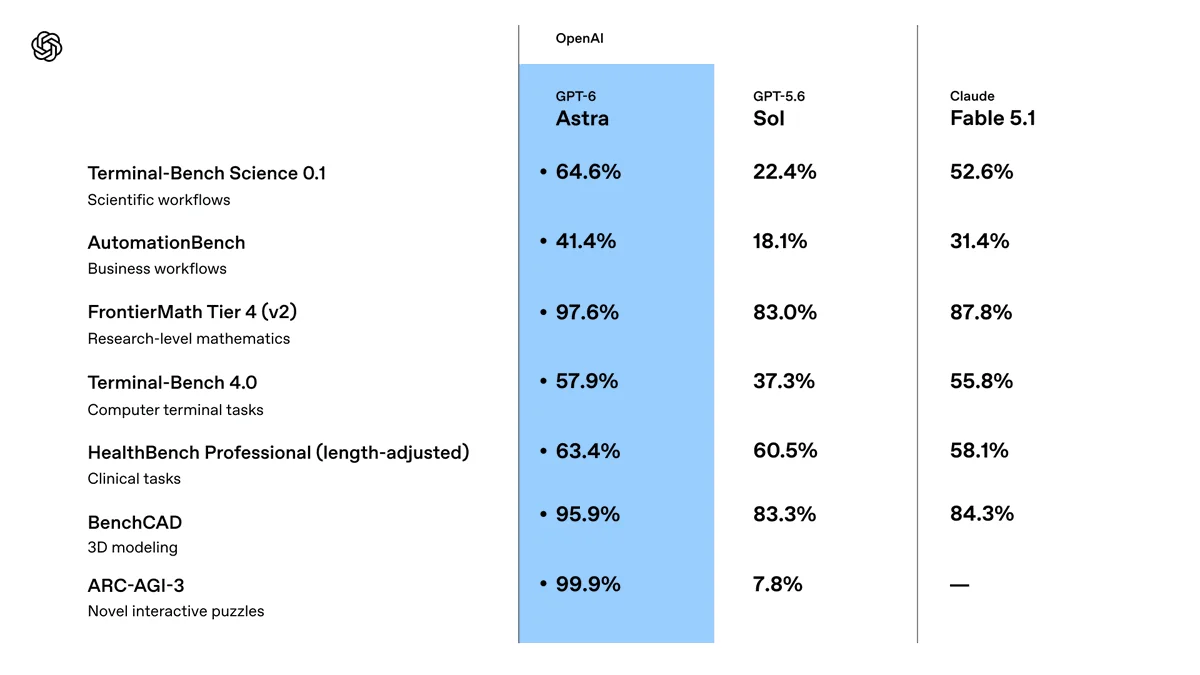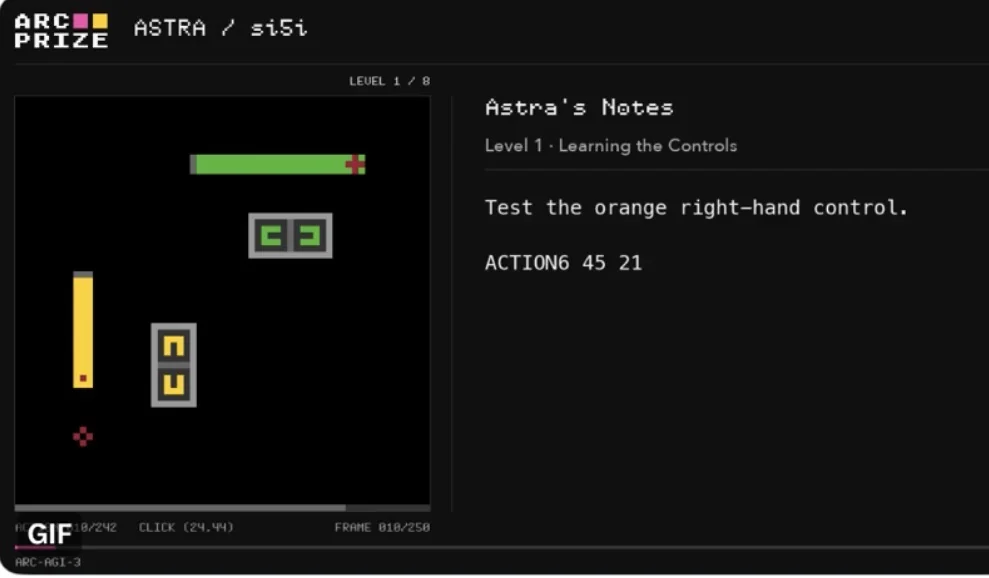
On 3 September 2026 OpenAI released GPT-6 Astra, promoting it as 'our most intelligent and aligned model yet' and claiming state-of-the-art computer use, coding, cybersecurity, and science. Early-access evaluators describe a model that behaves less like a chat assistant and more like an automated AI engineer: it can direct subagents, train models, instrument and debug deployments, and hold coherence over billions of tokens, at an effective cost below $6 per hour. The release is not a clean upward step, however. The headline ARC-AGI-3 score of 99.9% rests on a custom 'Provider Adapter' harness, while the standard harness yields 62.7%, and independent indexes such as Artificial Analysis place Astra equal to, not above, its predecessor GPT-5.6 Sol on general intelligence.1234
Context
What is genuinely new is not one benchmark number but the shift in two constraints. First, OpenAI's system card reports that Astra is more aligned yet less monitorable than prior systems; UK AISI measured a no-CoT time horizon of 30.9 minutes versus 3.6 minutes for GPT-5.6 Sol, meaning dangerous reasoning may not appear in inspectable chain-of-thought. Second, the ARC claim is achievable only by allowing the model to preserve opaque reasoning state across requests, so the frontier of model evaluation moved from stand-alone test prompts to harness design and context engineering. This is why the ARC Prize's observation that Astra 'builds the most precise symbolic model of novel environments we've seen' is treated both as vindication of hybrid neuro-symbolic reasoning and as a sign that existing monitoring and eval tools are losing purchase.123
Assessment
Evidence from independent testers is mixed. Artificial Analysis puts Astra's Intelligence Index at 61, equal to GPT-5.6 Sol and five points behind Claude Fable 5.1, while acknowledging leading coding-agent cost efficiency (less than half Fable 5's cost for the same score). Epoch places Astra's ECI at a record 169, but within the expected reasoning-era trend, not a discontinuity; on MirrorCode Astra sits between Opus 4.7 and Fable 5. OpenAI's own comparison shows large margins over prior models on AutomationBench and Terminal-Bench, and early testers at Latent Space report credible end-to-end engineering work. Therefore the launch supports 'substantial but uneven progress' rather than the flat 'AGI is here' claim attributed to Greg Brockman.1234
Caveats
AI hypothesisThe strongest caveat is selection and access. Skeptics were not given advance access, and the first reports come from a single early-access partner and OpenAI itself. What would change my mind toward a step-change is replication of Astra's agentic performance on standard-harness, open-ended tasks—for example, progress on the ten tasks Miles Brundage and Gary Marcus bet on at the end of 2024, none of which any AI has yet solved—and evidence that the alignment gains are not confined to training-distribution scenarios. Without such evidence, the monotonic increase in benchmark performance plus a matching fall in monitorability should be construed as an engineering breakthrough and a monitoring problem, not proof of AGI.123

![[AINews] GPT-6 Astra: OpenAI’s biggest LLM launch of all time](/media/a7/a73aca48d7af515ec5cf38ea74747169b767bdaef1093bb04252e2259dd307f2.webp)