Granite 4.2: Open Dense Reasoning LLMs with 512K Context and Agentic RL
Granite 4.2 introduces three Apache-2.0 dense decoder-only reasoning LLMs (3B, 8B, 30B) pre-trained from scratch on ~15T tokens with a five-phase schedule extending context to 512K, followed by SFT and a multi-stage GRPO curriculum; the 8B and 30B models also receive real-environment agentic RL for SWE, terminal, and search. The source is a detailed technical design post with no benchmark results.
Granite 4.2 is IBM's first family of dense, decoder-only reasoning LLMs, released in three sizes (3B, 8B, 30B) under Apache 2.0. The document's actual novelty is not a single architectural invention but a fully specified training recipe: from-scratch pre-training on ~15T tokens, a five-phase context extension to 512K, SFT on a mixture of agentic and non-agentic data, and a staged GRPO pipeline in which the 8B and 30B models additionally learn agentic behavior in real sandboxed environments.1
Context
Earlier Granite releases were strong instruction-following assistants; Granite 4.2 adds explicit reasoning. Every model supports thinking, non-thinking, and low-effort thinking modes plus native tool calling through an OpenAI-compatible endpoint. The 8B and 30B models are distinguished by an additional agentic RL block covering SWE, terminal, and web search, while the 3B model follows a shortened path without that block.1
Assessment
The document is unusually specific about the engineering recipe, giving architecture tables, SFT mixture breakdowns, per-stage hyperparameters, reward types, and rollout-turn counts for each RL environment. What is missing from the provided content is any results section or benchmark comparison; capability claims rest entirely on the authors' description of what the pipeline is designed to do.1
Caveats
AI hypothesisThe evidence is self-reported by the Granite Team, and terms such as 'real environments,' 'verifiable rewards,' or 'model quality' would need external checkable definitions or replication. What would change my assessment most is third-party benchmark results, public checkpoints with reproducible evaluations, or ablations showing the staged agentic RL block causes the claimed capability gains rather than the preceding SFT stages.1
TL;DR: Granite 4.2 is our first family of dense, decoder-only reasoning LLMs, released in three sizes: 3B, 8B, and 30B. Each model is pre-trained from scratch on roughly 15T tokens with a five-phase strategy that extends the context window to 512K tokens, supervised fine-tuned on chain-of-thought, reasoning, and agentic-trajectory data, then post-trained with a multi-stage reinforcement learning pipeline. That pipeline includes agentic RL, where the 8B and 30B models learn to act with tools inside real sandboxed environments. Every model has a thinking / non-thinking switch, a low-effort thinking mode that spends a short reasoning budget on easy questions, and native tool calling. All Granite 4.2 models are released under the Apache 2.0 license.
Links:
Granite 4.2 is the reasoning-focused release of the Granite language-model family. Earlier Granite releases were strong instruction-following assistants; Granite 4.2 adds explicit reasoning. Every model can produce a chain of thought before its answer and can run in thinking or non-thinking mode depending on how much deliberation a task needs. A low-effort mode falls between the two, spending a short reasoning budget on easy questions.
The three sizes (3B, 8B, and 30B) share the same architectural design and follow the same training pipeline (pre-training from scratch, SFT, then multi-stage RL), each at its own scale. All three are strong reasoners and instruction followers. The clearest capability split shows up in post-training. The 8B and 30B models additionally go through an agentic RL block that teaches them to operate as agents: calling tools, editing and running code, driving a terminal, and searching the web inside real environments. Every model supports native tool calling. Served through an OpenAI-compatible endpoint (for example, with vLLM), it emits tool calls in the OpenAI function-calling format and plugs into agentic harnesses without extra glue. Granite 4.2 is also supported in SGLang, see the SGLang cookbook for a ready-to-serve recipe.
The rest of this post walks through the build: architecture, pre-training, supervised fine-tuning, the multi-stage RL pipeline, and results.
Granite 4.2 models are built on a decoder-only dense transformer architecture with the following core components:
Attention: Grouped Query Attention (GQA) with 40 attention heads and 8 KV heads
Position Embedding: Rotary Position Embedding (RoPE) with θ = 10,000,000
Feed-Forward: MLP with SwiGLU activation
Normalization: RMSNorm (ε = 1e-5)
Embeddings: Separate input/output embeddings (not tied)
Precision: bfloat16
Component
3B Dense
8B Dense
30B Dense
Embedding size
2560
4096
4096
Number of layers
40
40
64
Attention head size
64
128
128
Number of attention heads
40
32
32
Number of KV heads
8
8
8
MLP hidden size
8192
12800
32768
MLP activation
SwiGLU
SwiGLU
SwiGLU
Sequence length
131072
131072
131072
Position embedding
RoPE
RoPE
RoPE
# Parameters
3B
8B
30B
Granite 4.2 is trained from scratch on approximately 15 trillion tokens using a five-phase training strategy. Phases 1–2 focus on foundational pre-training, phases 3–4 perform mid-training with progressively higher-quality data annealing, and phase 5 introduces long-context training, extending the context window to 512K tokens. Each phase uses a distinct data mixture and learning-rate schedule, gradually shifting from broad web-scale data toward more curated, high-quality sources.
The pre-training recipe closely follows the previous generation; for a detailed treatment of the data blend, phase schedule, and long-context extension, see the Granite 4.1 blog.
Supervised fine-tuning (SFT) turns the base model into a reliable instruction-following, reasoning, and tool-using assistant. The SFT data mixture combines agentic (31.6%) and non-agentic (68.4%) data, totaling approximately 7.2 million samples, or roughly 100B tokens, of which about 65B are trainable.
The agentic corpus covers a broad range of domains, including software engineering (SWE, 69%), tool calling (12.1%), terminal use (8.0%), math (3.5%), search (0.8%), and action (0.2%). These samples and trajectories are generated using a diverse set of agent scaffolds and harnesses, including OpenHands, OpenCode, Terminus-2, SWE-agent, OpenResearcher, MiniSWE, OpenSeeker, EnvScaler, Gemini CLI, Hermes, Codex, and Goose. The agentic data combines samples from both open-source datasets and our own synthetically generated RL environments, spanning a variety of agent–harness combinations.
The non-agentic corpus consists of several major categories: instruction following (18.8%), coding (18.8%), math (14.6%), multilingual (7.0%), science (5.4%), reasoning (3.0%), and safety (0.8%).
We apply multiple stages of quality control before a sample enters the final SFT mixture. First, data from different sources is normalized and reformatted into a consistent OpenAI Chat format, making the conversation structure and tool interactions uniform across datasets and scaffolds.
We then use GPT-OSS-120B and Gemma 4 as LLM-based judges to assess sample quality. Low-scoring samples are removed, as are samples containing hallucinated or fabricated information, invalid tool interactions, or tool calls to functions that are not defined in the corresponding tool list. Several targeted, dataset-specific heuristic rules are also applied where appropriate to further improve quality and remove known sources of noise.
Finally, we perform both local and global deduplication. Deduplication is based on SHA-256 hashes computed over the combination of the tools and messages fields, removing duplicate samples both within individual data sources and across the overall SFT mixture.
The complete corpus is first globally shuffled to reduce ordering effects and ensure that samples from different domains are well mixed during training. The shuffled corpus is then partitioned into equally sized .parquet shards, which are tokenized using the model's tokenizer and chat template and prepared for large-scale distributed training.
Before launching the final large-scale runs, we tune hyperparameters on representative configurations, sweeping learning-rate schedules, initial learning rates, and warm-up ratios to find settings that train stably across model sizes. The final training configuration is summarized below:
Parameter
Value
Compute
32–128 nodes (by model size), 4× Grace/GB200 per node
Sequence length (packed)
131,072 (128K)
Global batch size
128
Learning rate
1.0e-5, constant after warm-up; 3.0e-6 for Phase 2
LR warm-up
2.5% of train_iters
Training duration
~2 epochs
Parallelism
TP=2, PP=1, CP=4 or CP=2
For the 30B model, we additionally perform a second phase of SFT focused specifically on agentic coding. In this phase, agentic, SWE, and coding data are upsampled to increase their effective contribution to the training distribution, while approximately 16% of the mixture is retained as replay data from the original SFT corpus.
The 30B model is then fine-tuned for roughly one additional epoch at a lower learning rate of 3.0e-6. This targeted second phase increases the model's exposure to agentic coding trajectories without discarding the capabilities acquired during the initial SFT phase.
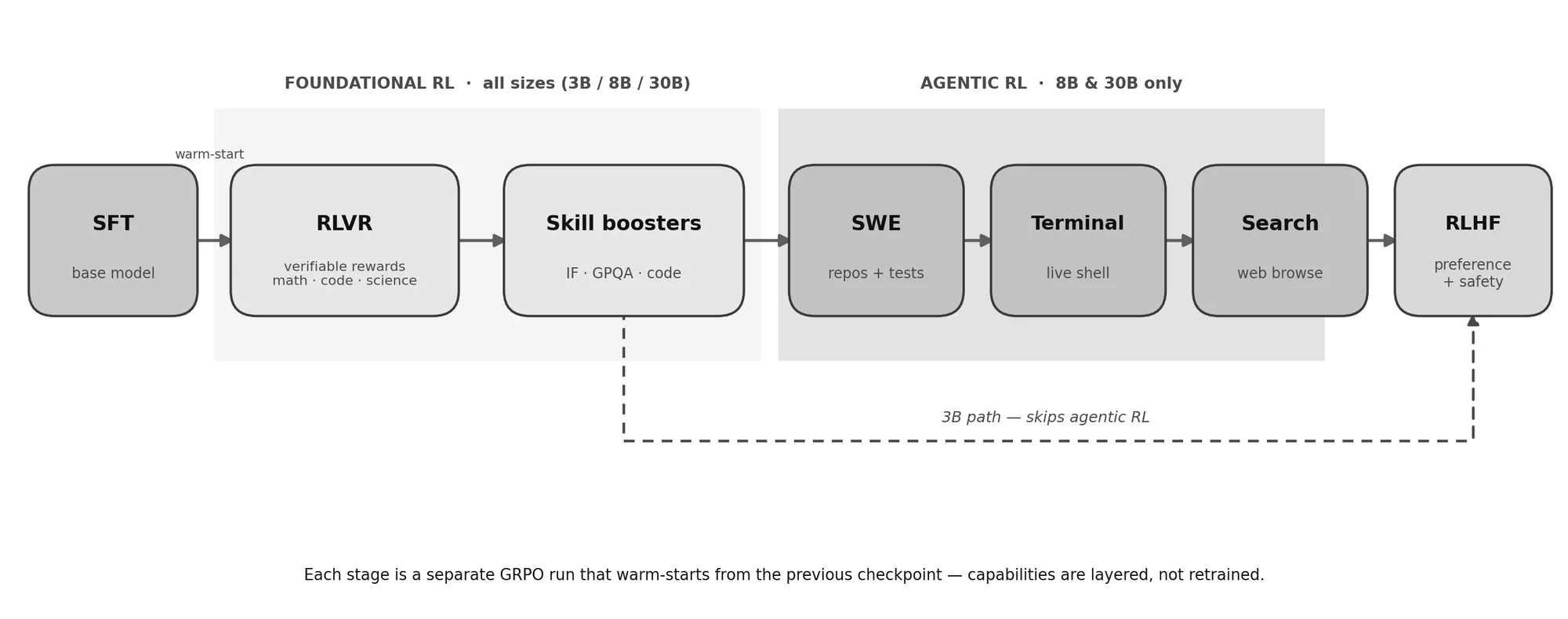
After SFT, we apply a multi-stage, multi-environment reinforcement learning pipeline. Rather than a single RL pass, we run a chain of focused stages spanning many environments: math, code, science, instruction following, tool use, and structured output, then software engineering, terminal use, and web search. Each stage is an independent RL run that targets one capability and warm-starts from the previous stage's checkpoint.
Figure 1. The staged RL curriculum. Foundational RL (verifiable rewards + skill boosters) runs for all sizes; the agentic RL block (SWE → Terminal → Search) runs for 8B and 30B only. Every model finishes with RLHF. Each stage is a separate GRPO run that warm-starts from the previous checkpoint.
Every stage trains with asynchronous GRPO (Group Relative Policy Optimization), so the generator and trainer halves of the loop never block on each other. A pool of generation workers keeps sampling responses and dropping the finished trajectories into a shared buffer; once the buffer holds a full step's worth, the trainer pulls that batch, takes an optimizer step, and streams the updated parameters back to the generator workers without pausing them. A refresh can land partway through a rollout, leaving a single trajectory stitched together from two adjacent policy versions. We allow this instead of paying to prevent it: the workers reuse their existing KV cache rather than rebuilding it after each refresh, and the one guardrail is a limit that keeps them from drifting more than a single update behind the trainer, which bounds how off-policy any sample can get. Whatever mismatch survives that limit is handled in the objective by truncated importance sampling, which clamps the train-versus-generation log-probability ratio to a fixed ceiling so a handful of stale tokens cannot dominate an update.
Advantages are group-relative with a leave-one-out baseline: each response is judged against the mean reward of the other samples drawn for the same prompt, which removes the need for a separate value network. To make this concrete, take RLVR, the first and longest-running stage: each step pairs 256 prompts with 16 sampled responses apiece for a 4,096-example batch, which the trainer consumes in a single optimizer step before the next rollout begins. Later stages keep this machinery unchanged and adjust only the per-stage shape, shown next.
The pipeline keeps a common backbone of hyperparameters across every stage, which makes the curriculum easier to run and compare. A handful of knobs are fixed everywhere:
Parameter
Value (shared across stages)
Algorithm
GRPO (no value network; group-relative advantages)
Training stack
NeMo-RL (Megatron-Core + vLLM) with NeMo-Gym environments
Ratio clip (min / max)
0.2 / 0.28
Micro-batch size
1
Parallelism
tensor-parallel 2–4; no pipeline- or context-parallelism
What changes from stage to stage is the shape of each run: how many prompts and generations per step, how long the context is, whether the agent loop runs, and how hard we pull back toward the reference policy. The table below gives the exact settings for the 30B chain, stage by stage:
Stage
Prompts/step
Gens/prompt
Max seq len
Rollout turns
KL
LR
RLVR (×3)
256
16
64K
1
0
5e-7
IF booster
256
16
64K
1
0
5e-7
Code booster
64
16
64K
1
0.05
5e-7
SWE 1
64
16
128K
1
0.01
5e-7
SWE 2
32
16
128K
128
0
5e-7
Terminal
8
32
64K
64
0.01
1e-6
Search
32
16
128K
64
0.01
5e-7
RLHF
128
16
48K
1
0.05
5e-7
Parameters shown for the 30B model. Global batch size = prompts/step × generations/prompt (e.g. 256 × 16 = 4096 for RLVR). The 3B and 8B models use the same recipe and hyperparameters with fewer stages (see How the Three Sizes Differ); the stage list is what changes, not the knobs.
The KL schedule follows the reward type: explore freely where the reward is objective and verifiable (RLVR and SWE 2 run at KL 0), and stay close to the reference where the objective is preference, safety, or a narrow skill graft (RLHF and the code booster use KL 0.05). The rollout-turns column counts the environment interactions GRPO itself sees per rollout. In every case the model is trained on complete, real-environment trajectories.
Each stage is a separate RL run with a single objective and its own reward signal. When it finishes, its policy is exported to Hugging Face format and becomes the base model for the next stage, so the pipeline is a sequence of warm-starts:
Did the model actually solve a task in a real environment?
SWE · Terminal · Search
Verifiable rewards are objective and hard to game, so the pipeline front-loads them. Judge- and preference-based rewards handle open-ended qualities that no checker can express. Agentic-outcome rewards are the sparsest: often a single bit at the end of a long tool-use trajectory.
RLVR is the foundational stage and the broadest data mix in the pipeline: a single blended dataset spanning many verifiable domains.
Math: chain-of-thought with boxed-answer checking, plus formal proving in Lean
Competitive coding: solutions checked against hidden tests in a sandbox
STEM / graduate-level science MCQA and general knowledge
Instruction following: structured-output and inverse-instruction tasks
Tool / function calling: single-step tool use
Reasoning puzzles and abstention (knowing when to refuse)
Each task type carries its own verifier, so the reward is grounded per example. RLVR runs for two rounds on 3B and 8B, and three on 30B. Each round is a fresh warm-started run on a re-weighted mix of public and internally curated RL data.
After RLVR, a few short booster stages sharpen specific capabilities that benefit from concentrated training focusing on the following domains:
Instruction following (IF): multi-turn chat, inverse-IFEval, structured outputs
Code: competitive coding only
Boosters are small, focused runs. A light KL penalty keeps the model close to its current behavior while nudging one skill.
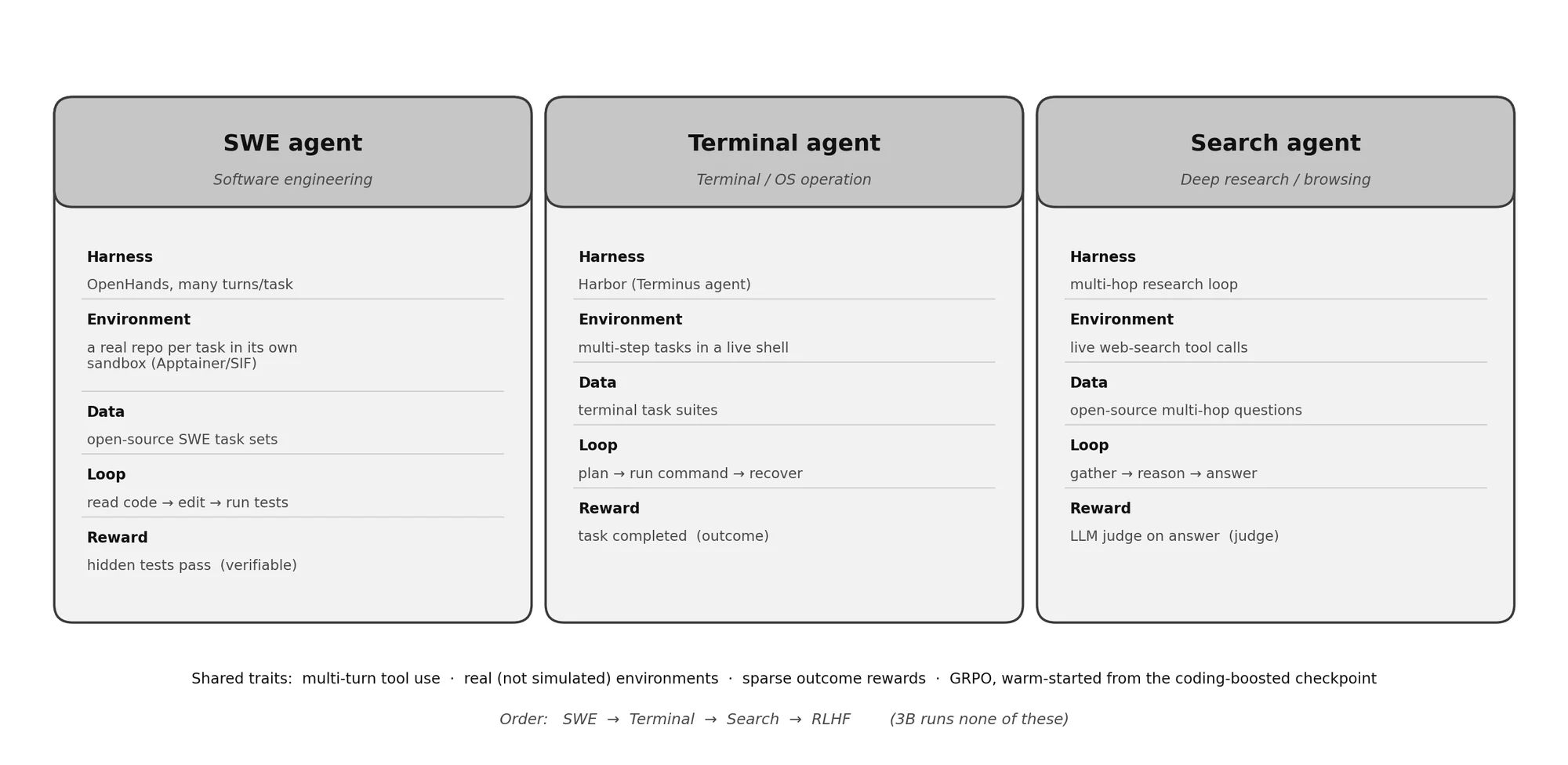
In the agentic stages the model learns to act: call tools, observe results, and iterate inside a real environment, rewarded on whether the task was actually solved. These stages share the same shape: multi-turn tool use, real (not simulated) environments, sparse outcome rewards, and GRPO, warm-started from the coding-boosted checkpoint. They run in order: SWE → Terminal → Search.
Figure 2. The three agentic-RL environments. Each pairs a real harness with a real environment and a sparse, outcome-based reward. The 3B model runs none of these.
SWE agent (software engineering). Each task is a real repository in its own sandbox. Driven by the OpenHands harness, the model reads code, edits files, and runs the test suite over many internal turns. The reward is verifiable: do the hidden tests pass? Tasks are drawn from open-source SWE datasets, each instance backed by a per-repo container image.
Terminal agent (terminal / OS operation). Multi-step tasks in a live shell, run through the Harbor / Terminus-2 agent harness. The model plans a sequence of commands, observes their output, and recovers from errors. Reward is assigned when the task completed successfully. This is the one stage that drives its multi-turn agent loop at the GRPO level, with rollouts spanning up to 64 environment turns.
Search agent (deep research). The model answers hard, multi-hop questions using live web-search tool calls inside a browsing agent loop: gather evidence across hops, reason over it, and produce an answer. Because correctness here is open-ended, the reward is an LLM judge on the final answer.
The final stage of every model is RLHF for human preference and safety. It optimizes against a generative reward model (GenRM) for preference, plus a safety reward covering jailbreak resistance and appropriate refusals. This stage uses the highest KL penalty in the pipeline, aligning tone and safety without eroding the capabilities the earlier stages built. In addition to human preference and safety alignment, this stage also applies a reasoning-length penalty to discourage overly verbose reasoning behavior acquired during earlier stages.
Same method and infrastructure; the difference is how far up the ladder each model goes.
Stage
3B
8B
30B
RLVR (verifiable)
×2
×2
×3
Skill boosters
code
IF · GPQA · code
IF · code
SWE agent
—
✓
✓
Terminal agent
—
✓
✓
Search agent
—
✓
✓
RLHF (preference + safety)
✓
✓
✓
3B is a strong foundational-RL model; 8B and 30B add the agentic-RL block on top, learning to act with tools in real environments.
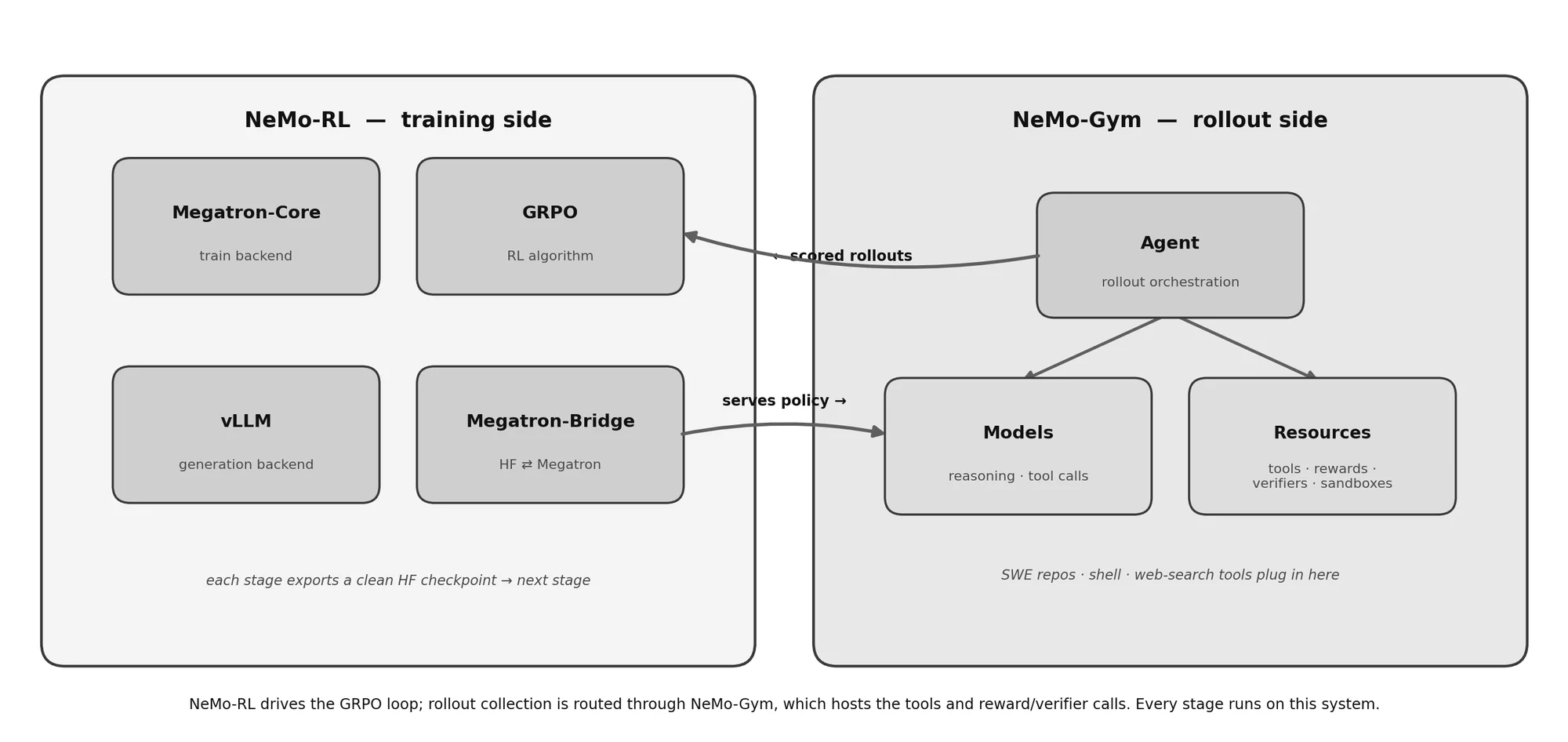
Reinforcement learning at this scale needs infrastructure that can drive a training loop and a fleet of live environments at the same time. This matters most in the agentic stages, where every training example is a multi-turn rollout that edits code, runs commands, or browses the web. Granite 4.2's RL runs on two open components: NeMo-RL on the training side and NeMo-Gym on the rollout side.
Figure 3. The RL system. NeMo-RL drives the GRPO loop (Megatron-Core training backend, vLLM generation, and Megatron-Bridge for HF⇄Megatron weight conversion). NeMo-Gym orchestrates rollouts and hosts the tools, sandboxes, and reward/verifier calls as pluggable Resources.
The division of labor:
NeMo-RL (training side). Megatron-Core is the training backend; vLLM generates rollouts; Megatron-Bridge converts weights between Megatron and Hugging Face formats, so each stage can export a clean HF checkpoint for the next one.
NeMo-Gym (rollout side). It exposes each environment as a set of Resources (verifiers, tools, sandboxes, and reward models) behind a uniform interface. This is the plug point for the agentic stages: the SWE repo sandboxes, the terminal harness, and the web-search tools all attach here, and to the training loop they look the same as a simple math verifier.
That uniformity is what makes the staged curriculum above practical: a booster's rule-based checker and a full SWE sandbox present the same interface to GRPO.
This split is also what makes the asynchronous training loop described above physically possible: generation and policy updates live on separate GPU pools, so the expensive generation fleet — including the live agentic environments — stays busy instead of idling through optimizer steps.
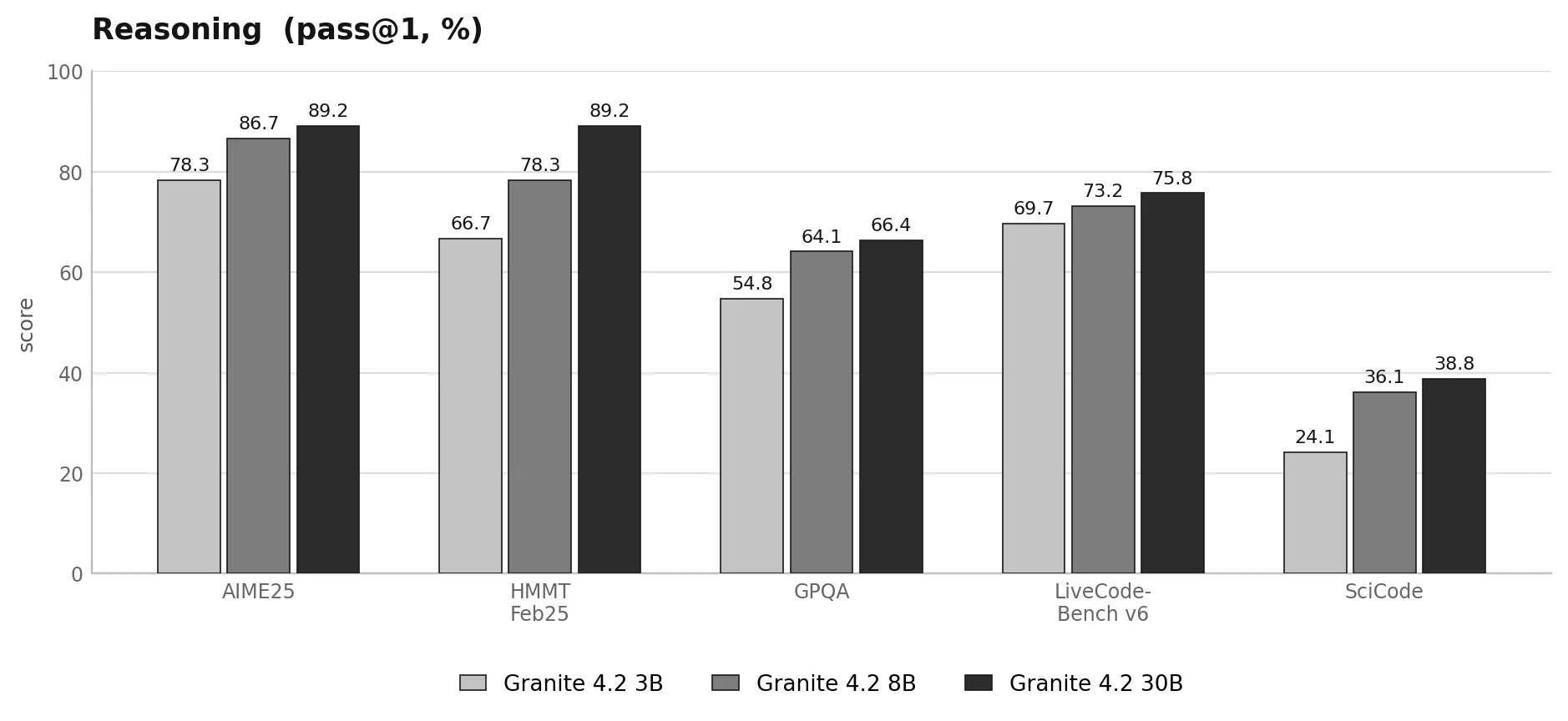
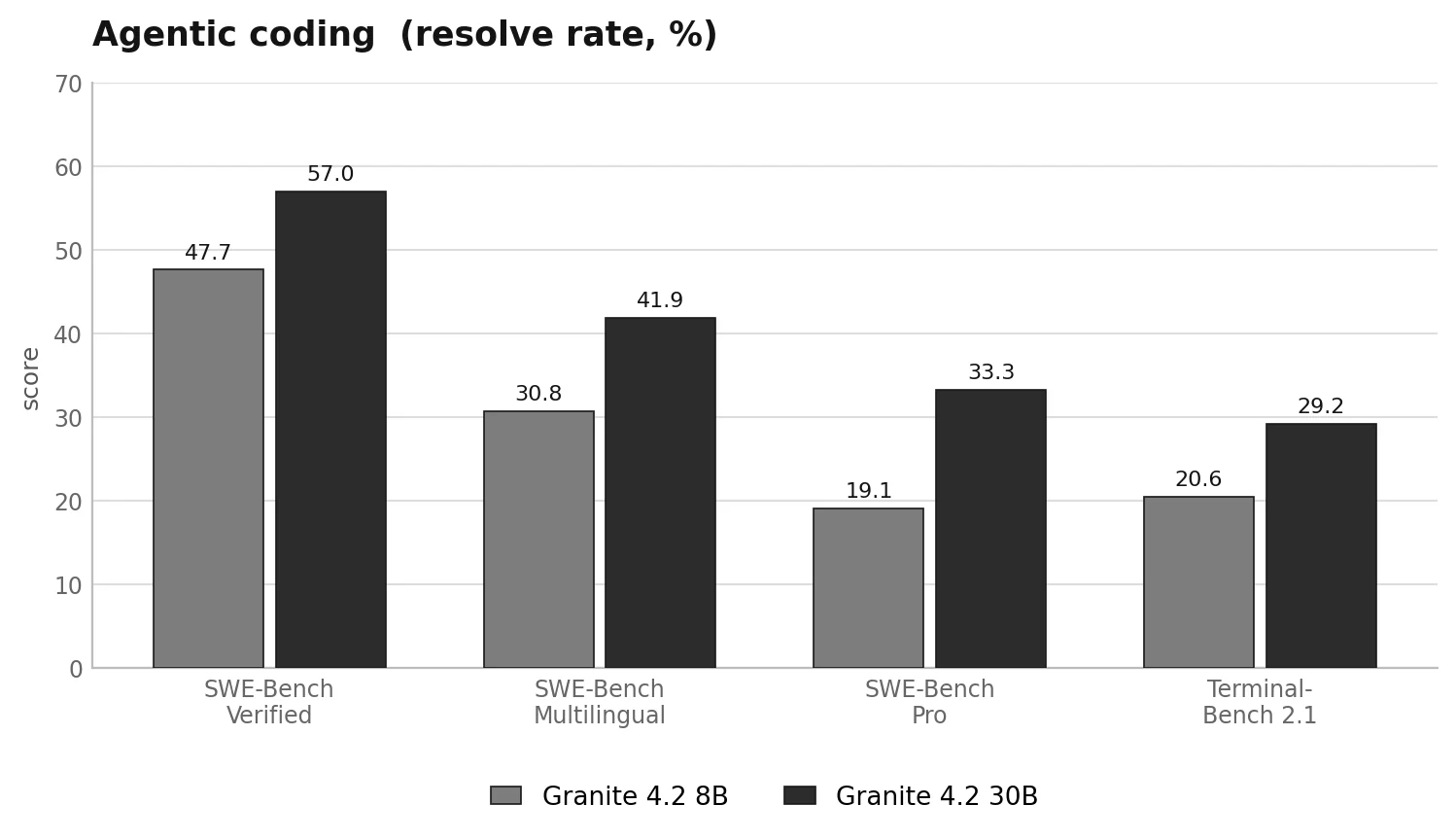
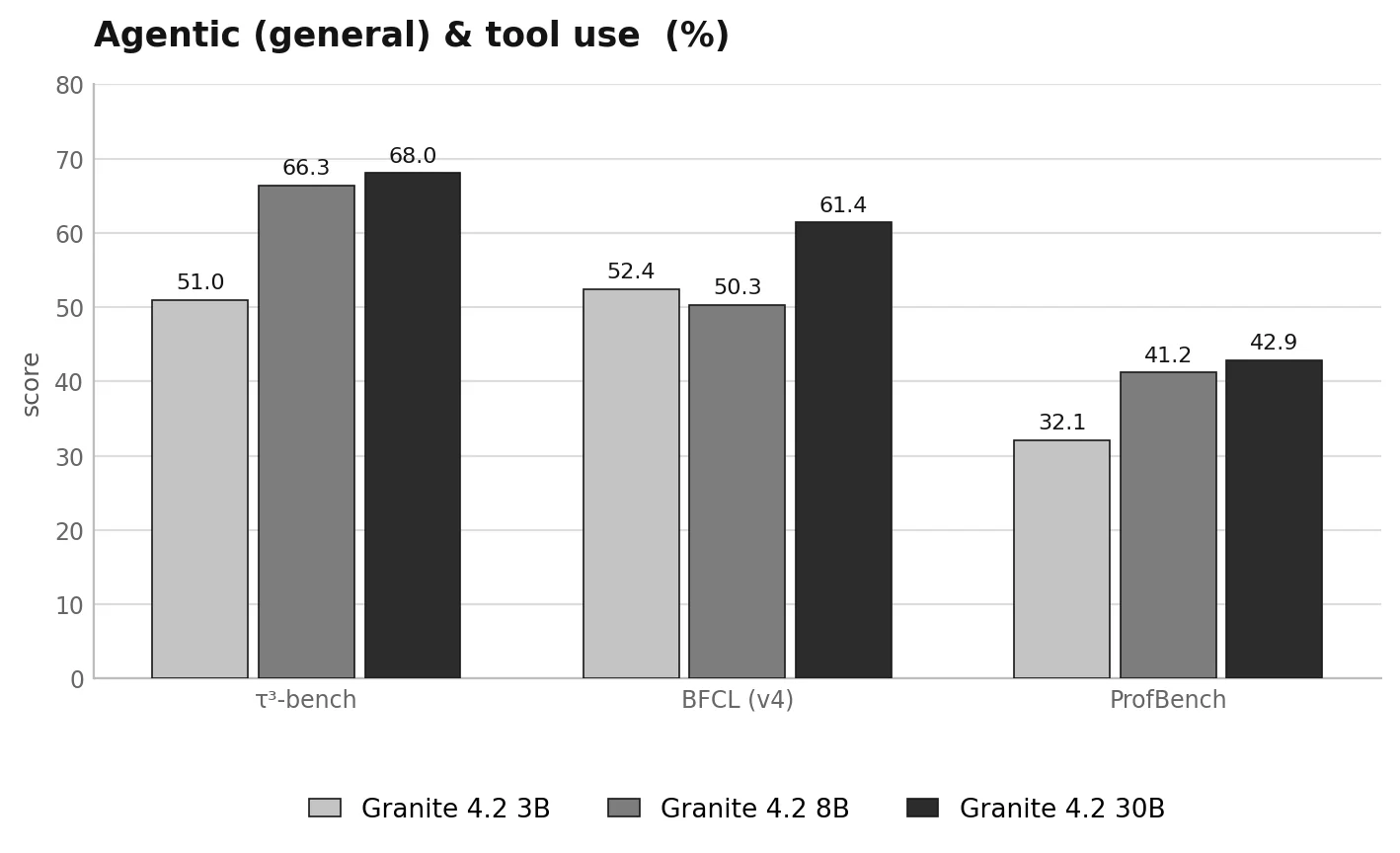
Granite 4.2 was evaluated across agentic coding, general agentic and tool use, reasoning, chat and instruction following, and long context. The full benchmark table is below, followed by charts that break out the headline results by model size.
The charts below break these results out by capability area.
Figure 4. Reasoning (pass@1). Scores rise consistently with model size across math (AIME25, HMMT), science (GPQA), and code reasoning (LiveCodeBench, SciCode).
Figure 5. Agentic coding resolve rates. The agentic-RL block is trained only for 8B and 30B; the 30B model leads across SWE-Bench variants and Terminal-Bench.
Figure 6. General agentic and tool-use benchmarks, reported for all three sizes.
We also released four quantized variants of the Granite 4.2 models for inference with vLLM. The models are converted to FP8, NVFP4, and MXFP4 using LLM Compressor, and to the GGUF format using the llama.cpp framework for reduced-memory deployment.
The FP8 version is quantized with dynamic per-channel weights and per-token activations. No calibration is used.
The NVFP4 and MXFP4 versions are quantized using GPTQ calibrated on 2K samples drawn from the SFT dataset. Max context length is 2K during calibration.
Conversion of the Granite 4.2 models to GGUF is done with the canonical llama.cpp tool as described in https://github.com/IBM/gguf#gguf-conversion--quantization.
Several GGUF formats are provided:
Q8_0
Q6_K
Q5_K_S
Q5_K_M
Q5_1
Q5_0
Q4_K_S
Q4_K_M
Q4_1
Q4_0
Q3_K_S
Q3_K_M
Q3_K_L
Q2_K
We trained the Granite 4.2 language models on an NVIDIA GB200 NVL72 cluster hosted by CoreWeave, featuring:
A 72-GPU NVLink domain for high-speed intra-rack communication
A non-blocking Fat-Tree NDR 400 Gb/s InfiniBand fabric for full-bandwidth inter-rack connectivity
Thousands of GPUs operating at cluster scale
This infrastructure delivers the high-bandwidth, low-latency communication required for efficient large-scale distributed training.
The training software stack is packaged into .sqsh container images, each giving a run a reproducible, portable environment with its SBSA-compatible CUDA targets, Linux aarch64 Python wheels, and GPU-specific binaries pinned. The large-scale SFT runs build on an NGC PyTorch base image (Ubuntu 22.04, CUDA 12.8, Python 3.12); the RL stack runs in its own NeMo-RL container.
import torch from transformers import AutoModelForCausalLM, AutoTokenizer model_path = "ibm-granite/granite-4.2-3b" tokenizer = AutoTokenizer.from_pretrained(model_path) model = AutoModelForCausalLM.from_pretrained(model_path, device_map="cuda", torch_dtype=torch.bfloat16) model.eval() messages = [ {"role": "user", "content": "How many r's are in the word 'strawberry'?"}, ] text = tokenizer.apply_chat_template(messages, tokenize=False, add_generation_prompt=True, enable_thinking=True) inputs = tokenizer(text, return_tensors="pt").to(model.device) with torch.no_grad(): output = model.generate(**inputs, max_new_tokens=8192, temperature=1.0, top_p=0.95, do_sample=True) print(tokenizer.decode(output[0][inputs.input_ids.shape[-1]:], skip_special_tokens=False))
Example Output
<think> Okay, let's see. The problem is to find how many 'r's are in the word 'strawberry'. First, I need to write out the word: s t r a w b e r r y. Now, I need to count the number of 'r' letters. Let's list each letter and check for 'r'. 1. s – not r 2. t – not r 3. r – yes, that's one 4. a – no 5. w – no 6. b – no 7. e – no 8. r – yes, that's two 9. r – yes, that's three 10. y – no Total r's = 3. </think> There are **3** r's in the word "strawberry".<|im_end|>
messages = [ {"role": "user", "content": "What is the capital of France?"}, ] text = tokenizer.apply_chat_template(messages, tokenize=False, add_generation_prompt=True, enable_thinking=False) inputs = tokenizer(text, return_tensors="pt").to(model.device) output = model.generate(**inputs, max_new_tokens=2048, temperature=1.0, top_p=0.95, do_sample=True) print(tokenizer.decode(output[0][inputs.input_ids.shape[-1]:], skip_special_tokens=False))
Example Output
<think></think>The capital of France is Paris.<|im_end|>
Granite models support tool calling with integrated reasoning: the model reasons about which tool to call and why before calling it. Tools are defined with the OpenAI function definition schema.
tools = [ { "type": "function", "function": { "name": "get_current_weather", "description": "Get the current weather for a specified city.", "parameters": { "type": "object", "properties": { "city": {"type": "string", "description": "Name of the city"} }, "required": ["city"] } } } ] messages = [ {"role": "user", "content": "What's the weather like in Boston right now?"}, ] text = tokenizer.apply_chat_template(messages, tokenize=False, tools=tools, add_generation_prompt=True, enable_thinking=True) inputs = tokenizer(text, return_tensors="pt").to(model.device) output = model.generate(**inputs, max_new_tokens=4096, temperature=1.0, top_p=0.95, do_sample=True) print(tokenizer.decode(output[0][inputs.input_ids.shape[-1]:], skip_special_tokens=False))
Example Output
<think> Okay, the user is asking for the weather in Boston right now. Let me check the tools available. There's a function called get_current_weather that takes a city parameter. I need to call that with the city set to Boston. </think> <tool_call> <function=get_current_weather> <parameter=city> Boston </parameter> </function> </tool_call> <|im_end|>
messages = [ {"role": "user", "content": "What's the weather like in Boston right now?"}, {"role": "assistant", "content": "<think>\nThe user wants to know the current weather in Boston. I should call get_current_weather.\n</think>", "tool_calls": [{"function": {"name": "get_current_weather", "arguments": {"city": "Boston"}}}]}, {"role": "tool", "content": '{"temperature": "72°F", "condition": "Partly cloudy", "humidity": "65%"}'}, ] text = tokenizer.apply_chat_template(messages, tokenize=False, tools=tools, add_generation_prompt=True, enable_thinking=True) inputs = tokenizer(text, return_tensors="pt").to(model.device) output = model.generate(**inputs, max_new_tokens=4096, temperature=1.0, top_p=0.95, do_sample=True) print(tokenizer.decode(output[0][inputs.input_ids.shape[-1]:], skip_special_tokens=False))
Example Output
<think> The tool returned the weather data for Boston: temperature 72°F, partly cloudy, humidity 65%. I need to present this information clearly to the user. </think> The current weather in Boston is 72°F, partly cloudy, with 65% humidity.<|im_end|>
messages = [ {"role": "user", "content": "What is 15 * 37?"}, {"role": "assistant", "content": "<think>\nLet me calculate 15 * 37.\n15 * 37 = 15 * 30 + 15 * 7 = 450 + 105 = 555\n</think>\n15 * 37 = 555"}, {"role": "user", "content": "Now divide that by 5"}, ] # Default: previous thinking is stripped to save context text = tokenizer.apply_chat_template(messages, tokenize=False, add_generation_prompt=True, enable_thinking=True, truncate_history_thinking=True) # To preserve full history: text_full = tokenizer.apply_chat_template(messages, tokenize=False, add_generation_prompt=True, enable_thinking=True, truncate_history_thinking=False)
Granite models can serve as the backbone for agentic coding tools. Because they support reasoning and tool calling through the OpenAI-compatible API, they integrate with popular agentic harnesses without extra adapters. Start the vLLM server, then follow the harness-specific instructions below.
OpenCode is an AI coding agent that runs in your terminal.
Then select the granite-4.2-30b model with /model or Ctrl+L in the interactive session.
For full documentation, see pi.dev/docs.
OpenHands is an AI software engineer that can plan, write code, and execute commands.
Install and launch OpenHands following the official installation guide.
Configure the LLM in the OpenHands settings with: Model: granite-4.2-30b Base URL: http://localhost:8000/v1 API Key: your vLLM --api-key value
Model:
Note: The openai/ prefix is required when connecting to OpenAI-compatible endpoints like vLLM. Refer to the OpenHands local LLM documentation for detailed setup instructions, troubleshooting, and alternative installation methods.
Resources:
The source text above remains the property of its publisher and is reproduced for commentary.