GPU-Accelerated SymNMF Clustering Scales to a Million Financial Instruments
NVIDIA's AdaptGrow solver and memory-optimized SymNMF formulation reduce peak storage from ~20n² to ~4n² bytes, enabling clustering of ~100,000 instruments on one GB200 and factorization of one million instruments across 16 nodes, while unifying correlation and tail-dependence inputs and detecting structural breaks.
NVIDIA's post introduces AdaptGrow, a single adaptive GPU solver that factors rolling correlation and tail-dependence matrices into hard clusters, soft factor loadings, and structural-break signals. The stated advance is a memory-efficient SymNMF formulation that cuts estimated peak storage from ~20n² to ~4n² bytes, which lets ~100,000 instruments fit on one NVIDIA GB200 and one million instruments be factored across 16 nodes.1
This is a practical constraint shift: dense SymNMF's memory footprint previously limited it to moderate instrument counts, and the distributed variant reduces inter-node communication to O(nk) by row-sharding the dependence matrix while keeping the factor matrix replicated. The constraint that moved is therefore memory and communication scaling, not the clustering objective itself.1
Context
The workflow builds on rolling return windows and two dependence inputs: absolute Pearson correlation for the body of the distribution and a tail pairwise dependence matrix for extremes. SymNMF rows give soft factor loadings; row-wise argmax yields hard labels. Structural breaks are detected by comparing adjusted Rand index across windows spaced a full window width apart, with a self-calibrating 3σ control limit.1
Assessment
The central claim—that the same solver adapts to clean and flat eigenspectra via full-batch versus block-stochastic gradients—is plausible but rests on synthetic benchmarks and a companion paper. What would change my assessment is replication on real returns data, end-to-end timings, or an independent implementation reporting comparable scaling and stability.1
Caveats
The post explicitly notes that the million-instrument results are separate distributed scale tests requiring the published 16-node configuration, that the gradient-selection threshold of five is empirical rather than universal, and that all 250-window results use a synthetic return stream with planted rank 24.1
Use AdaptGrow, a GPU-accelerated matrix factorization algorithm, to turn rolling correlation and tail-dependence matrices into hard clusters, soft factor loadings, and structural-break signals at single-GPU and multi-node scale
Quant strategies routinely group instruments for portfolio construction, risk aggregation, statistical arbitrage, and trade surveillance. Incorrect groupings can make concentrated positions appear diversified, obscure risk shared across nominal boundaries, and select statistical-arbitrage pairs whose relationships fail under stress.
The practical difficulty is that the right groupings are neither directly observable nor stable. Factor exposures drift, instruments change classifications, and dependencies can change sharply during market stress. A clustering pipeline must therefore separate routine variation from structural change and be inexpensive enough to rerun as new returns arrive.
There are two common ways to group instruments from a dependence matrix. Hard clustering methods are computationally cheap but assign every instrument to exactly one group, which breaks down at sector boundaries and masks the graded exposures that matter for risk budgeting. Soft factorization methods like SymNMF handle boundary instruments and produce usable factor loadings, but their dense matrix objectives have historically limited practical use to moderate instrument counts rather than the scale at which this problem actually lives.
This post covers a workflow that addresses both limitations. The workflow starts with rolling return windows and constructs two complementary inputs: absolute Pearson correlation for broad co-movement and the tail pairwise dependence matrix (TPDM) for joint behavior during extreme observations. SymNMF represents each instrument through a row of nonnegative factor loadings. Retaining the row provides a soft representation; taking its argmax produces a hard label.
A memory-efficient SymNMF formulation reduces peak storage from ~20n2 to ~4n2 bytes, which is what makes ~100,000 instruments fit on a single NVIDIA GB200. For larger problems, a distributed implementation row-shards the dependence matrix and reduces communication to O(nk) rather than O(n2), enabling factorization of one million instruments across 16 nodes. A single adaptive solver, AdaptGrow, handles both correlation and tail-dependence inputs by reading the eigenspectrum to choose between full-batch and block-stochastic gradients, eliminating the need to select or tune separate solvers for different input structures.
The result is a clustering pipeline that produces hard labels, soft factor loadings, and structural-break signals, reruns cheaply as new returns arrive, and scales from a single GPU to multi-node infrastructure without changing the solver interface.
A companion notebook, linked below, implements the full pipeline and reproduces all results in this post.
Scale is constrained first by memory. A dense FP32 dependence matrix requires ~40 GB for 100,000 instruments and ~4 TB for 1 million instruments. A naive SymNMF implementation also materializes several additional n x n intermediates. The trace-based formulation used here eliminates those intermediates, reducing estimated peak storage from approximately 20n2 bytes to 4n2 bytes plus smaller factor buffers. This change is what makes approximately 100,000 instruments fit on one high-memory GPU.
NVIDIA acceleration enters at each stage of the pipeline. PyTorch dispatches the dominant SH matrix multiplications to cuBLAS. cuSOLVER performs the spectral probe used for rank and solver selection. cuDF keeps optional Parquet ingestion and preprocessing on the GPU. For scale-out, PyTorch Distributed row-shards S while keeping a replica of H on each worker. NCCL all-gathers the row-sharded S H products and all-reduces the gradients, so communication operates on O(nk) data rather than the full O(n2) matrix. The environment is packaged with an NVIDIA NGC PyTorch container and cudf-cu13 .
In the companion paper, the 100,000-instrument matrix was distributed across four NVIDIA GB200 GPUs for faster execution, although its 40 GB input fits on one GB200. Across three seeds in FP32, AdaptGrow converged in 13.0 seconds on correlation and 12.4 seconds on TPDM. At 1 million instruments, the 4 TB matrix was row-sharded across 64 GB200 GPUs on 16 nodes; full-batch AdaGrad completed the correlation factorization in approximately 2 minutes, while AdaptGrow completed the TPDM factorization in approximately 4 minutes. These are individual factorization measurements, not end-to-end timings for all 250 temporal windows.
The workflow evaluates 250 rolling windows, approximating daily re-clustering over one trading year. The synthetic return stream contains two controlled events: instruments changing their planted group membership and several groups experiencing a joint tail-stress episode without changing membership.
This controlled setup verifies two different behaviors. Adjusted Rand index (ARI) should identify the membership change, while TPDM should expose the co-crash that ordinary correlation largely misses. For production use, replace the synthetic generator with a returns table while preserving the same windowing, dependence-estimation, factorization, and monitoring stages.
The million-instrument results are separate distributed scale tests and require infrastructure comparable to the published 16-node configuration.
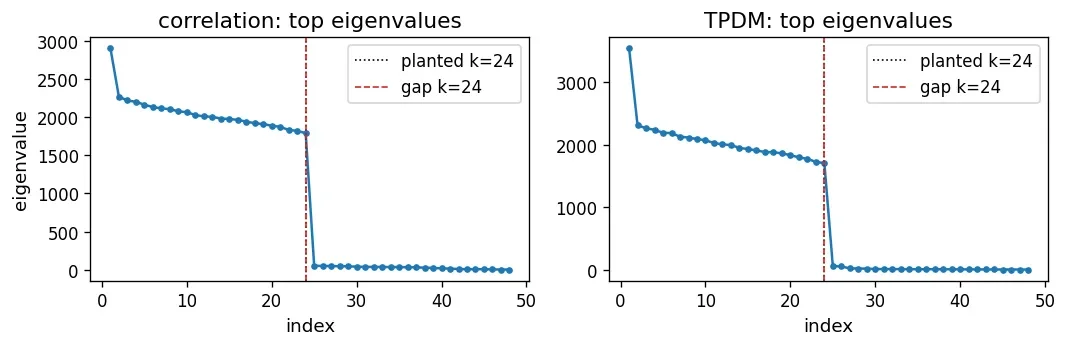
Start by inspecting the leading eigenvalues from an initial representative window. Choose k at the clearest separation between signal eigenvalues and the noise floor, then keep k fixed across subsequent windows so that stability scores remain comparable. The synthetic data used here has a planted rank of 24. Production data may not contain a sharp gap, so rank selection should also be checked against cluster interpretability and stability.
Figure 1. The correlation and TPDM spectra both recover the planted rank k=24 from the eigenvalue gap
For each rolling window, the workflow passes the dependence matrix S and selected rank k to AdaptGrow. The solver returns H, where each row of H contains an instrument’s soft factor loadings, and taking the row-wise argmax produces a hard cluster label.
Each window uses the same fixed-seed initialization and is fitted independently rather than warm-started, preventing previous labels from masking a genuine reclassification. AdaptGrow is a single adaptive solver that auto-configures from the matrix’s eigenvalue spectrum. Both regimes use the same per-coordinate AdaGrad preconditioner and differ only in how the gradient is computed. AdaptGrow seeds its batch fraction from the post-rank eigenvalue gap described in more detail below.
A clean gap selects the full gradient. A flatter post-rank spectrum starts with a cheaper block-sampled gradient corrected using Stochastic Variance Reduced Gradient (SVRG), then expands the sample toward the full gradient if progress stalls. The same solver runs unchanged from one GPU to many.
Mathematically, the diagonal AdaGrad update is defined as:
where g is either the full gradient ∇f(H) (full-batch branch) or a block-sampled estimate of it (stochastic branch), with all operations above being element-wise.
After selecting the factorization rank k, AdaptGrow examines the post-rank gap ratio \(\gamma_{k+1} = \lambda_{k+1} / |\lambda_{k+2}|\). The extra eigenvalue allows for a common factor, such as a market factor alongside the group-level factors. In the companion experiments, a large post-rank gap corresponded to shorter correlation-matrix runs, for which full-batch AdaGrad was most efficient. A flatter spectrum corresponded to longer TPDM runs, where lower-cost block-sampled gradients were more useful. AdaptGrow therefore starts with sampled SVRG updates when the gap is small and increases the sampled fraction toward the full matrix when progress stalls. The threshold of five used here is an empirical setting from these experiments, not a universal statistical cutoff. AdaptGrow algorithm sketch:
# phi is seeded from the post-rank eigenvalue gap: # gamma_{k+1} >= 5 selects the full gradient; otherwise start sampled def adaptgrow(S, k, lr, phi=None, steps=2000, eps=1e-8): phi = phi if phi is not None else seed_from_eigenspectrum(S, k) # fixed-seed init, independent per window (no warm-start) H = scale_matched_init(S, k) # diagonal (per-coordinate) AdaGrad accumulator G = torch.zeros_like(H) for t in range(steps): # clean post-rank gap if phi >= 1.0: g = 4 * (H @ (H.T @ H) - S @ H) # flat post-rank spectrum else: g = block_svrg_grad(S, H, phi) # same diagonal AdaGrad update either way G += g * g # projected step H = (H - lr * g / (G.sqrt() + eps)).clamp_min(0) # grow sampled fraction toward full gradient if stagnating() and phi < 1.0: phi = min(2 * phi, 1.0) return H
When only one label per instrument is required, spherical k-means provides a lower-cost baseline. It clusters the L2-normalized rows of S using cosine similarity, making it the appropriate comparison for SymNMF on this dependence geometry. The companion paper establishes the formal relationship between the two objectives. In practice, use spherical k-means for well-separated hard clusters and SymNMF when soft factor loadings or boundary instruments matter.
The same pipeline runs on two dependence matrices that share the latent structure but measure different things:
Correlation captures co-movement across the full return distribution, driven by the body of the data.
TPDM captures co-movement conditional on extreme events, which is what drives drawdowns and joint tail risk.
With k fixed and each window factored independently, the study is simple: factor every St, hard-label by argmax on H, and ask how the labels change as the window slides.
Since cluster labels are arbitrary across runs, pairs of instruments were compared instead. The ARI scores how often two clusterings put the same pair together or apart, giving 1 for identical clusterings and about 0 for unrelated ones.
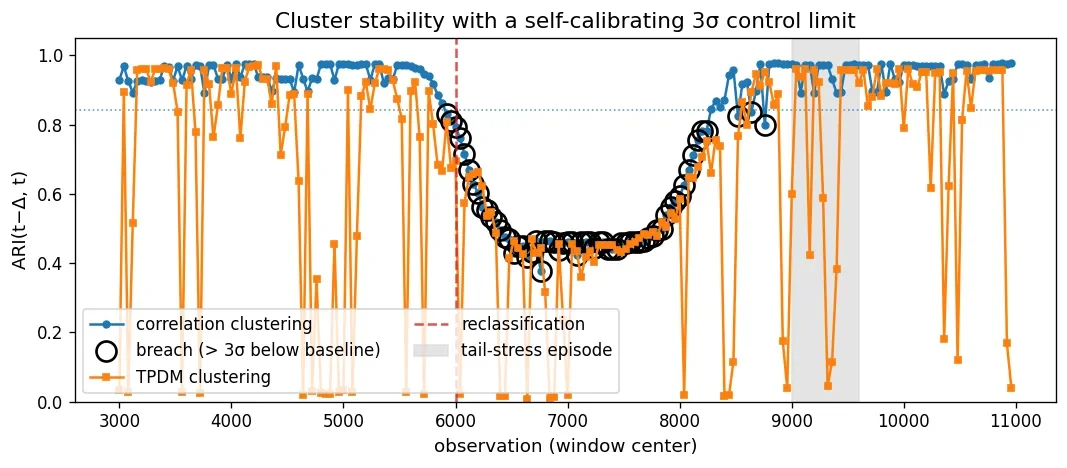
ARI(t-Δ, t) is tracked, comparing each window with the one a full window width earlier, where Δ = 50 steps is that width. Consecutive windows overlap by all but one stride, so a reclassification enters gradually and barely moves the step-to-step ARI(t-1, t); spacing the comparison a full width apart lets the accumulated change register as a real dip.
In this synthetic experiment, both curves sit high during the calm period (baseline ARI ≈ 0.93 for correlation and ≈ 0.80 for the noisier, tail-sensitive TPDM), then drop sharply when the window crosses the reclassification event before recovering.
To turn that dip into an alert, the workflow overlays a self-calibrating 3σ control limit: it calibrates on the calm pre-break windows and flags any drop below the limit, without any pre-set threshold.
Figure 2. ARI(t-Δ, t) stays high and stable in calm markets, breaches the self-calibrated 3σ limit at the reclassification, then recovers; the correlation curve stays quiet through the shaded tail-stress episode, since relabeling sees the membership change, not the co-crash
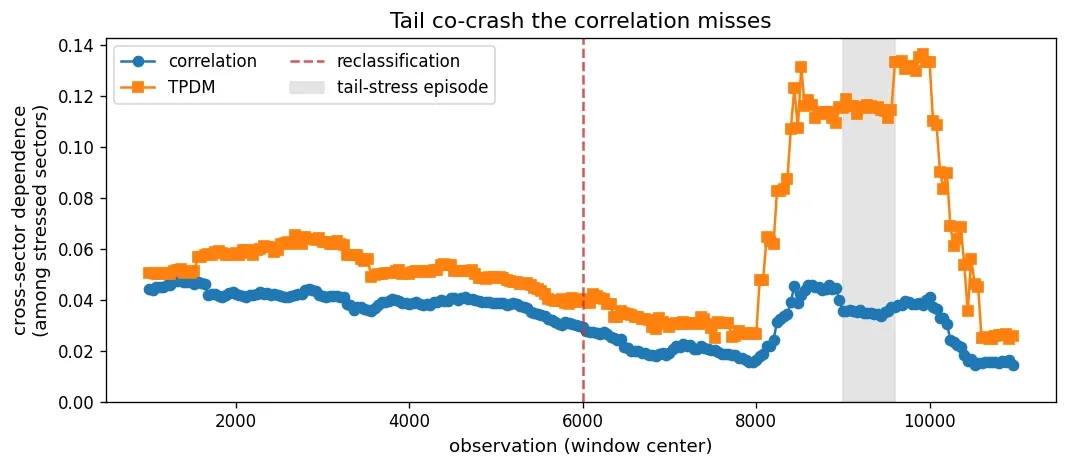
Why have different tail and body estimators? A co-crash changes co-movement, not group membership, so the relabeling metric doesn’t register it. The hard labels and the correlation curve stay unmoved, and by correlation the stressed sectors still look diversified.
To detect it, the cross-sector dependence is measured among those sectors directly, in each matrix, over time. At the crisis peak, correlation reads just ≈ 0.04 while the TPDM reads ≈ 0.13, several times higher, because the same sectors share tail dependence that correlation never registers. Off the diagonal, the correlation block stays dark while the TPDM’s stressed-sector block lights up. In this synthetic episode, the co-crash is muted in correlation but visible in the TPDM’s cross-sector dependence, even though the hard cluster labels do not change.
Figure 3. Cross-sector dependence among the stressed sectors: correlation stays near zero while the TPDM sits several times higher—the tail co-movement the body hides
In this synthetic experiment, the two methods recover the same broad structure but differ on a small, important subset of instruments. On the well-separated correlation matrix they reach a cross-method ARI of about 0.83, close enough that spherical k-means is a reasonable approximation but not interchangeable with SymNMF. About 9% of instruments sit at a boundary between clusters, which hard argmax must assign to a single group while the soft factorization keeps them split across both.
The two methods diverge further as the eigenvalue spectrum collapses toward a single dominant factor (the near-rank-1 TPDM regime the paper studies at scale). There every row of S aligns with nearly the same leading direction, so instruments are no longer separable by angle and a hard spherical partition is unstable.
SymNMF retains graded factor loadings in H, which is the useful output when hard cluster labels are no longer well defined. Spherical k-means is therefore the computationally more efficient choice when sectors are angularly well-separated and hard clusters are enough, while SymNMF provides results interpretable both as soft and hard clustering.
SymNMF’s dense objective previously limited practical implementations to moderate matrix sizes. The memory-efficient GPU implementation extends that capacity to approximately 100,000 instruments on one NVIDIA GB200 GPU and 1 million instruments across multiple nodes. AdaptGrow uses the eigenspectrum to select either full-batch AdaGrad or lower-cost block-stochastic updates, enabling the same workflow to adapt to clean-gap and flat-spectrum inputs.
The workflow applies this pipeline across 250 synthetic windows using both SymNMF and its matched spherical k-means baseline. The resulting soft loadings, hard labels, and stability diagnostics can support statistical arbitrage, momentum signals, market-neutral portfolio construction, exposure control, and risk budgeting while identifying structural breaks.
The companion notebook reproduces all results in this post, including:
Generating the synthetic return stream
Constructing rolling correlation and TPDM matrices
Selecting the factorization rank
Running SymNMF and spherical k-means
Deriving hard and soft cluster outputs
Calculating adjusted Rand index stability scores
Detecting the planted structural break
Reproducing the three figures in this post
Run clustering_through_time.ipynb end to end—rolling St, independent SymNMF fits, argmax labels, and the stability, tail-risk, and k-means figures. Deploy on build.nvidia.com with NVIDIA Brev, or on your own GPU from the repository.
PyTorch + cuDF: cuBLAS for the S·H GEMMs, cuSOLVER for the spectral probe, NCCL for the distributed runner; cuDF handles on-GPU Parquet ingest (optional, with a pandas fallback). One container: an NGC PyTorch image plus cudf-cu13.
Distributed PyTorch and NCCL implementations of both algorithms operate on a row-sharded S. AdaptGrow has been validated on up to 64 NVIDIA GB200 GPUs across 16 nodes. The repository’s scripts/run_distributed.py configures multi-node execution with torchrun or Slurm; deployment instructions are provided in scripts/README.md .
Companion technical paper (SymNMF derivation, spectral rank selection, and GPU speed-up ladder): Low-Rank Dependence Decomposition via Accelerated Symmetric Non-negative Matrix Factorization
Source repository and clustering_through_time.ipynb notebook: NVIDIA/SymNMF-factors
The source text above remains the property of its publisher and is reproduced for commentary.