Debian Code Search removes final cgo dependency with experimental Go SIMD codec
In September 2026, the Debian Code Search maintainer reports removing the last cgo dependency from the project by rewriting TurboPFor integer compression/decompression in native Go on top of Go 1.26's experimental simd/archsimd package. The post says the Go implementation with AVX512 kernels and positional popcount beats DCS's previous cgo-integrated C path, while an equally optimized C TurboPFor baseline remains about 1.4x faster than Go.
Debian Code Search has been a Go project since its inception but relied on the C TurboPFor library through cgo for integer compression for seven years. In August 2026, according to the author's report, the last cgo call was removed: the compression and decompression layers of DCS are now native Go implementations that use Go 1.26's experimental simd/archsimd package for AVX512 kernels. This is significant not because Go finally gained SIMD—assembly and Avo already existed—but because a production search engine was able to replace a mature C dependency with a pure-Go codec without sacrificing query-time performance.1
Context
Go 1.26 changed the constraint landscape by shipping an experimental package that exposes 128/256/512-bit vector types with ordinary Go syntax, gated by GOEXPERIMENT=simd and currently limited to amd64. The author reports that the initial native Go encoder ran at 76% of the C encoder, and that targeted optimizations—AVX512 kernels, bit-width specialization, and a positional-popcount technique for block scanning—were enough to beat the previous cgo-integrated C path. This raises the practical question of which baseline matters: the legacy C path as used through cgo, or C TurboPFor rebuilt with the same new techniques.1
Assessment
The central factual content is the performance comparison. The post states that when C TurboPFor is given the same AVX512 kernels and positional-popcount technique, Go benchmarks about 1.4x slower than C, while the DCS-facing Go encoder and decoder match or exceed the former cgo path. That distinction is easy to miss because the headline says the Go codec beats C TurboPFor. The document is also unusual in naming AI coding assistants among the optimization contributors, though it does not rely on that provenance for its performance claims.1
Caveats
AI hypothesisThe evidence would be stronger with an official Go benchmark, reproducible numbers on comparable hardware, and an explicit statement of how the experimental simd/archsimd dependency will be managed. The assessment would change if the reported apples-to-apples comparison were reversed, if a microbenchmark showed the decoding path does not match the cgo version, or if the codec did not work when built with GOEXPERIMENT=simd. No independent source is provided, so all conclusions currently rest on a single self-report.1
This August, I accomplished what I wanted for many years: I deleted the last cgo dependency in Debian Code Search! This was made possible by Go’s recently introduced SIMD support, because now we can implement the TurboPFor integer compression format as efficiently — more efficiently, in fact, by using the newer AVX512 instruction set! — as the reference implementation.
Background: Why does DCS need a fast Integer Codec?
Debian Code Search (DCS) is a search engine that allows searching all the Open Source source code within Debian, with either literal search expressions or regular expression search queries.
A search engine uses an inverted index: a map from term to documents containing the term. Each document is typically represented most efficiently by using an id, so the index consists of many lists of document ids.
When searching, it is important to quickly decode these lists to answer the search query. However, there is a point of diminishing returns where the decoding speed, even though it can still be measurably improved quite a bit, no longer influences the overall query duration.
From 2012 (its inception) to 2019, Debian Code Search used to use a small index format, and queries were fast because the index was kept entirely in RAM. In 2019, I implemented the new index format, which adds an on-disk positional index. For literal queries (78.2% of DCS queries), querying the positional index on disk is faster than querying the non-positional index in RAM.
The efficient encoding of the TurboPFor format makes it possible to fit such an index on a mid-sized Hetzner server, which I rent with two 1 TB SSD disks. The optimized decoder of the C TurboPFor library is what made decoding fast at query time.
If you want to dive deeper into the algorithm, see this blog post from February 2019:
If you want to learn more about the positional index, see this blog post from September 2019:
SIMD in Go
For many years, you had the following options for using SIMD instructions in Go:
Hand-writing Go assembler code. This is only doable for small functions, for example bytes.IndexByte is implemented with hand-written Go assembly (including AVX2).
Generating Go assembler code with tools like Michael McLoughlin’s “Avo”. This is how crypto/internal/fips140/sha256 uses AVX2. While Avo generator code definitely is higher-level than hand-written assembly, it is still too close to assembly for my taste.
Use a C library via cgo so gcc or clang compiles SIMD code. Debian Code Search used to use the powturbo/TurboPFor C library via cgo for the last 7 years.
The C TurboPFor library has served us well, but Debian Code Search was always intended to be a project using Go, so I would prefer it if I did not have any C code in the project.
Go 1.26 (released in February 2026) introduced the simd/archsimd package:
Go 1.26 introduces a new experimental simd/archsimd package, which can be enabled by setting the environment variable GOEXPERIMENT=simd at build time. This package provides access to architecture-specific SIMD operations. It is currently available on the amd64 architecture and supports 128-bit, 256-bit, and 512-bit vector types, such as Int8x16 and Float64x8 , with operations such as Int8x16.Add . The API is not yet considered stable.
For my 2019 TurboPFor analysis, I implemented goturbopfor , a native Go teaching decoder (without any SIMD), because I find Go code easier to follow than C code, especially optimized C code. My implementation was intentionally not optimized so that the code was easier to study.
The TurboPFor format/algorithm has a vector-optimized part: bitpacking comes in a scalar variant ( bitunpack32 ) and a vector variant ( bitunpack256v32 ), where the vector variant is used for full blocks (256 values) and the scalar variant is used for remainder blocks (< 256 values).
When Go 1.26 was released, I used Claude Code to explore whether my native Go decoder’s bitunpack256v32 function (for the vertical vector layout) could be implemented using Go SIMD, and the answer was yes, it was possible and it was faster than without SIMD, but not quite at the level of C TurboPFor. If you let Claude Code try for long enough, it eventually finds enough optimizations (about 10) to match C performance.
I don’t want to vibe-code Debian Code Search, though, so I figured I would find some time to review the SIMD code at some point and see if I could implement something similar myself.
Before I found enough time and motivation to complete said review, I discovered that to not regress real-life query performance by more than 10 to 100 milliseconds (which seems acceptable), I don’t actually need to add SIMD code to my teaching decoder at all; it would be sufficient to reduce allocations in my teaching decoder and specialize it per bit width.
Encouraged by the possibility of using the optimized native Go decoder in Debian Code Search, I explored whether I could also implement a native Go encoder so that I could get rid of the C TurboPFor dependency entirely. The answer is yes, it is doable in a few days, and it isn’t even that much slower: Go is at 76% of C, see Debian/dcs commit e920dc7 .
The goal I set myself at that point was to see if I could learn enough SIMD to optimize the native Go encoder such that its performance would match how DCS uses C TurboPFor (via cgo).
Beating C TurboPFor was possible in 2-3 commits (SIMD and bit width specialization). To my surprise, Claude Fable 5 pointed out that the encoder’s block scanning could be done more efficiently using a technique called positional popcount, and that is another 2x speed-up! 😲
To be clear: I am not saying the Go compiler beats C here. Certainly, the C compiler can also produce fast AVX512 code and can be used to implement positional popcount. When comparing apples to apples, i.e. backporting the AVX512 kernels and positional popcount technique to C TurboPFor, Go benchmarks a little slower at ≈1.4x C.
This spectacular result (much faster than what DCS had before) got me curious how far I could push the decoder with SIMD after all. I ended up matching/exceeding the cgo version here, too!
The rest of this article explains a few classes of optimizations I encountered along the way.
Starting Point
When I wrote my goturbopfor teaching decoder, I named its functions to match the upstream C TurboPFor library, but now I want to get away from names like p4ndec256v32 — they make sense from the TurboPFor perspective, but for Debian Code Search, we can use cleaner names.
Before writing any code, I audited how DCS uses integer compression / decompression.
API design: BlockEncoder, BlockDecoder and streaming
In Debian Code Search, we have the following usage patterns:
Partial Indexing: When a new package (or package version) enters Debian, all of its (text) files are indexed. If the hello-2.12.3-1 package (hypothetically) contained only hello.c with printf("hello!\n"); , we would assign document ID 1 to hello.c and store in the partial index that trigrams pri , rin , int , ntf , etc. are all found in doc 1 ( hello.c ).
Full Index Merging: The many thousands of partial index files (for each Debian package) are combined into a small handful of large index files: When searching, it would be expensive to consult thousands of indexes. To merge multiple partial index files into one larger index (which can then be efficiently queried), we need to re-encode the partial index files: what used to be document ID 1 in the partial index might be document ID 2531 in the full index.
Querying (searching): When users enter search queries, these queries need to be answered as quickly as possible. The relevant entries in the full indexes are decoded (in parallel).
For reading the index, we do keep the decoded uint32 s fully in memory, so we only need DecodeN(input []byte, output []uint32) (read int) , a function that reads len(output) values ( uint32 ) from input and returns how many bytes it consumed.
For writing the index (both in partial indexing, and when merging), keeping the entire index in memory is prohibitively expensive, so we need a streaming API, for decoding and for encoding.
Ultimately, I converged on the following API:
package pforenc type BlockEncoder struct { // scratch buffers can go here } // EncodeBlock encodes len(vals)<=256 uint32s into dest (one TurboPFor block). func (*BlockEncoder) EncodeBlock(dest []byte, vals []uint32) []byte {} // EncodeN calls EncodeBlock in a loop. func (*BlockEncoder) EncodeN(dest []byte, vals []uint32) []byte {} type StreamEncoder struct { be BlockEncoder vals [256]uint32 // scratch buffers } // if full, you need to call [EncodeBlock] func (*StreamEncoder) Add(val uint32) (full bool) // EncodeBlock must be called after all data was [Add]ed. // // Write the returned buffer to file or send it over the network; // it is only valid until the next [EncodeBlock] call. func (*StreamEncoder) EncodeBlock() []byte { if se.n == 0 { return nil } // turn an extra EncodeBlock into a no-op // … }
This API (the decoder works similarly) allows us to process data in TurboPFor format without any memory allocations. The types are not safe for concurrent use by multiple goroutines. The zero value is ready to be used. For the streaming API, the result only stays valid until the next call.
Initial Implementation
Before we can optimize anything, we need a working decoder and encoder. The decoder already exists: my goturbopfor teaching decoder. Next up, I needed an encoder.
Writing a TurboPFor encoder has a delightfully simple starting point: You can encode all values at bit width 32, in little endian, at which point you only need to add a one-byte TurboPFor block header every 256 values and you’re done:
func (be *BlockEncoder) EncodeN(dest []byte, vals []uint32) []byte { for len(vals) > 0 { chunk := min(len(vals), 256) dest = be.EncodeBlock(dest, vals[:chunk]) vals = vals[chunk:] } return dest } func (be *BlockEncoder) EncodeBlock(dest []byte, vals []uint32) []byte { const bitWidth = 32 dest = append(dest, bitWidth) for _, val := range vals { dest = binary.LittleEndian.AppendUint32(dest, val) } return dest }
Of course, this is a terribly inefficient compressor, so after the first commit, the real work starts: implement each block type until the compression matches the original C TurboPFor implementation (same output file size), or in other words: do the reverse of the decoder.
The TurboPFor bitpacking block type (bitpacking implementation commit) encodes a bit stream of variable bit width (where the bit width is in range 0 ≤ bitWidth ≤ 32 ) in little endian byte order. By scanning all values and choosing the smallest bit width that allows representing all values, this technique saves disk space (compresses).
The bitpacking with exceptions block type (bitpacking with exceptions implementation commit) determines two bit widths: one for values, the other bit width for encoding exceptions. This allows choosing a lower bit width (that does not cover all values) compared to the bitpacking block type. A bitmap encodes whether a value has an exception or not.
The bitpacking with VB exceptions block type (bitpacking with VB exceptions implementation commit) is a variant which does not use an exception bitmap and encodes exceptions using a variable byte integer encoding. This is more efficient when there are few exceptions (less than 20) or the exceptions are very different in bit width compared to the other values.
Lastly, the constant block type (constant implementation commit) stores just one value on disk. This is useful for all-zero or all-one blocks, for example.
I found it interesting to realize that the main work of the encoder is to scan the input values and choose the optimal block type, whereas the actual encoding itself is cheap in comparison.
At this point, we can look at performance and see that the Go encoder is at 76% of the C encoder.
In all honesty, I could have probably stopped here, but now that the milestone of a viable replacement was reached, I got curious to see how far it would be possible to push the encoder (how much work to reach C speeds?) and afterwards, the decoder, too.
Setup
The microarchitecture level: set GOAMD64
The microarchitecture of a CPU determines which instructions it provides, and that includes not just SIMD instruction sets (like AVX2), but also other useful instructions like LZCNT (Leading Zero Count), which can be used to implement math/bits.Len32 more efficiently, which the TurboPFor encoder needs to call on every input value to determine the ideal bit width.
Let’s walk through how to set the microarchitecture level when using Go on 64-bit x86 (x86-64).
Go uses the GOARCH environment variable to configure the target compilation architecture, and I am using the value amd64 to select 64-bit x86 (AVX2 and AVX512 are instruction sets found on x86-64 CPUs). With GOARCH=amd64 , the architecture-specific variable GOAMD64 configures the microarchitecture level for which to compile and Go 1.18 introduced these 4 different levels:
GOAMD64=v1 (default): The baseline. Exclusively generates instructions that all 64-bit x86 processors can execute. GOAMD64=v2 : all v1 instructions, plus CMPXCHG16B, LAHF, SAHF, POPCNT, SSE3, SSE4.1, SSE4.2, SSSE3. GOAMD64=v3 : all v2 instructions, plus AVX, AVX2, BMI1, BMI2, F16C, FMA, LZCNT, MOVBE, OSXSAVE. GOAMD64=v4 : all v3 instructions, plus AVX512F, AVX512BW, AVX512CD, AVX512DQ, AVX512VL.
In 2026, I generally recommend compiling with GOAMD64=v3 so that functions like bits.OnesCount8 are compiled into intrinsics ( POPCNT ) instead of using a lookup table.
For Intel CPUs, setting GOAMD64=v3 means your programs will only start on Haswell CPUs (2013) or newer; for AMD CPUs that means Zen 1 (2017) or newer.
In this specific case (DCS), I am even compiling with GOAMD64=v4 . The v4 microarchitecture level requires AVX512, which means AMD Zen 4, Zen 5 or newer (Intel’s story is… complicated). Luckily, both my main development PC (Zen 5) and the Debian Code Search server (Zen 4) are recent enough. Setting GOAMD64=v4 has little effect on Go 1.27 itself: the only change is that maps use one less instruction ( VPBROADCASTB instead of PSHUFB ). But compiling with GOAMD64=v4 allows us to move one more feature check from runtime to compile time, see SIMD build tags.
It makes sense to set the microarchitecture level in your benchmark setup so that you don’t measure the slow fallback implementations. I use export GOAMD64=v4 in my Makefile .
Benchmarking setup
Go’s built-in testing package contains support for benchmarks which are written in functions of the form func BenchmarkXxx(b *testing.B) . The simplest way to run such benchmarks is go test -bench=. , but I ended up configuring a few convenience make targets, which write results to bench.txt and compare against baseline.txt (the previous commit’s results, usually), using the very useful benchstat tool.
GOTEST=go test # -count=6 gives p≤0.002 in benchstat: # https://pkg.go.dev/golang.org/x/perf/cmd/benchstat BENCHFLAGS=-run=^$$ -bench=. -benchtime=200000x -count=6 # use taskset -c1 to always pin to the same single core, # avoiding accidental scheduling on different cores on # mixed-core CPUs like the Ryzen 9 9950X3D. TASKSET=taskset -c 1 BENCH=$(TASKSET) $(GOTEST) $(BENCHFLAGS) .PHONY: all test bench bench-baseline bench-relative all: test bench: test $(BENCH) | tee bench.txt # Compares compression ratio between C and Go implementation benchstat -col /impl -row '/n /vals' -filter '-/impl:go-stream .unit:(encoded-bytes)' bench.txt # Compares performance between C (cgo) and Go implementation benchstat -col /impl -row '/n /vals' -filter '.unit:(Mval/s)' bench.txt bench-baseline: test $(BENCH) | tee baseline.txt bench-relative: test $(BENCH) | tee bench.txt benchstat -filter '-/impl:go-stream .unit:(encoded-bytes)' baseline.txt bench.txt benchstat -filter '/impl:go .unit:(Mval/s)' baseline.txt bench.txt
The encoded-bytes and Mval/s units are custom metrics I am reporting from the various sub-benchmarks, which are arranged such that I can filter / report them with benchstat .
The main encoder (and decoder) benchmarks compare 3 different implementations (cgo, Go, Go with the StreamEncoder API) with a number of benchmark cases that are designed to cover the different block types and contain a similar mix of values as what we see in Debian Code Search:
// reportMetrics adds Mval/s and encoded-bytes metrics to all benchmarks. func reportMetrics(b *testing.B, n int, nencoded int) { b.ReportMetric(float64(nencoded), "encoded-bytes") b.ReportMetric(float64(b.N*n)/1e6/b.Elapsed().Seconds(), "Mval/s") } // BenchmarkEncode/n=<N>/vals=<testcase>/impl=<c|go|go-stream> // // e.g. BenchmarkEncode/n=2048/vals=one-constant/impl=go-stream func BenchmarkEncode(b *testing.B) { for _, tc := range allBenchCases() { n := len(tc.vals) b.Run(fmt.Sprintf("n=%d/vals=%s", n, tc.name), func(b *testing.B) { b.Run("impl=c", func(b *testing.B) { b.ReportAllocs() var encoded []byte buf := make([]byte, turbopfor.EncodingSize(n)) for b.Loop() { encoded = turbopfor.P4nenc256v32Buf(buf, tc.vals) } reportMetrics(b, n, len(encoded)) }) b.Run("impl=go", func(b *testing.B) { b.ReportAllocs() var be BlockEncoder var encoded []byte buf := make([]byte, 0, turbopfor.EncodingSize(n)) for b.Loop() { encoded = be.EncodeN(buf, tc.vals) } reportMetrics(b, n, len(encoded)) }) b.Run("impl=go-stream", func(b *testing.B) { b.ReportAllocs() var se StreamEncoder var encoded int for b.Loop() { encoded = 0 for _, val := range tc.vals { if se.Add(val) { encoded += len(se.EncodeBlock()) } } encoded += len(se.EncodeBlock()) } reportMetrics(b, n, encoded) }) }) } }
CPU counters: perf
Go has included excellent performance tooling for many years, see the “Profiling Go Programs” blog post (2011) for an example of how to use pprof , a sampling profiler. This profiler can help track down which part of a program runs slow, or where memory allocations happen.
Once you identified the slow part of a program, how do you know why it’s slow?
To learn more about the specific bottlenecks your program encounters, you can consult your CPU’s hardware performance counters. For example, you could check the branch predictor counters to see if your program is slow due to a high number of branch mispredicts.
On Linux, the perf tool is the best way to access the CPU hardware performance counters. A good starting point for working with perf is the documentation on “Top-down analysis with the perf tool”, which describes the optimization method that Intel established.
In my Makefile , I set up two perf targets:
# GOTEST and TASKSET like shown in the earlier benchmarking setup section: GOTEST=go test -pgo=encode.cpuprof TASKSET=taskset -c 1 PERFBENCHFLAGS=-test.bench='Encode/n=2048/vals=debian-mix/impl=go$$' -test.benchtime=200000x # Use perf(1) to capture AMD IBS (the equivalent to Intel PEBS) # PipelineL1 is roughly equivalent to Intel TopdownL1 perf: $(GOTEST) -c $(TASKSET) perf stat -M PipelineL1 ./pforenc.test -test.run=^$$ $(PERFBENCHFLAGS) sudo perf record -F 4999 -e ibs_op// --call-graph fp ./pforenc.test -test.run=^$$ $(PERFBENCHFLAGS) sudo chmod 644 perf.data # 488281 iterations × 2048 values = 1.000e9 values, so counter/1e9 = per value. perf-per-value: $(GOTEST) -c $(TASKSET) perf stat -x, -e cycles:u,instructions:u,branches:u,branch-misses:u ./pforenc.test -test.run=^$$ -test.bench='Encode/n=2048/vals=debian-mix/impl=go$$' -test.benchtime=488281x 2>&1 >/dev/null | awk -F, '{printf "%-16s %6.2f /val\n", $$3, $$1/1e9}'
The perf-per-value numbers are high level numbers that indicate how much work the implementation is doing. Reducing the number usually increases speed.
To see the counters for each instruction (and source code lines), I use make perf , followed by perf report . A quick shortcut is perf annotate , which directly shows the hottest function.
Optimizations (scalar)
Let’s first see how far we can get without reaching for SIMD instructions.
(The examples are not necessarily in commit order, but cherry-picked for clarity.)
Profile-Guided Optimization (PGO)
PGO stands for Profile-Guided Optimization and is a feature that Go introduced as a preview in Go 1.20 (released in February 2023) and shipped as ready for general production use in Go 1.21 (released in August 2023).
The idea is to capture a CPU profile that records where your program spends most of its CPU time, which you then provide to the Go compiler to give it more data to make better decisions.
Most importantly, this way the Go compiler can inline functions much more aggressively than its usual heuristics allow, which does have a measurably positive effect in my series of optimization commits. Another optimization that a PGO profile allows the compiler to do is conditional devirtualization — but our TurboPFor code does not use any interfaces.
My strategy is to enable PGO before doing any other optimizations, so that we have the full inlining budget available that PGO gives us, and can measure the effect of other commits clearly.
Surprisingly, turning on PGO actually decreases our performance (-13% geomean), but a closer investigation reveals that we just got unlucky. Let me explain.
Aside from inlining and conditional devirtualization, PGO also influences alignment: The Go compiler sets PCALIGNMAX(64, 31) on the first block of a loop (the “loop body”) for all loops in hot functions (per the PGO profile), i.e. Go will insert up to 31 bytes of padding to make the block land on a 64-byte boundary. Documentation like AMD’s “Software Optimization Guide for the AMD Zen5 Microarchitecture” (2024, #58455) explicitly recommends aligning hot loops that way:
[…] for hot loops, some further knowledge of trade-offs can be helpful. Because the processor can read an aligned 64-byte fetch block every cycle, it is suggested to either align the start of the loop to the beginning of a 64-byte cache line […]
Indeed, when compiling with -gcflags=all=-d=alignhot=0 to disable the alignment, performance remains as good as without PGO. How can the padding hurt more than help? The answer is: It’s not the padding itself! It’s a side-effect of the padding moving instructions to different addresses.
In the unlucky arrangement, a macro-fused CMPQ + JGE instruction pair now ends up exactly on a 32-byte boundary. However, the Go compiler ensures fused branch sequences must never cross or end at a 32-byte boundary to fix Intel erratum SKX102 (discussion: Go issue #35881) by inserting NOP s.
This NOP padding, unlike the loop alignment padding, is not free; these extra instructions slow down our otherwise dispatch-bound loops.
Because the commits after the PGO enabling commit change the code, this unlucky situation is avoided for the rest of the optimization series (by chance).
Reducing memory allocations
Memory allocations are quite expensive, at least in comparison to encoding/decoding integers, so I followed my usual strategy of first reducing memory allocations as much as possible.
In my goturbopfor teaching decoder, whenever the code needed a scratch buffer, it would allocate it right then and there with make() :
// p4dec32 decodes one block of TurboPFor-encoded 32 bit ints func (d *decoder) p4dec32(input []byte, output []uint32) (read int) { // … switch blockType { case blockBitpackingExceptions: bx, input := input[0], input[1:] n := len(output) exmap := input nex := 0 // number of exceptions for i := 0; i < n; i++ { if exmap[i/8]&(1<<uint(i%8)) != 0 { nex++ } } input = input[(n+7)/8:] exceptions := make([]uint32, nex) input = input[bitunpack32(input, exceptions, bx):] input = input[d.bitunpack(input, output, b):] for i := 0; i < n; i++ { if exmap[i/8]&(1<<uint(i%8)) != 0 { output[i] += exceptions[0] << b exceptions = exceptions[1:] } } return before - len(input) } }
The Go compiler can turn make(T, n) calls into stack allocations, if n is known at compile-time. But, in this case nex is not known at compile-time. We can verify that Go calls into the runtime ( runtime.makeslice ) by dumping the object code (assembly) with source annotated ( -S ):
An easy speed-up was to avoid allocations through reuse (in goturbopfor ). In the DCS pfordec package (with the improved API design), I ended up with a vals [256]uint32 field in the StreamDecoder type, which brings us from 773 Mval/s to 858 Mval/s on the debian-mix:
Aside from the speed-up, avoiding memory allocations is generally nice in benchmarks because it removes the garbage collector from the equation and makes it less likely that your benchmarks get other processes OOM-killed on the same machine.
Generics for bit width specialization
In general, we want to make it easy for the compiler to understand as much as possible about our algorithm. Consider this bitpack implementation:
func bitpack(dest []byte, vals []uint32, bitWidth int) []byte { mask := uint32(1<<bitWidth - 1) var acc uint64 var have int for _, val := range vals { acc |= uint64(val&mask) << have have += bitWidth for have >= 32 { dest = binary.LittleEndian.AppendUint32(dest, uint32(acc)) acc >>= 32 have -= 32 } } for have > 0 { dest = append(dest, byte(acc)) acc >>= 8 have -= 8 } return dest }
Let’s think through what determines the iterations and control flow this function uses:
The number of input values ( vals ), but not their actual value.
The bit width to pack into ( bitWidth ).
With a bit of careful rearrangement, we can provide the compiler with both, a fixed number of input values (say, 32), and a bit width, both known at compile time. Why is this worthwhile? Because we can manually unroll the loop, let the compiler eliminate much of the repetition and get much faster compiled code as a result!
Let’s first fix the number of input values to 32 and rewrite the loop to calculate the position offsets within dest instead of changing dest on each value (with AppendUint32 ):
func bitpack32Unrolled(dest []byte, vals *[32]uint32, bitWidth int) { // only one bounds check for 32 values dest = dest[: 4*bitWidth : 4*bitWidth] mask := uint32(1<<bitWidth - 1) var acc uint64 var have, pos int // Manually unrolled loop starts here. // Each iteration is identical except for the vals[x] index. acc |= uint64(vals[0]&mask) << have have += bitWidth if have >= 32 { binary.LittleEndian.PutUint32(dest[pos:pos+4], uint32(acc)) pos += 4 acc >>= 32 have -= 32 } // vals[1] .. vals[30] elided for brevity // Each loop iteration is 8 lines of Go code, so for 32 input values, // bitpack32Unrolled contains 8*32 = 256 lines of code. acc |= uint64(vals[31]&mask) << have have += bitWidth if have >= 32 { binary.LittleEndian.PutUint32(dest[pos:pos+4], uint32(acc)) pos += 4 acc >>= 32 have -= 32 } // have == 0; for all bitWidths }
Next, we want to specialize not just for 32 input values, but also for each of the 32 bit widths.
Can we do better than hand-copying bitpack32Unrolled 32 times (= 8192 lines of Go code)?
Yes, we can use Go generics to help us with the code generation!
In Go, array types like [4]byte (not slices like []byte !) contain the length of the array as part of their type, meaning [1]byte (an array of length 1) is a different type than [2]byte .
Instead of passing the bit width as a function parameter, we can declare 32 different types (one for each bit width) and recover the bit width (at compile time!) from the type system:
type bitWidthT interface { [1]byte | [2]byte | [3]byte | [4]byte | [5]byte | [6]byte | [7]byte | [8]byte | [9]byte | [10]byte | [11]byte | [12]byte | [13]byte | [14]byte | [15]byte | [16]byte | [17]byte | [18]byte | [19]byte | [20]byte | [21]byte | [22]byte | [23]byte | [24]byte | [25]byte | [26]byte | [27]byte | [28]byte | [29]byte | [30]byte | [31]byte | [32]byte } func bitpack32Unrolled[T bitWidthT](dest []byte, vals *[32]uint32) { var zero T bitWidth := len(zero) // known at compile time dest = dest[: 4*bitWidth : 4*bitWidth] // make cap known at compile time mask := uint32(1<<bitWidth - 1) var acc uint64 var have, pos int // Manually unrolled loop starts here. // Each iteration is identical except for the vals[x] index. acc |= uint64(vals[0]&mask) << have have += bitWidth if have >= 32 { binary.LittleEndian.PutUint32(dest[pos:pos+4], uint32(acc)) pos += 4 acc >>= 32 have -= 32 } // vals[1] .. vals[31] elided for brevity }
When we instantiate bitpack32Unrolled[bitWidthT] with all 32 different types ( [1]byte , [2]byte , …, [32]byte ), the compiler substitutes the bitWidthT type parameter and produces 32 copies of the function, which we can find in our compiled executable with names like github.com/Debian/dcs/internal/turbopfor/pforenc.bitpack32Unrolled[go.shape.[12]uint8] . The “shape” of a generic type is based on its memory layout, so a shape for [1]byte must be different than the shape for [2]byte .
Because the bitWidth is now known at compile time, the Go compiler can generate close to the optimal machine code for each bit width, which we can confirm using go tool objdump .
The code is branchless (after the one bounds check per 32 values) and aside from the loads and stores (from/to memory) consists only of shifts and bit operations, all with constant operands:
Now we need to actually call bitpack32 from the general bitpack function:
func bitpack(dest []byte, vals []uint32, bitWidth int) []byte { if bitWidth == 0 { return dest // no payload, sparse block with only exceptions } if len(vals) >= 32 { size := 4 * bitWidth for len(vals) >= 32 { existing := len(dest) dest = slices.Grow(dest, size)[:existing+size] bitpack32(dest[existing:] /*append*/, (*[32]uint32)(vals), bitWidth) vals = vals[32:] } } mask := uint32(1<<bitWidth - 1) var acc uint64 var have int for _, val := range vals { acc |= uint64(val&mask) << have have += bitWidth for have >= 32 { dest = binary.LittleEndian.AppendUint32(dest, uint32(acc)) acc >>= 32 have -= 32 } } for have > 0 { dest = append(dest, byte(acc)) acc >>= 8 have -= 8 } return dest } func bitpack32(dest []byte, vals *[32]uint32, bitWidth int) { switch bitWidth { case 1: bitpack32Unrolled[[1]byte](dest, vals) case 2: bitpack32Unrolled[[2]byte](dest, vals) case 3: bitpack32Unrolled[[3]byte](dest, vals) case 4: bitpack32Unrolled[[4]byte](dest, vals) case 5: bitpack32Unrolled[[5]byte](dest, vals) case 6: bitpack32Unrolled[[6]byte](dest, vals) case 7: bitpack32Unrolled[[7]byte](dest, vals) case 8: bitpack32Unrolled[[8]byte](dest, vals) case 9: bitpack32Unrolled[[9]byte](dest, vals) case 10: bitpack32Unrolled[[10]byte](dest, vals) case 11: bitpack32Unrolled[[11]byte](dest, vals) case 12: bitpack32Unrolled[[12]byte](dest, vals) case 13: bitpack32Unrolled[[13]byte](dest, vals) case 14: bitpack32Unrolled[[14]byte](dest, vals) case 15: bitpack32Unrolled[[15]byte](dest, vals) case 16: bitpack32Unrolled[[16]byte](dest, vals) case 17: bitpack32Unrolled[[17]byte](dest, vals) case 18: bitpack32Unrolled[[18]byte](dest, vals) case 19: bitpack32Unrolled[[19]byte](dest, vals) case 20: bitpack32Unrolled[[20]byte](dest, vals) case 21: bitpack32Unrolled[[21]byte](dest, vals) case 22: bitpack32Unrolled[[22]byte](dest, vals) case 23: bitpack32Unrolled[[23]byte](dest, vals) case 24: bitpack32Unrolled[[24]byte](dest, vals) case 25: bitpack32Unrolled[[25]byte](dest, vals) case 26: bitpack32Unrolled[[26]byte](dest, vals) case 27: bitpack32Unrolled[[27]byte](dest, vals) case 28: bitpack32Unrolled[[28]byte](dest, vals) case 29: bitpack32Unrolled[[29]byte](dest, vals) case 30: bitpack32Unrolled[[30]byte](dest, vals) case 31: bitpack32Unrolled[[31]byte](dest, vals) case 32: bitpack32Unrolled[[32]byte](dest, vals) } }
Encoding remainder blocks is quite a bit faster (full blocks use the vertical layout anyway):
This performance win comes at the cost of binary size increase. In this case, the .text section (executable code) grows by about 20 KB and the .gopclntab section grows by another 26 KB. Definitely a price I am very willing to pay, but the case might not be as clear in all circumstances.
Optimization: Bigger strides with SIMD
Even without reaching for SIMD instructions, a TurboPFor implementation can be made faster by making it work bigger strides. Take this code from the goturbopfor teaching decoder which counts the number of exceptions by checking if each value’s bit is set in the exception bitmap:
case blockBitpackingExceptions: bx, input := input[0], input[1:] n := len(output) exmap, input := input, input[(n+7)/8:] nex := 0 // number of exceptions for i := range n { if exmap[i/8]&(1<<uint(i%8)) != 0 { nex++ } } exceptions := d.scratch[:nex]
We can use the bits.OnesCount64 functions to count ones bits in the exception bitmap, 64 values at a time. For remainder blocks, the rest is processed 8 values (1 byte) at a time:
i := 0 for ; i+8 <= n/8; i += 8 { xm8 := binary.LittleEndian.Uint64(exmap[i:]) nex += bits.OnesCount64(xm8) } for ; i < (n+7)/8; i++ { xmb := exmap[i] // Clear the bits which do not belong to the exception map: if rem := n - i*8; rem < 8 { xmb &= 1<<rem - 1 } // Go compiles OnesCount32 into an intrinsic, // but not OnesCount8, so we convert to uint32: nex += bits.OnesCount32(uint32(xmb)) }
OnesCount64 uses a 64-bit register. For comparison, AVX2 SIMD instructions use 256-bit registers (= 8 uint32 ) and AVX512 SIMD instructions use 512-bit registers.
In the following sections, we will first set up our build tags for conditional compilation to use a trivial SIMD instruction, then walk through an AVX2 and AVX512 SIMD kernel.
SIMD build tags
Let’s assume we have the following scalar code:
constant.go :
package pfordec func fillConstant(output []uint32, val uint32) { for i := range output { output[i] = val } }
To increase throughput, we can use AVX2 instructions if they are available on the CPU on which the program runs, i.e. using runtime dispatch. We’ll first rename fillConstant to fillConstantScalar (it’s now the fallback path):
constant.go :
package pfordec func fillConstantScalar(output []uint32, val uint32) { for i := range output { output[i] = val } }
Next, we’ll supply two different implementations ( constant_nosimd.go and constant_amd64.go ), the latter of which is selected when compiling for GOARCH=amd64 with GOEXPERIMENT=simd (the latter will hopefully be dropped in a later version of Go). The nosimd variant just dispatches to the fillConstantScalar , which will likely be inlined:
The constant_amd64.go variant assigns the hasAVX2 global variable by doing a CPUID check and then jumps to the scalar fallback if !hasAVX2 , i.e. the CPU is too old:
//go:build goexperiment.simd && amd64 package pfordec import "simd/archsimd" var hasAVX2 = archsimd.X86.AVX2() func fillConstant(output []uint32, val uint32) { if !hasAVX2 { fillConstantScalar(output, val) return } val8 := archsimd.BroadcastUint32x8(val) i := 0 for ; i+8 <= len(output); i += 8 { val8.StoreArray((*[8]uint32)(output[i : i+8])) } // use the scalar implementation for the last <= 7 elements fillConstantScalar(output[i:], val) }
We can go one step further by conditionally compiling const hasAVX2 = true when GOAMD64 is set to v3 or higher (i.e. the amd64.v3 build tag is set). As a practical example from Debian Code Search, we currently need the following checks / dispatches:
code
function
vector instruction set
GOAMD64
encoder
bitpack256v
AVX2
GOAMD64=v3
encoder
exbitmap
AVX512
GOAMD64=v4
encoder
scan
AVX512+VBMI+GFNI+BITALG
n/a
decoder
bitunpack
AVX2
GOAMD64=v3
decoder
bitunpack256v32
AVX2
GOAMD64=v3
decoder
bitunpack256v32Ex
AVX512
GOAMD64=v4
In DCS, the effect is measurably positive, but small.
The 256 uint32 vertical layout
First, here is the layout explanation from my 2019 TurboPFor analysis blog post:
In regular (non-SIMD) bitpacking, integers are stored on disk one after the other, padded to a full byte, as a byte is the smallest addressable unit when reading data from disk. For example, if you bitpack only one 3 bit int, you will end up with 5 bits of padding.
SIMD bitpacking works like regular bitpacking, but processes 8 uint32 little-endian values at the same time, leveraging the AVX instruction set. The following illustration shows the order in which 3-bit integers are decoded from disk:
The scalar implementation uses an array of 8 uint64 to process 8 values at a time:
func bitunpack256v32(input []byte, dest []uint32, bitWidth int) (read int) { mask := uint64(1)<<bitWidth - 1 orig := len(input) var bits uint var acc [8]uint64 // accumulator: current+next bits for op := 0; op < len(dest); { if bits < uint(bitWidth) { // read 8 more uint32s for i := range 8 { acc[i] |= uint64(binary.LittleEndian.Uint32(input)) << bits input = input[4:] } bits += 32 } for i := range 8 { dest[op] = uint32(acc[i] & mask) op++ acc[i] >>= bitWidth } bits -= uint(bitWidth) } return orig - len(input) }
The SIMD version also processes 8 values, but without a for i := range 8 loop!
One difference is that we no longer have the luxury of using uint64 for acc (holding rest and current bits); because AVX2 registers only fit 8 uint32 (not 8 uint64 ). Instead, we split acc into rest8 and cur8 .
func bitunpack256v32(fullinput []byte, fulldest []uint32, bitWidth int) (read int) { dest := fulldest[:256] if bitWidth == 0 { clear(dest) return 0 } n := 32 * int(bitWidth) input := fullinput[:n] // tell the Go compiler how long the input is mask8 := archsimd.BroadcastUint32x8(uint32(1)<<bitWidth - 1) bitWidth8 := archsimd.BroadcastUint32x8(uint32(bitWidth)) var bits uint pos := 0 // var acc [8]uint64 var rest8 archsimd.Uint32x8 var cur8 archsimd.Uint32x8 for op := 0; op < 256; op += 8 { if bits < uint(bitWidth) { // read 8 more uint32s // acc[i] |= uint64(binary.LittleEndian.Uint32(input)) << bits next := archsimd.LoadUint8x32(input[pos : pos+32]).ReshapeToUint32s() pos += 32 // input = input[4:] cur8 = rest8.Or(next.ShiftAllLeft(uint64(bits))) // acc[i] >>= bitWidth rest8 = next.ShiftAllRight(uint64(uint(bitWidth) - bits)) bits += 32 } else { cur8 = rest8 // acc[i] >>= bitWidth rest8 = rest8.ShiftRight(bitWidth8) } // dest[op] = uint32(acc[i] & mask) cur8.And(mask8).Store(dest[op : op+8]) bits -= uint(bitWidth) } return n }
The SIMD version benchmarks about 3x as fast as the scalar version.
Another significant speedup is to use generics for bit width specialization for this SIMD kernel so that bitWidth becomes a compile-time constant and the compiler can generate better code.
Positional Popcount
For my TurboPFor encoder, I implemented the same techniques as described above:
These changes are sufficient to roughly match the cgo performance, but then Claude Fable 5 found another 2x speed-up on top of that!
The key observation is that once encoding blocks is fast, the preceding step of scanning the input values to decide which block type to use becomes the bottleneck. Here is the encoder’s main encode function, which first does one pass over the input values ( scan ) and then prices all different block types at all relevant bit widths (requires fast access to the scan histogram):
func (be *BlockEncoder) encode(dest []byte, vals []uint32, layout blockLayout) []byte { var stats stats scan(&stats, vals) // gathers statistics from every value in vals bitWidth := bits.Len32(stats.or) if stats.or == stats.and { return be.encodeConstant(dest, vals, bitWidth) } n := len(vals) // bitpacking is the default, unless we find a more efficient block type. bestType := blockBitpacking bestB := bitWidth best := priceBitpack(n, bitWidth, layout) // Walk from high bitWidths to low: to break ties, we prefer // the encoding with fewer exceptions (for faster decoding). for b := bitWidth - 1; b >= 0; b-- { // up to 32 iterations nex := int(stats.cnt[b]) size := priceBitpackExceptions(n, b, bitWidth, nex, layout) if size < best { bestType = blockBitpackingExceptions bestB = b best = size } // Over-approximate the number of VB bytes. vb := nex + // exceptions using 1, 2, 3, 4, or 5 VB bytes int(stats.cnt[b+7]+ // exceptions using 2, 3, 4, or 5 VB bytes stats.cnt[b+14]+ // exceptions using 3, 4, or 5 VB bytes stats.cnt[b+19]+ // exceptions using 4 or 5 VB bytes stats.cnt[b+24]) // exceptions using 5 VB bytes size = headerBytes + headerExBytes + payloadBytes(n, b, layout) + vb + nex if size < best { bestType = blockBitpackingVBExceptions bestB = b best = size } } switch bestType { case blockBitpacking: return be.encodeBitpack(dest, vals, layout, bitWidth) case blockBitpackingExceptions: return be.encodeBitpackExc(dest, vals, layout, bestB, bitWidth-bestB) case blockBitpackingVBExceptions: return be.encodeBitpackVBExc(dest, vals, layout, bestB, int(stats.cnt[bestB])) default: panic("BUG: bestType not implemented") } }
I’ll show you a slightly shortened version of scan , the function which is the bottleneck:
type stats struct { // cnt[n] = how many values where bits.Len32(val)>n, // i.e. how many exceptions are required for bitWidth=n. // Padded so that cnt[b+24] is always in bounds. cnt [32 + 24]uint32 } func scan(output *stats, vals []uint32) { for _, val := range vals { for b := range bits.Len32(val) { output.cnt[b]++ // b bits are not enough to store val } } }
Let’s consider the following 3 example values to understand the resulting cnt :
input
input (bin)
bits.Len32
23
0b0000010111
5
5
0b0000000101
3
666
0b1010011010
10
The resulting cnt exception count histogram would contain ( cnt shortened to c ):
c[0]
c[1]
c[2]
c[3]
c[4]
c[5]
c[6]
c[7]
c[8]
c[9]
c[10]
3
3
3
2
2
1
1
1
1
1
0
In words, this means that at bit width 10, we could encode all the values without any exceptions.
But most values do not need 10 bits, so a bit width of 5 would be more efficient, but requires storing one exception. Encoding at bit width 4 requires 2 exceptions, and so on.
The scan function above is intentionally kept simple for illustration. We can make it faster by moving the per-bit-width loop outside the per-element loop. The fast version still needs about 12 instructions per value. With SIMD, we can reduce this to by 8x to only 1.5 instructions per value!
The trick: smear masks enable positional popcount
The trick is to turn each input value into its “smear mask” (imagine taking the first 1 bit and smearing it across the remaining positions). Here are the smear masks for our example:
input
input (bin)
bits.Len32
“smear mask”
23
0b0000010111
5
0b0000011111
5
0b0000000101
3
0b0000000111
666
0b1010011010
10
0b1111111111
Turning a value into its smear mask is computationally cheap: Go implements BitLen(x) (functions like bits.Len32 ) by calculating 32 - LZCNT(x) . We can calculate the “smear mask” of a value with ^uint32(0) >> LZCNT(x) , i.e. starting with a 32-one-bits mask and shifting it by the number of leading zeros.
Now, to obtain e.g. cnt[4] , we can count the 1 bits at bit position 4 of all input values.
The POPCNT instruction counts bits very efficiently, but it counts one bits within a register, so it counts rows, not columns. Counting columns is called Positional Population Count.
I found the following papers that describe positional popcount with SIMD:
2019: “Efficient Computation of Positional Population Counts Using SIMD Instructions” (Klarqvist, Muła, Lemire) introduces an AVX512 implementation using Carry-Save Adder (CSA) networks, but in my testing, that approach is slower for TurboPFor encoding.
2024: “Histogramming bytes with positional popcount (GF2P8AFFINEQB edition)” (Harold Aptroot) shared a C++ implementation illustrating the technique I am using. If you are not familiar with how C++ vector intrinsics look, take a look at this example.
2025: “Faster Positional-Population Counts for AVX2, AVX-512, and ASIMD” (Clausecker, Lemire, Schintke) improves performance over the 2019 paper, but cites the Aptroot blog post as “Future Work”, promising even faster processing for smaller inputs.
Positional Popcount: a visual explanation
To understand the AVX512 implementation of positional popcount, I found it most helpful to visualize an AVX512 register (512 bits, i.e. 64 bytes). The graphic below uses the Uint64x8 layout, meaning it divides the register into 8 lanes of 64 bits (= 8 bytes) each.
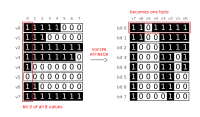
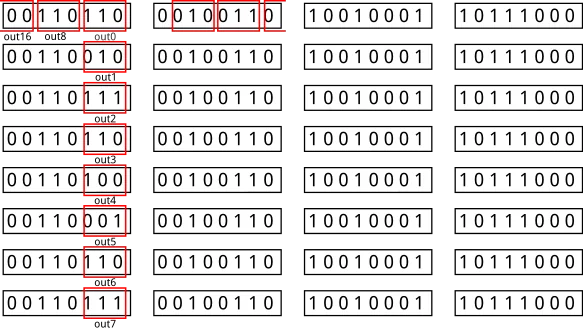
This illustration shows the whole process: how uint32 s are loaded into an AVX512 register (all 4 of its bytes, in sequence) and where we end up, i.e. the 32 positional popcounts:
Let’s break down this process into its individual steps.
First, we turn each loaded value into its smear mask as explained above.
The VPOPCNTB vector instruction calculates POPCNT (1 byte) of 64 bytes at once, but first we need to shuffle the bytes inside the register: in load order, we have a full uint32 (4 bytes), followed by another uint32 , per lane. First, we permute the bytes ( VPERMB ) such that all the first bytes of each value end up in one lane (“transpose the bytes”):
Next, we “transpose the bits” using the GF2P8AFFINEQB instruction, which sounds scary but turns out to be quite flexible for bit manipulation of all kinds. The GF2P8AFFINEQB instruction is also “the star of the show” in Go’s Green Tea Garbage Collector (2025). Here is the bit transpose, shown in the AVX512 register layout (see below for a different layout):
I found it easier to understand the transpose step when arranging the 8 bytes of lane 0 from top-to-bottom (instead of left-to-right), because then it looks like a 90 degree clockwise rotation:
Now we can use VPOPCNTB to count the bits in all 64 bytes at once:
After all loop iterations (processing 16 values each) are done, we add the two groups (first 8 values, second 8 values) to obtain the 32 exception counts:
Positional Popcount: Go SIMD
Here is the Go code that implements what I described visually above:
func scanSIMD(output *stats, vals []uint32) { ones16 := archsimd.BroadcastUint32x16(^uint32(0)) // 16 32-one-bits masks shuffle := archsimd.LoadUint8x64Array(&scanShuffle) units := archsimd.LoadUint8x64Array(&scanUnits) var acc archsimd.Uint8x64 idx := 0 for ; idx+16 <= len(vals); idx += 16 { v := archsimd.LoadUint32x16(vals[idx : idx+16]) // Replace all values with their smear masks. smear := ones16.ShiftRight(v.LeadingZeros()).ReshapeToUint8s() // Transpose: shuffle the bytes, then transpose the bits. matrices := smear.Permute(shuffle).ReshapeToUint64s() transposed := units.GaloisFieldAffineTransform(matrices, 0) // Popcount 64 bytes at once into the accumulator. acc = acc.Add(transposed.OnesCount()) } // Store the accumulator into output.cnt: // Widen the two groups of byte counts to uint16 lanes (so that // 128+128 = 256 fits), fold them into cnt[b] for b=0..31, // then widen again to the uint32 lanes of output.cnt. sum := acc.GetLo().ExtendToUint16().Add(acc.GetHi().ExtendToUint16()) sum.GetLo().ExtendToUint32().Store(output.cnt[0:16]) sum.GetHi().ExtendToUint32().Store(output.cnt[16:32]) // scalar tail for the 0..15 remaining values for _, val := range vals[idx:] { for b := range bits.Len32(val) { output.cnt[b]++ } } }
Have a look at the commit introducing positional popcount to DCS for the full code (including shuffle tables and ISA checks) as well as the detailed benchmark results.
Go even faster?
The SIMD optimizations I showed above beat the cgo TurboPFor library that Debian Code Search used before. When comparing apples to apples, i.e. backporting the AVX512 kernels and positional popcount technique to C TurboPFor, Go benchmarks a little slower at ≈1.4x C.
Could we make my Go TurboPFor implementation even faster, to truly match the C speed?
Yes! But also no. Let me explain:
We could use more SIMD instructions to remove all code that still processes one value at a time. For example, in my encoder’s encodeBitpackVBExc function. Or we could price all bit widths concurrently in encode . Or in the decoder’s exception apply code path. But all of these SIMD instructions make understanding (and changing) the code harder, so I am cautious regarding which ones I introduce.
A big part of the performance gap is due to Go’s bounds checks. While it costs performance, bounds checking is great for safety, so I will not turn off bounds checking. The Go compiler eliminates a number of bounds checks when it understands it’s safe to do so. One optimization avenue could be to make the prove pass in the Go compiler smarter to eliminate more bounds checks.
When doing mid-stack inlining (proposal #19348) (2017), Go sometimes needs to put NOP instructions into the binary so that it can attach inlining markers. For dispatch-bound functions, these extra NOPs can measurable slow down execution.
The Go compiler currently allows specifying the architecture ( GOARCH=amd64 ) and microarchitecture ( GOAMD64=v3 ), but not a specific CPU architecture (like AMD Zen 4). Therefore, CPU-specific workarounds for one vendor affect all the generated code. The specific one I encountered in my code is that the Go compiler emits XORL CX,CX before every POPCNT to break a false-output-dependency from the Intel Sandy Bridge Skylake era, which is unnecessary on AMD Zen CPUs. I suspect that Go intentionally does not offer this level of customizability.
After all of the above points are addressed, what remains is better code generation in specific cases. To illustrate what I mean, consider the example of incrementing a loop variable, where Go re-derives an index every time: Go: POPCNTL; ADDQ DI,CX; LEAQ (base)(CX*4) (3 instructions) clang: popcnt; lea rax,[rax+4*rdi] (2 instructions) Depending on the specific case, improving the compiler might be easy or prohibitively complex. Often, such improvements are hard to measure conclusively.
Conclusion
Go’s SIMD support makes available — in Go code without having to resort to cgo or assembly — a powerful part of modern CPUs which allows speeding up the kind of computation that TurboPFor needs by an order of magnitude! 😲
I found it very valuable to use a coding agent (Claude Code, with Opus 5 and Fable 5 in this case) to help with the many tedious parts of such performance work (and still it took me weeks!). The LLM can read objdump output much faster than I can, can see patterns and correlations I might never identify, never becomes frustrated after a compiler error or runtime panic, and never runs out of patience to run one more experiment, as long as I give it measurable and reachable goals.
The performance of the SIMD code which one can get from the Go compiler is pretty close to what a good C compiler like clang provides. The CPU performance counters show value decoding speeds of 7 instructions/cycle (IPC) on a machine where the maximum is 8 IPC.
To me, SIMD support is a very welcome addition to Go.
Did you like this post? Subscribe to this blog’s RSS feed to not miss any new posts!
I run a blog since 2005, spreading knowledge and experience for over 20 years! :)
All of my content is human-authored. I do use LLMs for research and knowledge work, and even to review my posts, but all writing is my own, every word is my own voice.
The source text above remains the property of its publisher and is reproduced for commentary.