A single commentary article cites Ramp data asserting that OpenAI and Anthropic’s enterprise revenue is heavily concentrated in a top 1% of customers, with spend skewed toward tech and venture-backed AI startups, and argues that AGI declarations and data-center announcements obscure this concentration risk.
This source document is not a research artifact but an editorial brief. Its new analytical event is a claim about revenue concentration: Ramp-based statistics are used to assert that 80% of OpenAI and Anthropic’s enterprise revenue comes from 1% of customers and that concentration has not improved over three years. In the same argument, this concentration is identified as a distinctive, AI-specific risk rather than a general software pattern.1
The editorial wraps that statistic in a skeptical narrative around AGI: it reads Jensen Huang’s “AGI has arrived” and OpenAI executives’ “AGI era” statements as public-relations reactions that lack definition, and it juxtaposes them with an unverified claim that the Stargate Abilene campus remains only partially built. The immediate effect is to reframe common capability narratives as financial risk.1
AI hypothesisIf the concentration claim holds, the operative constraint on OpenAI and Anthropic demand is not intelligence quality or enterprise adoption but the continuity of venture-financed token spend. The analytical move is to model AI demand as a flow of external capital rather than as an autonomous willingness-to-pay by diversified enterprises.1
Context
The text is an opinion piece in a subscription newsletter, a genre choice that matters for evidence assessment. Its three supporting examples—Harvey, Cursor, and Anthropic’s two largest customers—are reproduced from named media accounts or author estimation, not from audited financials.1
If you liked this piece, you should subscribe to my premium newsletter. It’s $70 a year, $18 a quarter, or $7 a month, and in return you get a weekly newsletter that’s usually anywhere from 10,000 to 18,000 words, including vast, detailed analyses of NVIDIA, Anthropic and OpenAI’s finances, and the AI bubble writ large. My Hater's Guides To the SaaSpocalypse, Private Credit and Private Equity are essential to understanding our current financial system, and my guide to how OpenAI Kills Oracle pairs nicely with my Hater's Guide To Oracle, as well as the Hater’s Guide To Oracle (Part 2).
I also just did a two part Hater's Guide To Circular Financing, covering the depths of NVIDIA's circular madness and the history of a very dangerous kind of "financial innovation."
Subscribing to premium is both great value and makes it possible to write these large, deeply-researched free pieces every week. This week's premium will be The Hater’s Guide To Broadcom, a company that has long ceased to innovate, and whose existence centers on buying successful companies and jacking up prices, and now, building chips for Anthropic and OpenAI, while also taking on (and backstopping) insane amounts of debt. In short, Broadcom is the unholy lovechild of NVIDIA and Oracle.
If you want to get in touch — and especially if you have any juicy information about Anthropic, OpenAI, or any other companies in the AI bubble — hit me up on Signal at ezitron.76. I’m also on IB on your Bloomberg Terminal.
Jensen Huang, CEO of NVIDIA, the largest company on the stock market, has declared that “AGI has arrived” in a response to the CEO of Crusoe congratulating OpenAI on the launch of its GPT-6 Astra model, who said that this “made Abilene the birthplace of AGI.”
Per sources with direct knowledge of the current progress of Stargate Abilene, the AI data center being built by Crusoe for Oracle to lease to OpenAI, there are at most four out of eight buildings functional at the Abilene campus, which started construction some time in 2024. Huang at no point defines what “AGI” is, other than to say that we’ve reached it, and that “400k GPUs coming online” was what was next, I assume referring to somewhere else on Earth, because Abilene only has space for a total of 400,000 Blackwell GPUs, of which (as I’ve noted) at best half of which are actually installed and functional.
The reason that everybody is talking about AGI is that TIME magazine, bereft of any journalistic standards or shame, quoted OpenAI Chief Research Officer Mark Chen as saying that OpenAI was “80% of the way” to AGI,” only for Chief Operating Officer Greg Brockman to say a few days later that we had entered the “AGI era, whether you view it as this model, the last one or the next one,” which the Wall Street Journal agrees with, even though it cannot define exactly what AGI means, but this is the AI bubble and those most-responsible for telling the truth are mostly incapable or unwilling to bother.
These companies are treating everybody like they’re stupid, in large part because everybody, including the largest media outlets in the world, appears to fall for just about anything. Neither NVIDIA nor Crusoe have actually done anything — we have not reached “AGI,” nor has “the birthplace of AGI” been completed, nor does anybody seem to bring up these facts in any of the pieces I’ve read outside of saying “hmm, well AGI isn’t really well-defined,” humouring what these companies are saying without a single thought entering their minds.
If anything, the far-more-interesting way to look at this is why all of these people are suddenly jerking their shit from first principles over a term that is meant to mean “an artificial intelligence that can handle tasks beyond its original training” but now means basically anything the companies want it to, and how that times with the rush for both Anthropic and OpenAI to go public.
The answer is pretty simple: these people want to stop you thinking about what’s actually happening — that the underlying financials and demand do not make sense, and their cloud software does not remotely justify its alarming costs.
Today I’m going to talk to you about why I think there’s a Silicon Valley Financial Crisis brewing, and the concentration risks involved.
Let’s Talk About Concentration Risk
So, today we’re going to talk about a term you may or may not have heard of before: concentration risk.
It’s a term that refers to having all your eggs in one or a few baskets, becoming overly reliant on a few investments, customers or particular business lines to the point that without them your business or portfolio would suffer massive harms. In banking specifically, to quote the National Credit Union Administration, it refers to any single exposure or group of exposures with the potential to produce losses large enough (relative to capital, total assets, or overall risk level) to threaten a financial institution’s health or ability to maintain its core operations.
I bring this all up because you’re going to hear this term, or variations of this term, a lot in the next few months and years as the AI bubble unravels, because just about every part of the industry involves its own flavor of concentration risk.
80% Of OpenAI And Anthropic’s Enterprise Revenues Come From 1% Of Its Customers, Which Skew Heavily Toward AI Startups Subsidized By Venture Capital
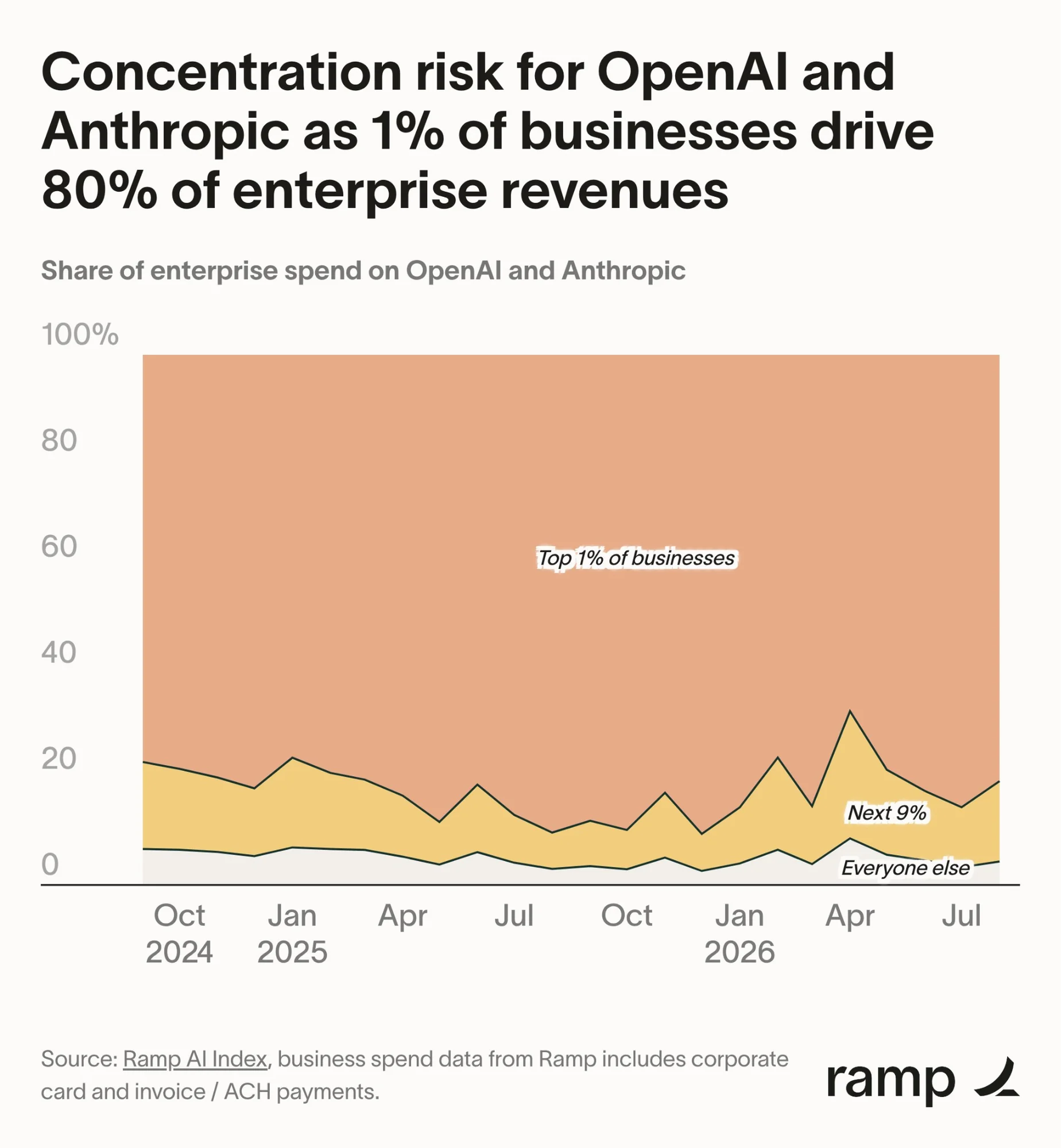
Let’s start at the top. Per data from fintech firm Ramp, 80% of OpenAI and Anthropic's enterprise revenues come from 1% of their customers, a number that hasn’t improved over the last three years. Ramp’s lead economist Ara Kharazian notes that the top 1% skews heavily toward the tech sector and AI products and services, and that this was a level of concentration risk unseen in any other software category they tracked.
Oh, and it hasn’t gotten better over time.
This dataset, which likely includes big companies like Visa and Cursor as well as a great deal of startups and regular-sized companies, is indicative of the overall spend of the AI industry, with the caveat that it doesn’t include massive players like Microsoft or major banks, and customers can opt out of being included in research.
I also want to be clear that when Ramp says “AI products and services,” that includes AI startups that sell subscriptions with subsidized token spend, meaning that users can burn far more than their subscription price in tokens. This means that the money made by Anthropic or OpenAI from an AI startup in that 1% spend is contingent on their continued ability to raise venture capital.
This means that the vast majority of enterprises — which is where the real money is in software — just don’t spend that much money on AI. Those that do spend the most on it are heavily-concentrated in either AI companies that either use a lot of tokens internally because they’re bankrolled by venture capital, AI companies that allow their users to blow unsustainable amounts of money on tokens bankrolled by venture capital, tech companies that are currently under heavy peer pressure to spend money on AI tokens, and I assume a few whale customers of some sort.
Concentration Risk 1: AI Startups Are The NINJA Borrowers Of AI
During the Great Financial Crisis, millions of people took on debt they never had any hope of paying, with one of the most egregious examples being “NINJA” loans — No Income No Job Applicants or No Income No Job Assets (I've seen both).
Per Pew, “...in the years before the Great Recession, almost 38% of new mortgages required little or no documentation.”
To be specific, 36.5% of 2005 and 37.9% of American home purchases in 2006 were from buyers with little-to-no income documentation, which meant that, for the most part, these subprime mortgage payments were only made possible by a system that was desperate to create more demand for loans rather than creating a lending agreement with a stable customer who would be able to make regular payments.
Sidenote: Before we go any further, I want you to also know that “subprime” doesn’t refer to the borrower but the loan itself. Plenty of “well off” people got mortgages they couldn’t afford in the time leading up to the Great Financial Crisis.
A “homeowner” in 2005 and 2006 could easily be somebody who could not, in any real sense, afford the home they were buying.
I sure hope that nobody is making that same mis-OH MY GOD!
Anthropic and OpenAI Are Dependent On Artificial Revenue Driven By Unprofitable Venture-Backed AI Startups For Billions Of Dollars Of Revenue
This means that 80% of OpenAI and Anthropic’s enterprise revenues — which make up the vast majority of their total revenues — are dependent on what are likely hundreds of customers spending outsized amounts of money on AI tokens, with an indeterminately-large chunk of them being AI startups that can only do so as long as venture capital supports them.
Let me break down exactly what this means:
AI startups, when they run their services, connect to models provided by OpenAI and Anthropic and pay on a per-million token basis.
In virtually every case I’ve found, the AI startup “subsidizes” the AI use of their customers, allowing them to burn way more than their monthly subscription in tokens, with the AI startup paying for the tokens at either full or a slightly-discounted price.
This is only made possible through endless venture capital. For example, legal AI startup Harvey has raised over $1 billion and is trying to raise another $500 million, all while only having $350 million in ‘annualized’ revenue, meaning (assuming a straight-line month x 12 calculation) it makes only around $29 million a month. Harvey, like many AI startups, is sending hundreds of millions of dollars to Anthropic and OpenAI.
This means that these AI startup customers will, at some point, run out of money to keep feeding to OpenAI and Anthropic, because running their services is economically unviable by the very nature of connecting to AI models.
AI startups are an artificial source of revenue. They are not paying Anthropic and OpenAI out of cashflow, or because they’re “getting great value,” and indeed are only able to do so as long as somebody else hands them endless amounts of cash. While their revenues may be increasing, they pale in comparison to the sheer sums raised or the rate at which they’re raised. Harvey raised over $800 million in 2025 alone, and exited the year at around $190 million in annualized run rate, or around $15.8 million a month, meaning that it would’ve been completely dead over a year ago without venture capital propping it up.
And let’s be completely clear: OpenAI and Anthropic are financially dependent on these customers to survive. While “enterprise” could refer to a cluster of Fortune 500 or big businesses that are theoretically using LLMs for coding or whatever, it’s very clear based on Ramp’s data that one of (if not) the largest sources of revenue for these companies is AI startups that can literally not afford to pay for tokens without venture capital funding.
AI startups are also the easiest to make spend more on AI because of their users’ subsidized token burn. When somebody fires up something like Harvey or Perplexity, they’re going to expect the latest models, which means that every AI startup is effectively a venture-backed marketing platform for the latest models, spiking costs for the company while feeding those dollars directly to the AI labs. When a user doesn’t have to worry about their actual costs and the provider doesn’t have to either because it’s bankrolled by venture capital, it’s really easy to see surges of revenue around every new model launch, giving AI startups a new way to beckon users back to the platform (see: Perplexity) and AI labs a bump in revenue in return.
AI startups represent a massive concentration risk for OpenAI and Anthropic, because this isn’t real revenue. Providing these services to AI startups isn’t making their customers “more money” so much as it gives them a justification to keep raising money. While Harvey or Perplexity might “need” AI models to run their businesses, they are not paying for them because of any value or business model or strategy so much as that they’re in a Red Queen’s Race where they must offer the latest models at whatever cost to “stay current.” If anything, without funding these businesses would have to stop offering Anthropic and OpenAI’s models to reach anything approximating sustainability, because the cost of AI tokens is the primary driver of their losses.
To give you an idea of the scale of these customers, last week OpenAI announced it was cutting off AI coding company Cursor (which is now part of SpaceX), with WIRED reporting that it was set to make OpenAI over $1 billion in revenue in 2026, or over 3% of its projected $30 billion in 2026 revenue. With OpenAI only representing 5% of Cursor’s traffic, it’s likely sending billions more to Anthropic this year, a massive underlying exposure that could easily evaporate if Elon Musk decides he doesn’t want to send all that money to competing AI labs.
Cursor was only able to keep sending that money to Anthropic and OpenAI because it raised $3.2 billion in the space of four months — June ($900 million) and November 2025 ($2.3 billion). Per The Information from July 2025, Anthropic’s two largest customers represented $1.2 billion of annualized run rate (30% of its $4 billion run rate at the time), with investors believing they were Cursor and Microsoft’s GitHub Copilot, the latter of which moved to token-based billing in June 2026.
The problem is both that Anthropic and OpenAI’s largest customers cannot afford to pay them and that they desperately need them to keep paying them more every quarter, which means that every single AI startup will need to raise more and more money to do so.
They are, as I’ve suggested, the NINJA borrowers of the AI era. They do not have to show functional businesses or sustainable demand for their products, only an excitement to sign pieces of paper and an eagerness to continue spending money that isn’t theirs. The “houses,” in this case, are the ever-increasing valuations of the startups themselves. There is no logical or rational basis to value Perplexity at a potential $30 billion (per The Information) or to give it billions of dollars, other than the fact that venture capitalists want to see the value of the company go up, and NVIDIA wants to make sure it can keep spending billions with Anthropic and OpenAI.
And much like NINJA borrowers, this bad behavior is enabled on a systemic level, with 50% of all global venture capital flowing into AI in 2025.
Concentration Risk 2: The Tech Industry Seems To Be The Only One Spending Real Money On AI
As mentioned, the “top 1%” skews toward tech and AI startups, which means that even outside of unsustainable AI companies, Anthropic and OpenAI are mostly-reliant on the same customers they’ve always had for revenue growth.
That means that outside of unprofitable AI startups, the vast majority of “enterprises” spending money on AI are tech companies rather than other industries. The tech industry is far more willing to dabble and invest money in new stuff, especially if everybody else in the industry is screaming about it non-stop for years, meaning that its “interest” is driven by far more than “is this actually useful” or “do we actually need this.”
Tech companies have more software engineers, and in turn more software to be built or iterated upon, along with more willingness at the C-suite level to spend money on software tools.
I’ll add, however, as Ramp’s Kharazian noted, that this was “...a level of concentration risk unseen in any other software category [than they track],” which means this is an AI-specific concentration rather than a problem with software writ large.
Sidenote: At this point, somebody is probably screaming that “Ramp skews towards startups” and “Ramp’s data doesn’t include every big business.” Neither of these arguments are actually based in reality, but even if they were, these are still massive revenue sources that are dependent on the whims of tech executives or venture capital.
In other words, outside of the tech and AI world, very few companies are willing to pay very much for AI, which is catastrophic on just about every level, with no clear sign as to how you reverse the trend.
AI has been in every media outlet and discussed in every boardroom and company for the last three years, every single company has on some level dabbled in using AI, most businesses have been given the greenlight to spend a bunch of money on AI, and in the end, it seems the only people the tech industry can get to spend significant money on AI is…the tech industry itself. “The tech industry” also includes an indeterminately-large amount of venture-backed startups who, much like AI startups, can only afford to spend a lot of money on AI as long as somebody else gives them the money to do so.
This is yet more underlying exposure for the AI labs, because these customers are also prime targets to move to either cheaper open source models that they train themselves or, eventually, on-device models.
Even if they choose to stay with Anthropic and OpenAI, a chunk of this spend is contingent on venture capital funding, and the rest is contingent on whether tech firms continue to be willing to spend money at scale. 80% of their revenue concentration depends on spending and capital that varies from unreliable to actively-unstable.
Things get worse from here.
OpenAI and Anthropic’s $1.3 Trillion In Compute Commitments Have Become The Subprime Mortgages of the AI Bubble
Sidenote: I estimate that there’s around $22 billion of annual non-OpenAI/Anthropic AI compute demand, with most of that coming from Jane Street (an investor in both CoreWeave and OpenAI) and, on a much larger scale, NVIDIA renting back its own GPUs. I think this number could be smaller, but this is my closest estimate based on my analysis. I’m saying this because I anticipate someone will say “Ed, someone else will buy the compute.” No they won’t. As I’ll get into, the companies that are meant to buy the compute can’t afford it, and nobody else is buying compute at even close to that scale.
So, I realize that a few months ago I described AI data center debt as the subprime mortgages of the AI bubble, and I stand by that comparison at the time I made it, and think it still matches.
That being said, another example has emerged — Anthropic and OpenAI’s monstrous compute commitments, which now represent over $1.3 Trillion in revenue for hyperscalers and neoclouds like Google, Microsoft, Amazon, SpaceX, Hut8, SB Energy, Oracle, Cerebras, Nscale and Lambda.
To be specific, per the Wall Street Journal, OpenAI projected to spend over $750 billion on compute through 2030 in July 2026 before it signed its deal with SB Energy (more info here), and per The Information’s research, Anthropic has signed approximately $517 billion in agreements in the last 11 months.
These are, from what I can tell, “take-or-pay” agreements where they agree to buy that compute capacity regardless of how much capacity they actually end up using, and how much revenue they actually bring in.
And when the compute is available, or about to be available, you have to pay a chunk of money up front before you start using it.
As a reminder, both are woefully unprofitable and lose tens of billions of dollars a year. Even if they were profitable, the sheer scale of their commitments is astonishing, representing a massive underlying risk to some of the largest companies in the world.
To give you an idea of that risk, per Bloomberg OpenAI’s compute spend and revenue share represented around 70% of Microsoft’s AI revenue in Fiscal Year 2026 — which just ended in June — or a little over 7% of Microsoft’s entire fiscal year revenue, and UBS estimates that Anthropic and OpenAI’s compute spend will account for 48% of Google Cloud’s entire revenue next year, or somewhere between $84 billion and $100 billion dollars, in 2027.
That’s on top of, per Barclays, OpenAI and Anthropic’s estimated $40 billion dollar spend on Amazon Web Services, and at least $50 billion dollars that both of them will spend on Microsoft Azure in Calendar Year 2027, which I note because Microsoft uses its odd fiscal year system.
On the low end, that means that Anthropic and OpenAI account for over $200 billion dollars worth of expected revenues for Microsoft, Google and Amazon in 2027, which is contingent on their ability to raise venture capital or debt, which is contingent on the continued growth of their businesses, which is contingent on growing AI spend from a small subset of customers, many of whom are funded by venture capital.
The reason this hasn’t been a problem yet is that when you sign these contracts, you tend to pay a small up front fee, and the capacity in question is yet to come online.
All it takes for Anthropic or OpenAI to sign hundreds of billions of dollars’ worth of obligations with a little bit of cash and a few clicks of a DocuSign agreement, meaning that all that capacity isn’t costing them anything until the date hits when they have to start paying.
That’s going to start happening next year, and get dramatically worse month after month as capacity comes online.
Hey, that reminds me of something too.
Concentration Risk 3: OpenAI and Anthropic’s Compute Commitments, Which Commence At Scale In 2027 and Beyond, Are The Adjustable-Rate Mortgages Of The AI Bubble, And Hyperscalers Are The Banks
Anthropic and OpenAI’s compute commitments, in my mind, should be seen more as debt obligations than “contracts,” because they (as take-or-pay agreements) function in much the same way, requiring the company to pay whether or not they need the capacity.
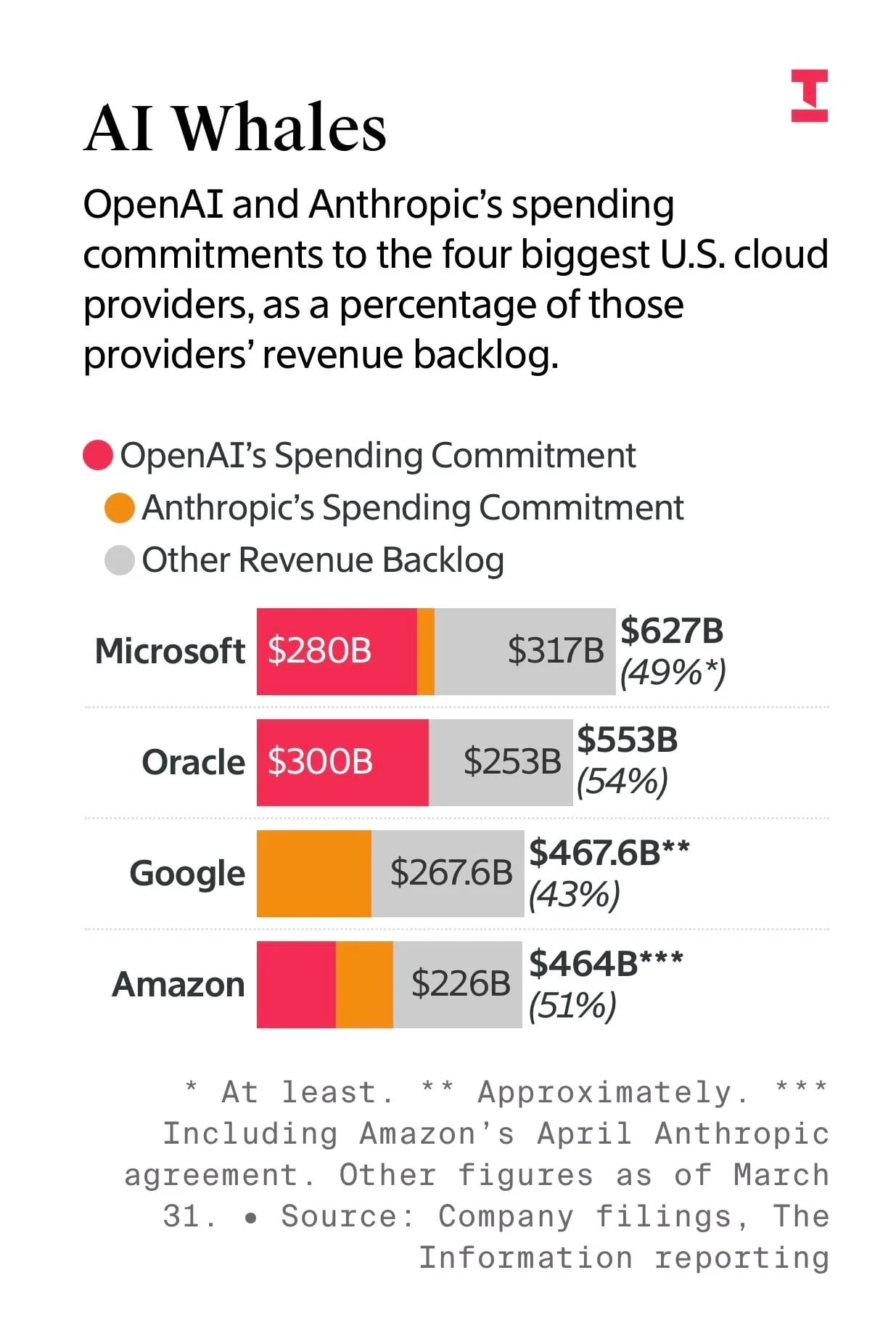
For now, everything looks awesome. Microsoft, Google and Amazon have all had big bumps in revenue from AI lab compute spend along with massive, ever-swelling revenue backlogs — over $1.5 trillion worth to be specific. More than half of that backlog is attributable to Anthropic and OpenAI, which, as I’ll say again and again, isn’t a problem because the money is yet to stop coming in.
As mentioned, this is going to begin in earnest in 2027, and expand dramatically every year following (though I doubt we will make it that far).
A really shittily-written piece (full of incorrect numbers and zero citations written using an LLM) from an outlet called Groundbreaker made a good point about this, comparing it to when the rates on millions of mortgages exploded as they hit a “reset wall,” where the low “teaser interest rates” ended, exploding the monthly mortgage payments to unsustainable highs, with customers assuming, incorrectly, that their houses would keep appreciating or they’d be able to refinance.
In other words, Anthropic and OpenAI are currently in the teaser rate period where all of that capacity — and all of the associated costs — are yet to hit.
Next year, at least $200 billion in compute costs are coming due.
The question is whether Anthropic and OpenAI, two unprofitable, unsustainable AI labs that lose tens of billions of dollars a year, will be able to afford to pay them.
If you ask the vast majority of tech and business journalists, consultants or sell-side analysts, they’ll tell you not to worry — that there’s insatiable demand for compute, or even that said demand “may never be sated,” and that even if there is a bubble, society will get “gigantic benefits” either way. These views are always backed up by data from the industry, which is trusted, for some reason, to tell the truth about itself.
The argument that most would make is that both Anthropic and OpenAI will be able to buy all of that compute, and even if they couldn’t afford it, other customers would line up to take the demand. When pushed about how the big AI labs would actually afford this compute, everyone will tell you that “they’re the fastest growing companies in the world.”
In this case, we’re talking about $1.3 trillion in demand from two customers who have a few hundred customers that mostly pay them based on the availability of venture capital dollars.
While the consequences might be different — as the scale and damage of the Great Financial Crisis was driven by trillions in speculation — the mistakes are increasingly looking very, very similar.
And so are the rationalizations.
Let’s Talk About Teaser Rates
In the period leading up to the Great Financial Crisis, approximately 80% of US-based subprime borrowers got adjustable-rate mortgages with “teaser rates” — lower interest rates for the first two-to-three years followed by adjustable rates that changed with both interest rates and, in some cases, fees associated with said adjustments.
These mortgages were known as 2/28 or 3/27 mortgages, depending on whether the teaser period lasted two or three years. One important thing to note is that the “teaser rate” wasn’t by any means low (they could be as much as 7%), only that they were lower than the normal rate.
When borrowers worried about the potential for higher monthly payments, they were reassured that they’d be able to refinance, or that the price of their house would only ever increase.
Under the more relaxed underwriting standards at the time, many borrowers qualified for adjustable rate mortgages based only on their ability to pay the low initial monthly payments as determined under the introductory teaser rate. Hence, their ability to afford the mortgage after the teaser rate expired was predicated on their ability to refinance the mortgage before the higher payments became effective. The ability to refinance—counted on by many investors, homebuyers, and originators—depended critically on house prices. As long as house prices were rising, lenders were generally willing to supply new funds with new terms. And even after house prices at the national level peaked, in mid-2006, housing market participants generally did not expect house prices to crash.
How The Media Laundered (or outright missed) The Great Financial Crisis In Exactly The Same Way They’re Doing So With AI
While warnings about a housing bubble started as early as August 2002 (good work, Dean Baker!), there was a broad (though not complete) consensus that there was, in fact, no housing bubble. In August 2005, the National Association of Realtors put out multiple “anti-bubble” reports, saying that “the facts simply do not support the possibility of having a housing bust” in 130 specific markets and the nation at large. Then Fed Chair nominee Ben Bernanke said in October 2005 that “there was no housing bubble to go bust,” noting that even if there was a “moderate cooling in the housing market,” that it would “not be inconsistent with the economy continuing to grow at near its potential next year.”
Yet my favourite is from July 2005, when the Wall Street Journal’s Neil Barsky (in a piece called “What Housing Bubble?”) mocked The Economist for calling it “the biggest bubble in history,” castigating “the media and economists [scaring] homeowners with words of doom and gloom, however knee-jerk, consensual and misguided they may be,” saying that “there is no housing bubble [in America].”
His justifications involved saying that the housing market was strong as a result of “real economic underpinnings” like “low interest rates, local job growth and the emotional attachment one has for one’s home.”
Yet the most-relevant one was that he connected the strong housing market to the “real economic underpinning of "one's view of one's future earning-power,” and his thoughts around housing demand:
What we do have is a serious housing shortage and housing affordability crisis. Despite robust construction, unsold inventory stands at four months, well below its 25-year average. Private builders complain they can't get land permitted to meet demand. Low-income housing advocates complain housing prices are out of reach for many Americans, and that government subsidies have been slashed.
Hey, this kind of reminds me of something that NVIDIA CFO Colette Kress said on its latest earnings call:
The Frontier AI labs have extraordinary demand for training and inference compute, but they are growing faster than what their balance sheets and credit profiles can support. They have rapidly growing customer demand, yet still lack the decades-long infrastructure contracts and investment-grade financing capacity needed to secure the AI factory infrastructure independently. In other words, their growth is not limited by their technology or customer demand. It is limited by compute.
This piece rules, primarily based on its answer to the “myth” that “risky mortgage products are fueling house appreciation, which mostly boils down to “homeowners only own their homes for an average of seven years [note: he has no citations for this claim], which means that you’re basically wasting money by not getting an adjustable rate mortgage.
I could go on. On December 21, 2006, CNBC’s Diana Olick ran a piece based on reader feedback around housing numbers provided by the National Association of Realtors, The Department of Commerce and the National Association of Homebuilders:
Another [reader], Michael Crespy, writes: “Although you periodically have a “housing bear” on the program, more than not, the program is filled with the NAR or NAB’s “economists” who are no more than the HEAD cheerleaders for the housing industry!!” Mr. Crespy, you’re right, they are the cheerleaders for the housing industry, but they are also economists whose sole purpose is to organize and present data on the industry. Interestingly enough, the Dept. of Commerce, which has no stake in the industry, has far higher margins of errors on its numbers than do the industry numbers. The NAR’s existing homes data, which are monitored by the Federal Reserve, has a 1% margin of error. Their data comes from a sampling of 40% of the MLS listings. Forty percent is pretty high in survey land.
Olick’s piece, at least on the surface, attempted to have a “balanced” view, but mostly ended up arguing that everything was fine, with even a quote from Wharton School of Business professor Susan Wachter saying that the numbers — which all said that things were “improving” — “in some ways [gave her] confidence,” adding that she had no problem with statistics from realtors or home builders.
Olick, feeling defensive, ended the piece as such:
Here at Realty Check, we report the numbers, we talk to the industry leaders, we also talk to umpteen brokers out in the field, to economists who study real estate trends and to buyers and sellers who are trying to make sense of it all; then, for better or worse, we try to make some sense of it all. I confess, I do own a house, so there’s my bias; I’d like it to continue to appreciate. If you don’t buy what I’m reporting, that’s your choice.
Now, in her defense, perhaps the numbers did say everything was fine if you squinted, but the sheer venom that Olick had for concerned listeners that called her “some kind of apologist or defender of the industry” rather than, say, going out and doing journalism…mirrors basically all of the reporting on AI today, which mostly says “the numbers look great!” while, well, ignoring the ones that don’t.
Less than a week later on December 27, 2006, CNBC would run a story called “Analyst: Housing Bubble Fears Behind Us,” quoting former US International Trade Commission economist Peter Morici as saying that home numbers sales were “very good news for the economy,” and that he “expected new home construction to rebound in the second and third quarters of 2007.”
The Adjustable Rate “Reset Wall” Started In 2007 — And A Compute Reset Wall Begins In 2027 For Anthropic and OpenAI
The Adjustable-Rate “Reset Wall” — And How Manias Turn Nasty
Terminology Time! A “reset” in this case is when a mortgage goes from a lower “teaser rate” percentage to an adjustable-rate that changes based on the terms of the mortgage and current interest rates, massively increasing your monthly payments.
I must be clear that the Groundbreaker piece that inspired this piece is horribly written Claudeslop, but deserves credit for this idea, even if it fumbles basically every number, cites effectively nothing, and has near-impenetrable text that I’m not certain most people even read.
Sidenote: The term “Reset wall” is a term that seems to have entered adoption after the fact, and doesn’t appear in contemporaneous coverage of the subprime mortgage crisis. Coverage of that era uses the term “rate reset.”
Nevertheless, I must quote it:
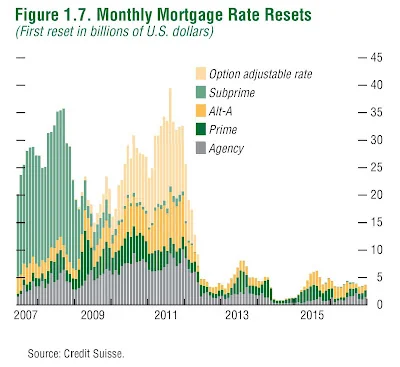
Millions of subprime borrowers were, at that moment, paying the low introductory rate on a two-year adjustable rate mortgage - the 2/28 ARM. A low fixed-rate for two years, then the rate reset to a payment 30% to 50% higher. During those first two years the loan performed beautifully: the borrower paid, the servicer collected, and the bond paid its coupon. Nothing looked wrong because the whole complex - housing, mortgages, securitization - was sitting inside the teaser period. Every ARM reset was known, dated, and contractually inevitable from the moment of origination. Aggregate those reset schedules and you get the most damning exhibit of the era: the reset wall. Roughly a trillion dollars of adjustable-rate mortgages were contractually set to reset across 2007 and 2008 - thirty to forty billion dollars a month at the peak. Credit Suisse published the chart in March 2007. The IMF reprinted it. It circulated on every trading floor in New York and London.
Groundbreaker neglects to cite anything, so I went and actually found the chart shared by the IMF via Credit Suisse:
The “wall” in this case refers to the large group of Subprime borrowers who suddenly, starting in 2007, would see their mortgage payments skyrocket to the tune of tens of billions of dollars a month (as Groundbreaker correctly said).
Sidenote: Though there’s not a ton of data out there, the Center For American Progress noted that 1.8 million mortgages hit or would hit a rate reset in 2007 and 2008,
In other words, before everyone had to pay more money, everything looked fine because everybody could still make their payments. Once they had to start making larger payments and couldn’t make those payments, with mortgage delinquencies spiking gradually every month from January 2007, peaking at 11.49% more than three years later in March 2010, taking another six years to drop below 5%.
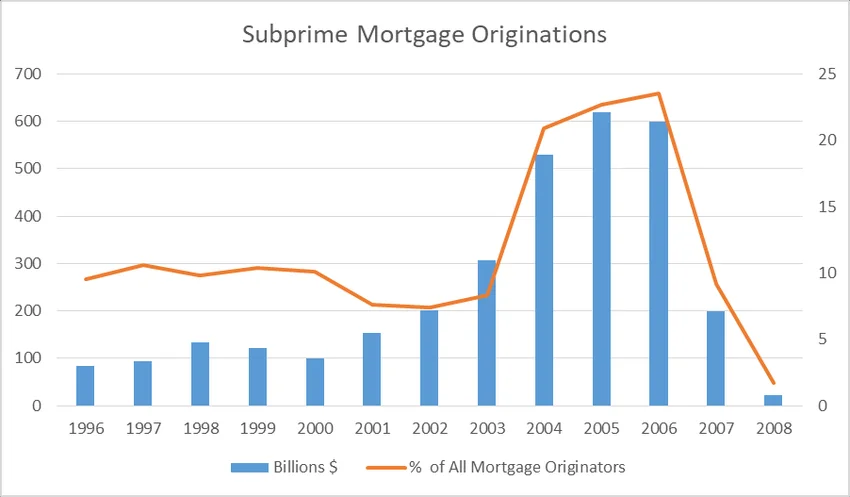
You’ll also note that everything unwound very quickly, with much of it beginning in 2007 and 2008 as teaser rates ended. Subprime mortgage originations collapsed by the end of 2008 as private label securitization from banks and financial institutions (per page 19 of the FDIC report) which “had provided much of the funding for new mortgages” dropped dramatically and had “virtually disappeared” by 2008.
Said interest in funding new mortgages was, as we know now, barely anything to do with building houses so much as it was a way to build a new asset class for investors to speculate on.
And, very importantly, the massive expansion of subprime mortgage issuance mostly took place over a three-year-long period. While this rush of new housing development and mortgage origination was sold to everybody as the result of endless demand for housing, said demand for housing was driven by masses of easily-available money being given to people who couldn’t afford it outside of a manic period in history.
You can probably see where I’m going with this.
The AI Bubble Reset Wall — When The Compute Commitments Begin With Over $200 Billion In Compute Commitments Starting In 2027, Growing Every Single Year — And Neither OpenAI nor Anthropic Can Afford To Pay For Them
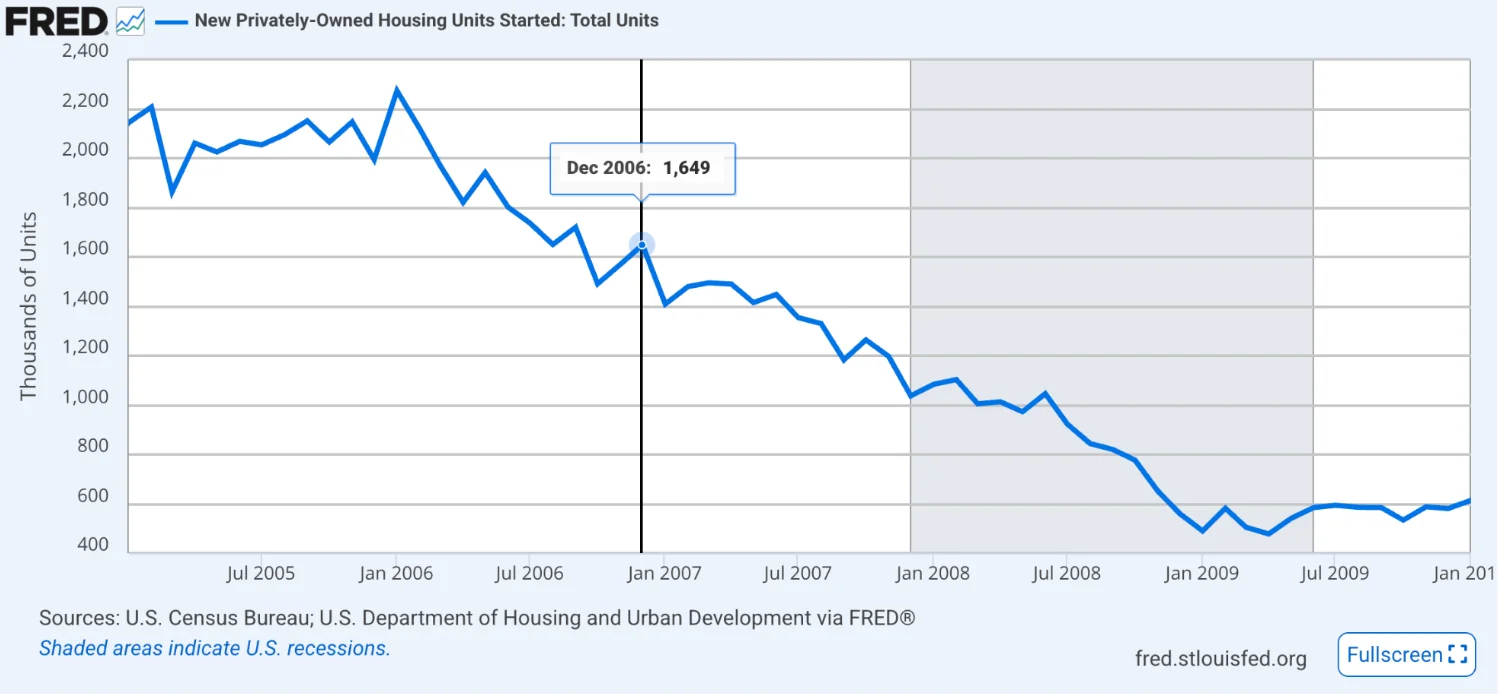
Everything seemed totally fine in the years running up to the Great Financial Crisis because, based on external data, the money hadn’t stopped coming in. Because effectively anybody could get a mortgage, US construction spending comprised nearly 9% of GDP by 2006, employing 7.7 million people, all because of the “demand” for housing created by the illusory demand created by subprime lending.
While nobody at the time could’ve possibly anticipated the sheer scale of speculation that would eventually unwind the global financial system, there was plenty of coverage of subprime borrowers being a problem. Not to worry though, The Brookings Institute explained in October 2007 that this wouldn’t be a problem, emphasis mine:
Unless the U.S. economy dips dramatically, however, the vast majority of subprime mortgages will be paid. And, because there is no basic shortage of money, investors still have a tremendous amount of financial capital they must put to work somewhere.
Nevertheless, in November 2007, Fed Governor Randall S. Kroszner did make a very clear warning:
Finally, another factor that could affect subprime delinquencies is the substantial payment increase often experienced at the first interest rate reset. For the most common type of subprime variable-rate loan, the so-called "2/28" loan, this reset occurs after two years, before which payments are typically based on a fixed below-market rate. In early 2007, the typical subprime mortgage experiencing a first reset had its rate increase from 7 percent to 9-1/2 percent, producing an increase of 25 percent to 30 percent in the monthly payment. This increase translates into an additional monthly debt obligation of $350 per month for the average subprime variable-rate mortgage.
And here’s the fun part: Anthropic and OpenAI’s reset wall is actually way simpler, more-concentrated and easier-to-spot if you bother to look!
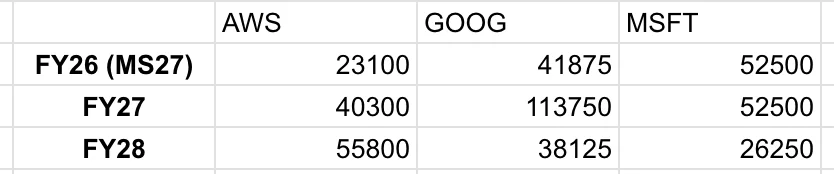
As I mentioned in my premium from a few weeks ago (How Much Money Does AI Need?), analysts from UBS, Barclays and Wells Fargo expect — by which I mean they are setting expectations — that Anthropic and OpenAI will account for at least $444 billion of hyperscaler earnings in the next three years.
To be specific, I pulled together all the numbers from my AI Demand Bubble newsletter from a few weeks ago, and found that Anthropic and OpenAI will account for at least $365 billion in revenue across Fiscal Years 2026, 2027, and 2028.
Sidenote: Except this analysis is only partially complete, as it’s based on Wells Fargo’s single Fiscal Year 2027 estimate of a $52.5 billion expected contribution from OpenAI and Anthropic. One weakness of this analysis is that we’re talking about Microsoft’s Fiscal Year 2027, which actually began in the middle of 2026. Most other hyperscalers (including Amazon, Meta, and Google) align their financial years with the calendar years. Nevertheless, I think it’s fairly illustrative of the problem.
To estimate the contribution — and be incredibly fair! — I have assumed OpenAI and Anthropic’s Microsoft spend will be linear (at $52.5 billion) across fiscal year 2028, and then halved it for fiscal year 2029, which gets us to a grand total of $444 billion.
That spike in costs comes from Stephen Ju of UBS’ estimates, and even if you think that’s a little high, I would estimate that the $250 billion of commitments made by OpenAI alone on Microsoft Azure will likely mean Microsoft is expecting tens of billions more than $52.5 billion in FY27 and beyond.
I also need to express how much more money this is than these companies are already spending on compute.
In 2025, OpenAI spent (per my own reporting, assuming 50% of sales and marketing was compute expenses) a little over $29.5 billion on compute. Per The Information’s reporting, it spent $12.1 billion (with no affordance for sales and marketing) in the first quarter of 2026, and while we don’t know how much it spent in Q2 (when revenues grew by $1 billion quarter-over-quarter), it’s fair to assume that it’ll spend another $12 billion or so a quarter for the rest of the year, for a total of $48.4 billion, which is less than the $50 billion it said it expected to spend on compute in 2026.
Per Barclays and UBS, OpenAI is projected to spend $15 billion on AWS and $12.5 billion on Google Cloud in 2027, with Wells Fargo estimating it will spend $22.9 billion for the first two quarters of 2027 making it reasonable to assume at least $45 billion, for a total of $72.5 billion… which, even then, seems a little low based on what it’s already on track to spend in 2026.
Then you have to add in another $30 billion from Oracle’s $300 billion, five-year-long deal with OpenAI, which the Wall Street Journal reports is expected to drive $30 billion in revenue starting in 2027, though my own research found that it could be more than $50 billion or $60 billion
Meanwhile, Anthropic is expected to spend $25.3 billion on AWS and $101.25 billion on Google Cloud in 2027, increasing to $35.8 billion with AWS in 2028 and dropping to $25.6 billion with Google Cloud in 2028, likely as a result of the initial cost being buying TPUs. Since then, Anthropic took on $35 billion in debt to buy TPUs from Broadcom (which also backstopped the debt), with another $70 billion deal potentially on the cards.
I haven’t even included either company’s deals with CoreWeave, OpenAI’s contract with Cerebras, Anthropic’s SpaceX deal, or many of the deals noted in The Information’s story about Anthropic’s $517 billion in compute commitments.
We Don’t Know The Exact Scale Of The Compute Reset Wall, And That’s Really Bad
As both Anthropic and OpenAI are private companies and we lack any meaningful accounting standards around disclosures for revenue backlogs, we can only estimate how big the compute reset wall is at any given point in time.
Part of the problem is that we don’t know how much capacity is actually coming online (as hyperscalers refuse to give any clarity), and said capacity has to come online for Anthropic and OpenAI to pay for it. It’s frustrating, because it means that “$1.3 trillion” number is hard to append to a period of time.
That being said, we do know that the Wall Street Journal has OpenAI projecting it will spend $750 billion on compute through the end of 2030, which suggests at least $250 billion a year in compute spend.
If it doesn’t, it means that in 2028 or 2029, its commitments could spike to $300 billion or $400 billion a year.
Is that good?
OpenAI and Anthropic’s Subprime Compute Commitments Are Tantamount To Poorly-Underwritten Debt
Let’s be abundantly clear about something: there is no rational or responsible way that Google, Microsoft, Amazon and the various other neoclouds should have allowed Anthropic and OpenAI to sign up for so much compute capacity, outside of the kind of blind faith that always goes wrong. Neither OpenAI nor Anthropic can actually afford to pay their commitments if they don’t grow by around 10x in the next three years, and at some point find a way to become profitable, which will require at least a trillion dollars in funding or debt.
Hyperscalers are doing all of this based on the very same logic that led to the massive issuance of subprime (and prime-but-unpayable) mortgages and the resulting overbuild of housing — that the money hadn’t stopped being spent. Venture capital and private credit have conspired to keep feeding Anthropic and OpenAI money (along with the hyperscalers themselves), much as they’ve continued to feed money into data center deals they’d theoretically occupy.
Similarly, hyperscalers continue to build out capacity for Anthropic and OpenAI under the continued assumption that they’ll keep paying, driven mostly by the fact that they’ve yet to stop doing so. They assume, somehow, that OpenAI and Anthropic’s ability to pay them tens of billions a year is all the proof they need that they’ll pay them hundreds of billions of dollars’ worth in the future.
Sidenote: At this point, I really want to use Groundbreaker’s charts, but their numbers are, if I’m honest, total fucking dogshit — Anthropic and OpenAI are very unlikely to have spent over $120 billion on compute in 2026, and I can find absolutely nothing to back them up. Nevertheless, this mound of Claudeslop makes several good points, and I have to cite it.
A take-or-pay contract is, in economic substance, a lease. And a lease is a financing. The defining feature of debt is a fixed payment on a schedule, owed regardless of the borrower’s circumstances. That is exactly what a take-or-pay commitment is. The payment does not flex with utilization. It does not wait for the customer’s revenue. It is owed on the commencement date and every period thereafter, for the term.
This is completely correct, unless of course you’re a member of the tech and business media, in which case it’s “a large amount of money that will of course be paid without fail.”
So, let me give you some context about how big these commitments are. Microsoft’s trailing-twelve-month operating expenses are $176 billion for a company with $331 billion in annual revenue. Meta, a company with $228 billion in annual revenue, has around $141 billion in operating expenses. Salesforce, a company with a little under $44 billion in annual revenue, has $35 billion in operating expenses.
OpenAI, in 2025, had $34 billion in operating expenses on $13.07 billion in revenue. In Q2 2026, its operating margin worsened to negative 183%. This is a company with deteriorating economics that has been allowed to sign hundreds of billions of dollars’ worth of compute commitments based on, for the most part, Sam Altman’s ability to say yes and the general sense that nothing bad ever happens to anyone.
These commitments were signed, I assume, with effectively no underwriting, because anyone with a calculator and sentience can see that on paper these companies cannot afford their commitments. The rationale is exactly the same as that used to hand-wave against worries around subprime defaults — that the system is working, that the system will always correct itself, and that things keep on growing.
In any case, neither OpenAI nor Anthropic actually have the money to pay for their obligations, and have only been able to keep up because of the low cost of signing contracts.
As these commitments begin, their needs for capital will dramatically accelerate in ugly chunks, both with hyperscalers and neocloud partners, on top of any debt deals they sign with Broadcom to fund their own silicon.
And the vast majority of these commitments and payments are yet to occur, which is, as is the theme of this newsletter, why nobody is worried yet.
Meanwhile, one abstraction higher, even the companies that are actually making a profit on the AI bubble are exposed to the underlying risk of Anthropic and OpenAI.
Concentration Risk 4: Both Broadcom and NVIDIA’s Customers Are Dependent On Anthropic and OpenAI To Monetize Their AI Chips
I’m going to dispense with the direct Great Financial Crisis comparisons at this point because I think it’ll get in the way of the analysis, but let’s be abundantly clear about something: either directly or by proxy, NVIDIA’s customer base is effectively Anthropic and OpenAI.
As I went into in part 2 of my Hater’s Guide To Circular Financing, OpenAI and Anthropic provide two functions to hyperscalers and NVIDIA:
They are the largest direct consumer of AI compute, representing more than 70% of all AI revenues for Google, Microsoft, Amazon, Oracle, SpaceX, Cerebras and Lambda, either through direct contracts or via hyperscalers renting compute (see: Nebius and Microsoft, Lambda and Microsoft/Amazon, CoreWeave with Microsoft).
They are a way of creating the illusion of demand via revenue backlogs.
To get specific about that second point, whenever you hear someone say that there’s “massive demand for AI compute,” they always point to revenue backlogs that are, for the most part, either OpenAI, Anthropic, or someone else renting them compute. For example, CoreWeave’s latest earnings involved the outright-deceptive statement that its “[$104 billion] revenue backlog [highlights] unprecedented demand for CoreWeave Cloud,” even though $22.4 billion of that is OpenAI, $21 billion is from Meta, $6 billion is from Jane Street (which also invested), and the rest is from some combination of Anthropic, Microsoft, and NVIDIA’s $6.3 billion backstop deal to buy unused capacity. To be specific, CoreWeave’s backlog increased by $32.6 billion in the earnings immediately following its Anthropic deal.
These revenue backlogs exist as both circular financing and financialized marketing schemes.
From the outside, every company with masses of AI compute also has an astonishingly-large backlog, which everyone assumes must be sold to a diverse subset of customers rather than Anthropic, OpenAI, and the companies that might one day sell them compute.
In other words, everything is based on the idea that Anthropic and OpenAI are A) going to have near-infinite demand for compute and B) that their existence is proof somebody else will too.
The other problem is that NVIDIA’s GPUs are so god damn expensive that nobody — including the largest and richest companies in the world (minus Microsoft) — can afford to keep buying them and building data centers without taking on near-infinite amounts of debt, reducing the pool of potential customers dramatically.
You can already see this in NVIDIA’s latest earnings. Almost half — 44% — of its FY2027 revenue so far (two quarters) came from three customers, and 16% of its most-recent quarterly revenue came from one customer, likely SpaceX, which serves Anthropic compute. Per my recent premium newsletter, UBS estimates that around 50% of NVIDIA’s data center revenue comes from Meta, Google, Microsoft, Amazon, and Oracle, with Deutsche Bank estimating it’s as high as 60%.
The justification for these further capital expenditures is, for the most part, driven by OpenAI and Anthropic, with their demand driven in large part by unprofitable AI startups subsidizing their users’ AI tokens.
While NVIDIA might talk about how we’ve “reached AGI” or that there’s “crazy demand,” the actual financial returns on buying NVIDIA GPUs are driven almost entirely by OpenAI and Anthropic, by which I mean Microsoft, Google, Amazon, Oracle, CoreWeave, Lambda, Hut8, Fluidstack, and basically every other counterparty is building capacity either mostly or entirely to capture their revenue.
The best example I can find is SB Energy, which has a $439 billion backlog, 99.4% of which is earmarked for OpenAI.
Further non-OpenAI/Anthropic GPU sales are contingent on NVIDIA’s perception management keeping everybody believing that there’s real demand for AI compute, which is why it effectively acquired Poolside, and may invest billions in Perplexity and Thinking Machines. Neither of these companies could actually afford to exist without venture capital (or NVIDIA) dollars, but with NVIDIA’s investment, they can potentially add hundreds of millions or billions of dollars of further “demand” to the backlogs of hyperscalers or neoclouds.
Once again, everyone assumes everything is fine, because the money has yet to run out, and because NVIDIA is promising 70% year-over-year growth in Fiscal Year 2028. Data center debt continues to be available for neoclouds as well as barely-existent data center developers like SB Energy (backstopped, of course, by NVIDIA), mostly because of the illusion of “massive demand for AI compute” created in part by NVIDIA itself.
And, fundamentally, NVIDIA’s revenues are dependent on whether hyperscalers keep being paid by OpenAI and Anthropic, because those are the only two companies that could ever hope to justify their trillion-plus dollars of capex. As I’ve already noted, per Bloomberg, only around $10 billion of Microsoft’s $33.33 billion in FY2026 AI revenue came from selling compute or AI-powered software to its customers — a pathetic sum that suggests very little actual demand for AI when you remove its unsustainable failson.
Broadcom, in its attempts to compete with NVIDIA, has decided it needs a little concentration risk of its own, and per its most-recent earnings, Anthropic and OpenAI are set to become its largest and second-largest customers in its next fiscal year.
Much like the hyperscalers, neither Broadcom nor NVIDIA is going bankrupt as a result of the AI bubble bursting, but Broadcom’s future revenues — estimated at $230 billion in Fiscal Year 2028 (which begins November 2027) — are now dependent on both direct purchases from hyperscalers (justified by Anthropic and OpenAI) and the AI labs themselves, creating, somehow, greater underlying exposure.
Everything’s Fine Until The Money Stops Flowing
However you may feel about me or the greater AI bubble is immaterial to the fact that everything will seem like it’s fine right up until somebody can’t raise money and make a payment to either a neocloud, hyperscaler or AI lab.
For this to keep working, AI startups must continue to be able to raise hundreds of millions of dollars every few months, all as Anthropic and OpenAI must continue to raise tens (or hundreds) of billions of dollars to pay hyperscalers for compute so that they can, in addition to raising hundreds of billions of dollars, spend that money on GPUs from NVIDIA, who can only continue to make hundreds of billions of dollars a year as long as it can either provide justifications for lenders to keep issuing hundreds of billions of dollars in debt or backstop the data centers the debt will get spent on.
In other words, the AI bubble is based on the whims of maybe a few hundred companies spending money on two companies to justify five companies spending money with one company. Or two if you count Broadcom, which you don’t have to if you don’t want to.
If you tell most journalists or investors any of this stuff, they’ll tell you not to worry about it. Per The Information:
But investors may want to temper their expectations. One large public investor summed up Anthropic’s approach to the markets as: “Don’t think too hard. Just look at the revenue growth rate. That’s all you need to know.”
Anyone who tells you “not to worry” about a company that loses billions of dollars a year and has made $517 billion in compute commitments is a con artist, and anyone who prints a quote like that without a comment about how deeply worrying it is doesn’t really give a shit about whether you live or die.
But that really is the current state of the tech industry: a death cult obsessed with growth empowered by a media ecosystem obsessed with measuring and celebrating how much it’s growing and might grow in the future, always framed in the terms set by the rich and powerful.
The failure of both parties to meet the moment with clarity and purpose will lead to a market correction that likely dwarfs the Dot Com Bubble, exposing many of those involved as a phoney, a fraud, an imbecile, a ghoul, a coward, or utterly, impossibly ignorant.
If you liked this piece, you should subscribe to my premium newsletter. It’s $70 a year, $18 a quarter, or $7 a month, and in return you get a weekly newsletter that’s usually anywhere from 10,000 to 18,000 words and provides vast, detailed analyses of the biggest events and companies in the AI bubble.
If you want to get in touch — and especially if you have any juicy information about Anthropic, OpenAI, or any other companies in the AI bubble — hit me up on Signal at ezitron.76. I’m also on IB on The Terminal.
The source text above remains the property of its publisher and is reproduced for commentary.