Commodore 64 Launch and 2025 FPGA Re-release: A Retrospective Analysis
A retrospective blog post dated September 1, 2026 marks the Commodore 64's 1982 launch, defends the September 1 release date, recounts its 10-12 million sales, and reveals an alleged 2025 FPGA-based re-release under a re-acquired Commodore brand, with ~19,000 units sold.
This source commemorates the September 1, 1982 release of the Commodore 64 and, more significantly for current research, claims that in 2025 a YouTuber acquired the Commodore brand and licensed a FPGA-based replacement motherboard, selling about 19,000 units. The historical launch date is positioned as settled via Michael Tomczyk's 1984 book over engineers' August-shipment anecdotes. The operative constraint for a 64KB computer has moved from achieving a sub-$600 retail price in 1982 to sustaining niche production economics in the 2020s.1
Context
The post provides context for the original event: the C-64 was the first computer with 64K of memory under $600, sold about 500,000 units in its first six months and roughly 5 million by fiscal 1984. Technical trade-offs—three-voice SID chip, limited modem support, slow disk drive—are presented as deliberate compromises. The author's personal history as a C-64 user and IT professional contextualizes but does not independently validate the sales and engineering claims.1
Assessment
As a single retrospective source, the document's evidentiary strength is moderate to weak for quantitative claims. It resolves the launch-date dispute by prizing Tomczyk's contemporaneous book over Bagnall's interview-based oral history, but no primary source is cited. The best-selling computer figure fluctuates with inclusion of the C-128, indicating definitional sensitivity. The 2025 re-release is the only forward-looking claim; it is a single, uncorroborated assertion in a personal blog, so it should be treated as a hypothesis unless corroborated.1
Caveats
Confidence in this analysis would change if new evidence emerged: period newspaper advertisements or price lists showing the first C-64 retail availability before or after September 1, 1982; Commodore internal shipping manifests; or independent media coverage of the 2025 FPGA re-release with unit sales. The 'best selling computer of all time' claim would require a defined scope (including clones or demarcating the C-128) and a recognized sales tracking methodology. Without such evidence, the source's factual assertions remain plausible but unverified.1
On September 1, 1982, the Commodore 64 launched. Its name referred to the amount of memory it had on board: 64 kilobytes. And it was the first computer with 64K of memory to sell for under $600.
When the Commodore 64 was introduced vs when it was released
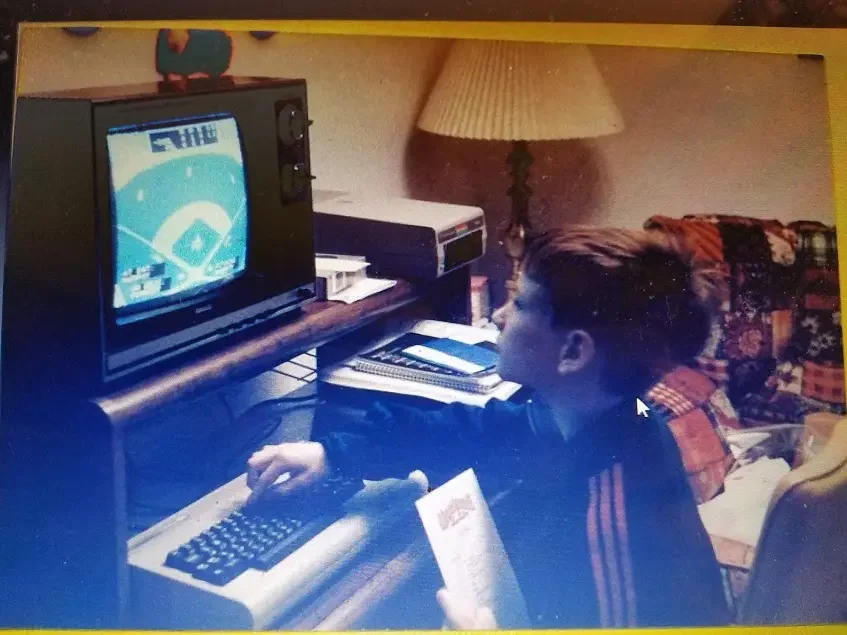
This is a photograph of me playing Micro League Baseball on a Commodore 64 in late December 1984 or January 1985.
When the C-64 first shipped is a bit of a mystery. Commodore showed prototypes at the January 1982 Consumer Electronics Show, but these weren’t production-ready models yet. Some engineers quoted in Brian Bagnall’s books say they shipped some units in August. Michael Tomczyk’s book, The Home Computer Wars, says it launched September 1. Given that Tomczyk was writing in 1984, not long after the actual launch, I’m inclined to think Tomczyk’s date is correct. Why the discrepancy? Commodore wasn’t selling direct. So if they intended to sell any machines on September 1, they had to ship the first units in August.
Commodore built the initial units in Santa Clara, Calif., but ran into quality control problems, so they outsourced production to a Japanese company called Kentron. Kentron was mass producing C-64s by January 1983.
Within six months, they’d sold half a million units. And it quickly went up from there. By the end of its fiscal 1984 years, Commodore had sold about 5 million units.
It became the best selling computer of all time, selling about 12.3 million units. Or, if you count the C-128 as a separate product, the C-64 alone sold about 10.6 million units.
It was the computer I grew up with, and invariably, when I join a videoconference from my basement, where I have a C-64 hanging on my wall behind me, someone my age will say something about it, that they had one, or remember using one.
Its early success was no accident but its staying power was
By modern standards, it wasn’t cheap. Even in 1984, when we got one, the computer with a disk drive typically cost $450 unless you really shopped around. But the only other thing comparable both price-wise and capability-wise at the time was an Atari 800XL, and Atari was having supply chain problems in 1983, so it was a lot easier to find a Commodore 64 that year.
The Commodore 64 probably would have been successful just because it was cheap and had a lot of memory for 1982. Its predecessor, the VIC-20, was the first computer to sell a million units, and it did so because it was the first computer with color to sell for less than $300. It took some weird compromises to hit that price point, with rudimentary graphics and sound capabilities and an oddball 5K of RAM.
Commodore expected both the VIC-20 and C-64 to have a shelf life of around 3 years. They were about right in the case of the VIC-20, but the C-64 kept selling about 700,000 units a year through the end of the decade and was still hanging on in 1993. It wasn’t selling well in 1993, mind you, and Commodore didn’t want to be making them by then. But there was still demand for them, and Commodore in 1993 wasn’t in a position to say no to a sale.
Why the C-64 had staying power
The C-64 went through plenty of compromises to reach its price point. But they got the mix of compromises just about right. The disk drive was slower than it needed to be, largely because of a last-second design change. Its modem support was pretty limited too, but there wasn’t a lot of demand for modems yet in 1982. But it had 16-color graphics at a resolution of 160×200 or 320×200. The lower resolution mode gave you more flexibility with how you used the colors. It also had 8 sprites, which was very useful for game programming.
The sound chip was a compromise. Its designer, Bob Yannes, was both an engineer and a musician. The chip he wanted to design would have been impressive for 1992, let alone 1982. He built the elements he needed, then replicated them until he ran out of room on the silicon wafer. He ran out of room at three voices, so the C-64 had three-voice sound. Some competing designs had four, but the 64’s SID chip had more flexibility with the volume of each channel, and could produce more complex sound waves than competing chips from General Instrument and Texas Instruments could.
Creative programmers could coax impessive video and audio effects out of the C-64 beyond what its designers imagined in 1982. So even as the machine aged late in the decade, there was still interesting new software being released for it. By then, there were much more powerful computers on the market, but for a while that helped the C-64, as artists could develop graphical assets on one of those other computers using more powerful software, then move them to the C-64.
How the Commodore 64 affected me, personally
My story with the C-64 is a familiar one. I learned how to program it a little using Basic and 6502 assembly language. By the time I was 12, I knew how to take one apart and do simple repairs. And by the time I was a teenager, I could run a sector editor and recover data from corrupted disks, edit saved game files to make video games easier, and I will neither confirm nor deny cracking some games that used code wheels for copy protection. I knew how. I did my first writing for large audiences on a C-64 too.
Everyone assumed I’d do something computer-related for a living when I got older. A lot of us did. Decades later, I run into people I knew from the local C-64 scene, and they’re working in IT like me.
Jack Tramiel, the CEO of Commodore when the C-64 launched, loved hearing those kinds of stories. A Gen Xer would walk up to him, talk about how growing up with a C-64 led to a career in technology, and then Tramiel would always say something like, “And you look very successful, I’m thrilled to hear it!”
I never had a chance to say that to Jack, but I did have a chance to thank one of his sons, Leonard. Leonard Tramiel was just as gracious.
It wasn’t just games
That was the great thing about the C-64. You didn’t have to be born on third base to afford one. Yes, its price still meant it was a bit of a sacrifice for most of the 12 million people who bought one, but it was doable.
The C-64 had a lot of great games, but it wasn’t just about games. I did my homework on it. Not all my teachers would accept a computer printout. But I could work out my answers, organize my thoughts, print them, and then hand-write a final draft for those teachers who insisted computers had no future.
And as it turned out, computers did have a future. The job I have today did not exist in 1984. But the C-64 taught me concepts that I still use almost every day. I understand buffer overflows because of the C-64.
Sometimes I return to the C-64 just to get my mind in the right place. For example, back in 2019, my then-boss told me he needed me to learn Python. I hadn’t programmed in 20 years. I’d barely even tried to program anything in 10. So I told him I’d try, but no promises. And I struggled at first. So I asked myself when I last felt comfortable programming. And I thought of the C-64. So I dug a C-64 out of storage, set it up, and started programming it in Basic, doing what I used to do, either writing simple programs, or finding an existing program and modifying it to do something slightly different. And after a few weeks of that, Python started making more sense.
The Commodore 64’s Legacy
I’m not the only one with C-64 nostalgia. The reason this is a retro tech blog is largely the C-64’s fault. I wrote some one-off content more than 21 years ago talking about how to set up a C-64. I figured maybe two other people in the world cared about that, but I didn’t have anything else to blog about that day, so I did it.
It wasn’t long before that became most popular content. Eventually I noticed, and over time, I started writing more retro tech content, refining the formula as I went, and while demand for some other things I can write about have come and gone, demand for retro tech content remained steady or even increased. It all started with me randomly deciding to write a blog post on connecting a C-64 to a television.
And the C-64 is back in production, sort of. In 2025, a Youtuber who grew up with a C-64 managed to acquire the Commodore brand and sign a deal to license an FPGA-based C-64 replacement motherboard. Starting about a year ago, the C-64 was back in production, and sold around 19,000 units at a price higher than the C-64 was selling for when it was new. Obviously it’s no longer a high-volume item so the cost per unit will be higher. But selling 19,000 C-64s in 2025, more than 30 years after the Gould/Ali-era Commodore produced its last C-64, shows the staying power this platform had.
David Farquhar is a computer security professional, entrepreneur, and author. He has written professionally about computers since 1991, so he was writing about retro computers when they were still new. He has been working in IT professionally since 1994 and has specialized in vulnerability management since 2013. He holds Security+ and CISSP certifications. Today he blogs five times a week, mostly about retro computers and retro gaming covering the time period from 1975 to 2000.
The source text above remains the property of its publisher and is reproduced for commentary.