Biomarker Discovery Framework: Multi-Agent AI for Rigorous Wearable-Derived Candidate Biomarkers
This Google Research blog post introduces the Biomarker Discovery Framework, a multi-agent system for prioritizing candidate biomarkers from wearable physiological data. Across three cohorts totaling 9,279 participant-observations, it generated 41 mental-health and 25 metabolic candidate biomarkers, including novel composite features, while enforcing statistical rigor through an 11-test adversarial filtering process. The framework recovered known clinical signals and improved prediction when combined with demographics, but effect sizes were modest and the evidence tier markers indicate literature support, not clinical validation. A blinded expert review rated it highest among competing systems, though the sample was small and the setting simulated.
The Biomarker Discovery Framework (BDF), a multi-agent system from Google Research, is introduced to prioritize candidate biomarkers from wearable sensor data through iterative hypothesis generation, statistical analysis, and literature-grounded reasoning. BDF was applied across three cohorts totaling 9,279 participant-observations spanning mental health and metabolic disease, recovering known clinical signals and identifying 41 mental-health and 25 metabolic candidate biomarkers.1
The claimed advance is not simply higher prediction accuracy but a constraint shift: instead of scaling model capability alone, BDF forces rigor by separating deterministic computation from generative reasoning, requiring all candidates to pass an 11-test adversarial filtering stage, and orchestrating specialized agents (Scout, Critic, Defender, Mechanism) in a closed loop under human supervision. This directly targets the failure of earlier LLM agent systems that overlooked statistical validity on physiological time-series data, producing spurious correlations and leakage.1
Across three cohorts, the framework derived novel composite features such as sleep-duration variability as a correlate of depression severity (Spearman rho = 0.252) and a cardiovascular fitness index (steps/resting heart rate) as a correlate of insulin resistance. Adding these features to demographic variables improved prediction (ΔR2 = 0.040 for depression, 0.021 for insulin resistance). In a blinded expert evaluation with 15 reviewers, BDF received the highest mean scores across seven quality dimensions and was the only system receiving Accept or Minor Revision recommendations.1
Caveats temper these claims: the underlying effect sizes are modest, the cross-cohort convergence is construct-level rather than direct replication, and the evidence-tier markers (Established, Supported*, Emerging**) reflect prior literature support, not clinical validation in this study. The expert evaluation was small and simulated, with BDF assessed in a different number of sessions than most baselines. Direct external replication, statistically significant held-out validation, or actual clinical adoption would be needed to confidently accept BDF's candidate biomarkers as validated discoveries.1
We introduce the Biomarker Discovery Framework, a multi-agent system that supports the discovery of biomarker candidates from wearable sensor data through iterative hypothesis generation, statistical analysis, and literature-grounded reasoning.
Wearable devices capture continuous physiological signals at population scale. These streams, ranging from heart rate dynamics to sleep patterns, can reveal early physiological changes before symptoms appear. The bottleneck is no longer data collection, but turning these signals into reliable, clinically meaningful biomarkers.
Existing language model-based agent systems automate parts of the scientific workflow, but can often break down on physiological time-series data. These systems optimize for predictive performance while overlooking statistical validity, leading to spurious correlations, leakage, and brittle features.
To this end, we introduce the Biomarker Discovery Framework, a multi-agent system that structures candidate biomarker prioritization as an iterative research loop under human supervision. By combining hypothesis generation, parallel statistical analysis, model training, adversarial validation, and literature-grounded reasoning, Biomarker Discovery Framework accelerates the discovery process while maintaining strict statistical rigor and preserving human oversight. Across three cohorts (N = 9,279 participant-observations), Biomarker Discovery Framework recovered known clinical signals, identified convergent biomarkers across independent datasets, and improved downstream prediction when combined with demographic features.
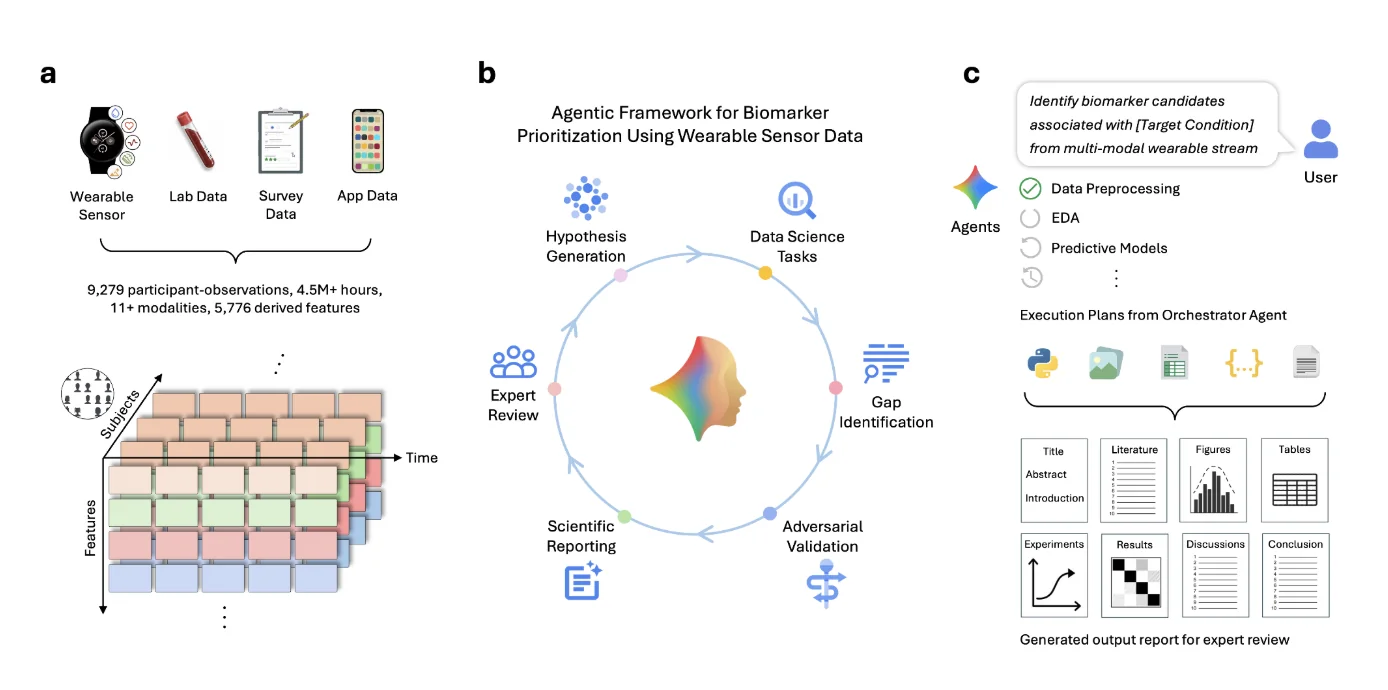
Overview of the Biomarker Discovery Framework. (a) The system ingests time series data from consumer wearables and clinical labs. (b) A closed-loop architecture orchestrates six phases mirroring the human biomarker prioritization lifecycle. (c) An Orchestrator agent decomposes natural-language research directives into execution plans.
Biomarker Discovery Framework combines deterministic computation for numerical analysis with generative reasoning for hypothesis formation and interpretation. An Orchestrator agent decomposes natural-language research directives into execution plans and guides specialized agents through a six-phase process. Meanwhile, shared memory, a structured fact sheet, and common tools preserve traceability across the workflow:
For example, given a request to prioritize wearable candidates associated with depression severity, Biomarker Discovery Framework profiled the DWB dataset, proposed sleep-timing variability features, and estimated an association between sleep-duration variability and PHQ-8 severity (ρ = 0.252). The workflow then checked stability, leakage, subgroup consistency, and alternative explanations before framing the result as a literature-grounded circadian-instability hypothesis for human review.
Biomarker Discovery Framework Architecture. Specialized sub-agents (Scout, Critic, Defender, Mechanism) operate over a shared state. Biomarker Discovery Framework enforces safety mechanisms to ensure statistical validity, separating feature construction from target signals and requiring candidates to pass an 11-test adversarial filtering stage.
To assess the Biomarker Discovery Framework's capability to extract plausible physiological insights from noisy data, we applied it independently across three large-scale cohorts totaling 9,279 participant-observations, spanning both mental health (DWB and GLOBEM) and metabolic disease (WEAR-ME) domains. The pipeline autonomously identified 41 candidate digital biomarkers for mental health and 25 for metabolic outcomes.
The table below shows a curated sample of candidate associations. Spearman’s ρ summarizes the direction and strength of an association. The 95% confidence interval quantifies uncertainty, and the adjusted p-value accounts for multiple comparisons. The mechanism presents a literature-grounded hypothesis rather than a causal conclusion. Importantly, the final column describes the strength of prior evidence — not clinical validation in this study — and the stars denote evidence-tier markers rather than statistical-significance codes.
The Biomarker Discovery Framework did not simply select existing variables; it constructed novel composite features. For instance, in the mental health domain, it identified sleep duration variability and sleep onset variability as top correlates of depression severity. In the metabolic domain, it derived a cardiovascular fitness index (steps divided by resting heart rate) as a non-invasive correlate of insulin resistance, linking it to prior work on glucose regulation and cardiometabolic fitness.
Effect sizes and uncertainty come from deterministic analysis and mechanistic explanations are literature-grounded hypotheses. Established denotes substantial supporting prior literature, Supported* indicates the underlying physiological axis is established, but the digital operationalization is new, Emerging** means prior evidence is limited & needs held-out confirmation, R signifies candidates rejected by the construct-overlap gate. † marks wearable-derived features, and Flagged unstable identifies held-out estimate reversed direction.
We deployed the Biomarker Discovery Framework across three distinct large-scale cohorts totaling 9,279 participant-observations, spanning both mental health and metabolic disease domains.
Across the two depression domains, Biomarker Discovery Framework prioritized different operationalizations of a related circadian-instability construct. In DWB, sleep-duration variability was associated with PHQ-8 severity (ρ = 0.252, p < 0.001). In GLOBEM, sleep-onset variability emerged as an exploratory, low-signal association with PHQ-4 (ρ = 0.126, p < 0.001; CV AUC = 0.535). Because the cohorts, endpoints, and feature definitions differ — and no identical candidate was replicated — this pattern should be interpreted as suggestive construct-level convergence, not direct replication.
Related circadian-instability candidates in two depression cohorts. Variability increases across symptom-severity groups in both cohorts, but the findings are hypothesis-generating and do not constitute causal evidence or direct cross-cohort replication.
In total, the Biomarker Discovery Framework identified 41 candidate digital biomarkers for mental health and 25 for metabolic outcomes. While the effect sizes reflect the modest magnitudes typical of passive-sensing digital phenotyping, the integration of these Biomarker Discovery Framework-derived features alongside demographic variables improved predictive performance when combined with demographic features (ΔR² = 0.040 for depression, 0.021 for insulin resistance).
Overview of the Biomarker Discovery Framework. Left: The Biomarker Discovery Framework was additionally evaluated on data-science and health benchmarks, achieving competitive performance against per-benchmark strongest baselines. Right: In a blinded human expert evaluation, the Biomarker Discovery Framework received the highest mean scores across quality dimensions.
To assess manuscript quality, 15 experts in medicine, biomedical data science, machine learning, bioinformatics, and digital health reviewed blinded reports from the Biomarker Discovery Framework and three contemporary AI research systems (Google DeepMind’s AI co-scientist, Biomni, and Google ADK’s Data Science Agent). Biomarker Discovery Framework, Biomni, and the Data Science Agent were scored together in 21 sessions, and Biomarker Discovery Framework was scored in a separate 13-session set using the same evaluation instrument.
In the blinded evaluation, the Biomarker Discovery Framework received the highest mean scores across all seven quality dimensions. Under the study’s simulated editorial rubric, it was the only system to receive any “Accept” or “Minor Revision” recommendations: 2 Accept, 8 Minor Revision, 8 Major Revision, and 3 Reject. Reviewers estimated that they would retain 56.9% of Biomarker Discovery Framework-generated manuscript content on average, compared with 18.8%–30.4% for the baselines, and ranked the Biomarker Discovery Framework first in 9 of 13 four-system ranking sessions.
Blinded Human Evaluation. (a) Biomarker Discovery Framework achieved the highest mean expert scores across all seven quality dimensions, excelling in Statistical Validity and Soundness. (b) Editorial decision distribution shows Biomarker Discovery Framework as the only system to receive non-rejection (Accept/Minor Revision) decisions from the expert panel.
As wearable health data continues to scale across populations, the bottleneck in digital medicine is no longer data collection, but rather principled, rigorous hypothesis generation. Scaling model capability alone does not address the problem of scientific rigor. However, when deployed within a meticulously structured architecture that separates deterministic computation from generative reasoning, and forces agents to defensively debate their findings, AI can support structured hypothesis generation, validation, and prioritization under human supervision. By shifting from black-box automation to transparent, human-in-the-loop workflows, we can build AI systems capable of safely accelerating the hypothesis-to-validation cycle in clinical research.
This blog post was written by Yubin Kim, Hamid Palangi, and Daniel McDuff from Google Research. This work was spearheaded by MIT PhD student Yubin Kim during a Google internship advised by Daniel McDuff and Hamid Palangi. We are grateful to our co-authors and collaborators from Google Research, Google DeepMind, and academia for their contributions to this work.
The source text above remains the property of its publisher and is reproduced for commentary.